

The Meg! When the (giant prehistoric) shark bites, the science bites back
- Written by: Michael Milford, Professor, Queensland University of Technology
The Meg is the blockbuster shark monster movie we didn’t realise we needed in our lives. With a cast led by Jason Statham, this is a big-budget version of several megalodon movies that have popped out over the years – including Megalodon (2002) and Jurassic Shark (2012).
Other reviewers have already covered the potential for such a movie to exacerbate public perception issues around endangered shark species.
Warner Bros. Pictures.We’re going to focus instead on other scientific issues raised by the movie, featuring a giant shark that is thankfully now extinct (it lived from about 16 million to 2.6 million years ago).
Warning: mild spoilers and tongue-in-cheek analysis of a fictional movie ahead.
Read more: Friday essay: The Meg is a horror story but our treatment of sharks is scarier
Bite force and glass
Smashable, crackable glass is just such a great action prop for monster movies.
In The Meg, we see the giant shark try out the glass walls of the submerged research station and the deep sea glider vehicle, cracking the glass but not immediately breaking through it.
 Marine research isn’t all it cracked up to be.
Warner Bros. Pictures.
Marine research isn’t all it cracked up to be.
Warner Bros. Pictures.
But is this realistic, given the Meg’s famed bite force of 18 tonnes? (That’s 176,519.7 Newtons.)
First of all, let’s get it out of the way that pressure is not force: pressure depends on the area over which the force is applied. So a bite force is applied through the contact points of the teeth; if the contact area is small, the pressure can be quite high, which is why pointed teeth are better at cutting.
To give the movie a fair go, we can assume that the glass is overdesigned to the same extent as James Cameron’s Deepsea Challenger deep-diving submersible. That craft was tested to an “equivalent full-ocean-depth pressure of 16,500 pounds per square inch or 114,000kPa”.
Massively oversimplifyingif (ignoring impact loading, angles of attack, and many other factors), we can work out the minimum contact area required for the glass to hold:
Area = force / pressure
= 176,519.7N / 114,000,000Pa
= 0.0015 m2
That’s a contact area of about 4cm x 4cm spread out over all teeth. From the footage, it seems plausible that there would be this much contact area between the teeth and the glass, meaning the pressure would be insufficient to immediately break through. Score one for human technology, zero for nature.
Verdict: Toothily tenable.
Sucky shark size sensing
We are expected to suspend belief many times throughout the movie, but one scene particularly stretches credulity. The team successfully poisons what they think is the Meg, and haul it onboard using the ship’s crane.
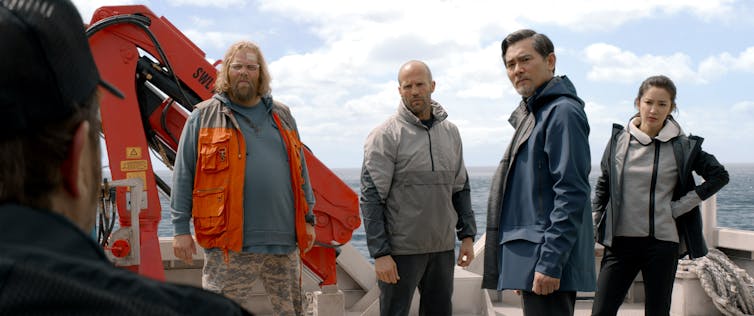 Asking a lot of a little crane.
Warner Bros. Pictures
Asking a lot of a little crane.
Warner Bros. Pictures
The problem: the shark they have caught is clearly (at least to us viewers) much smaller than the one they’ve been fighting with for the rest of the movie. The big bad shark is still out there, and the characters are oblivious.
So is this plot-critical mistake plausible?
In the character’s defence, most of their encounters with the shark have been underwater in panicked situations with few reference objects, making absolute size estimation difficult. Real-world studies of large whale sharks have shown that measuring their dimensions is extremely difficult, and have even involved using lasers.
But this plot hole is nothing compared with the larger gaffe in the same scene: the supposed megalodon carcass is strung up on a flimsy crane, as shown in the picture above.
For reference, this is the size of a 50-tonne capacity mobile crane.
Verdict: Suspended shark suspends belief.
Meg motoring along?
According to the film’s production notes, the Meg in the movie can reach speeds of more than 80 knots (150kph), and appears to approach this speed when chasing Jason Statham.
 Meg can move! (But has slowed down for the buffet in this scene).
Warner Bros. Pictures.
Meg can move! (But has slowed down for the buffet in this scene).
Warner Bros. Pictures.
One of the fastest current sharks is the Shortfin Mako, which can reach speeds of around 50kph, with more speculative evidence of them topping 70kph in short bursts. The fastest fin whales reach around 40kph.
The fastest submarines reached reported speeds of more than 75kph. Conventional torpedoes top out at around 110kph, whereas Russia’s supercavitating torpedoes could reach 370kph.
Given that the shark appears to be a “normal” shark in all respects other than its size, and without access to any special supercavitation capabilities, its slated top speed seems optimistic at best.
Verdict: Shifty speed specifications.
Maintaining megalodon’s menu
The Meg in the movie is shown to be really hungry (or just nasty); it appears to eat a lot of people. But how much would it actually need to consume to sustain itself?
 This cracker has a nice topping!
Warner Bros. Pictures.
This cracker has a nice topping!
Warner Bros. Pictures.
An old study calculated that a 943kg shark could survive on 30kg of blubber for about 1.5 months. New studies suggest that this amount of food would only last the shark about 11 days, or an equivalent daily consumption rate of about 3kg.
Dietary requirements of larger sharks scale with mass to the power of about 0.8, so taking a Meg weight of 48 tonnes:
Meg daily intake = 3kg / day × (meg / normal shark weight)0.8
= 3kg / day × (48,000 / 943)0.8
= 70kg/day
So unless the Meg had a strikingly different metabolism, it would probably only need to eat the equivalent of about one person a day. The Meg in the movie eats a lot more than that.
Verdict: Plausibility requires a massively magnified Megalodon metabolism… or perhaps the shark was stocking up for the next month.
Setting shark attack statistics straight
In the movie, the Meg attacks enough people to skew global shark attack statistics for years to come.
But in reality, the average person is incredibly unlikely to be attacked by a shark. Various statistics abound, but the chances of a person being killed by a shark in their lifetime is around 1 in 4 million.
Such statistics taken out of context are relatively meaningless; many people live far from the ocean and rarely go swimming, meaning their chances of attack are effectively zero (unless a waterspout drops sharks on top of them).
The statistics adjusted based on the activity undertaken at the time are significantly higher: one estimate of attack rates (not necessarily fatal) among those scuba diving and snorkelling was more than 10 attacks per 100,000 people performing the activity.
Either way the chances are very low, but not as low for regular ocean-goers as for a random person plucked from a continent.
Verdict
The Meg movie combines all the typical monster movie cliches with a few nice touches and some terrifically bad dialogue (so bad it’s good in parts; it had people in our cinema in stitches).
It’s also somewhat liberating that the villain in this movie is not a modern shark but a fantastical creature from millions of years ago, allowing us to be a little more indulgent as viewers. Statham is great, as is ten-year-old rising star Sophia Cai.
The science is generally as dodgy as you would expect for a blockbuster monster movie; the only problem here being the real prehistoric existence of the Meg.
Read more: Giant monster Megalodon sharks lurking in our oceans: be serious!
The script writers have stretched plausibility on some of the shark’s general physical capabilities with respect to size (a little bit), speed (probably a lot), and appetite, mainly for dramatic effect.
But turn down your brain and it’s hard to argue with the entertainment value of a big monster spectacle, especially one that features scintillating lines like this:
That living fossil ate my friend.
Wow.
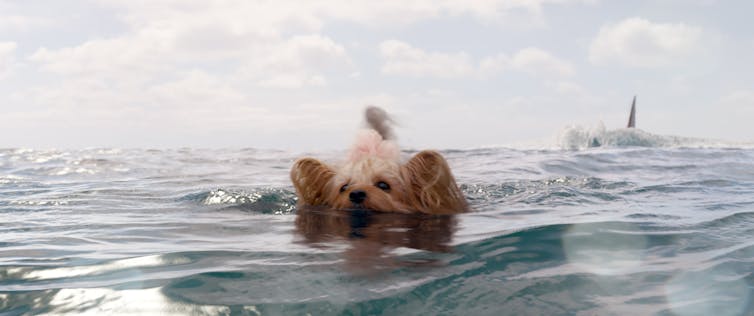 For a a 50 tonne Meg, chasing this tiny dog would be like us picking up a breadcrumb.
Warner Bros. Pictures
For a a 50 tonne Meg, chasing this tiny dog would be like us picking up a breadcrumb.
Warner Bros. Pictures
Authors: Michael Milford, Professor, Queensland University of Technology
-shark-bites-the-science-bites-back&media=https://dailybulletin.com.au/https://cdn.theconversation.com/static_files/files/229/gif1.gif?1534122364&description=The%20Meg!%20When%20the%20(giant%20prehistoric)%20shark%20bites,%20the%20science%20bites%20back "Pin It")

 Daily Bulletin


