

So your child refuses to go to school? Here's how to respond
- Written by: Jade Sheen, Senior Lecturer, School of Psychology, Deakin University
Have you had to deal with grumbling kids who don’t want to go back to school after the winter holidays?
While some school reluctance is normal, spare a thought for parents whose back-to-school struggles have reached a whole new dimension. Their child’s reluctance to go to school has escalated into a more significant psychological problem, called school refusal.
Around 1-2% of children experience school refusal: becoming severely distressed at the prospect of going to school and having prolonged absences.
Unlike truancy, young people diagnosed with school refusal don’t experience other behavioural concerns: their parents know where they are; they remain at home despite their parents’ best efforts to get them to go to school.
Read more: Evidence-based parenting: how to deal with aggression, tantrums and defiance
School refusal commonly arises after a period of school absence – due to illness or holidays – or a big change, such as starting a new school or moving from primary to high school.
No one factor or person is to blame for school refusal; it’s caused by a complex interaction of multiple risk factors involving the child (such as a fear of failure), their family (such as overprotective parenting or illness), the school (such as bullying), and social challenges (such as pressure to achieve academically).
What can you do?
Interventions to treat school refusal favour cognitive behavioural therapy (CBT) to encourage relaxation, challenge anxious thoughts and support a gradual exposure to the fear. Interventions also include parent therapy to discuss optimal support strategies, and school liaisons.
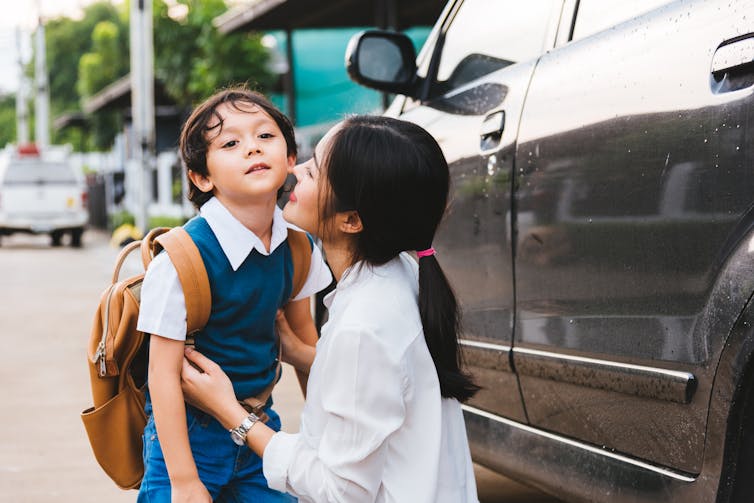 Strategies to address school refusal can be tailored to children of all ages.
From shutterstock.com
Strategies to address school refusal can be tailored to children of all ages.
From shutterstock.com
The aim of intervention is to provide skills to cope with distress or discomfort while increasing school attendance. Research suggests that with professional support, school attendance can be improved, but anxiety may persist for some time.
If your child refuses to go to school, or you’re supporting another parent or child in this situation, here’s how you can respond:
1. Ask for help
Schools and parents often wait until the problem is deeply entrenched before acting.
Unfortunately, every day of school missed has an impact on academic achievement, and continued absence is associated with higher rates of early school drop-out, emotional and behavioural difficulties, and poor social adjustment.
To minimise these outcomes, you need to act early, mobilise your support network and, if needed, seek professional help.
2. Consider possible triggers
At a time when you’re both calm (and not on school mornings), ask your child to describe the key challenges of going to school. Together, you may be able to solve these problems or develop a plan to manage them.
For younger children or those who struggle to express their feelings, you may need to use the observe-validate-redirect model:
Observe: “I have noticed that you appear upset and worried in the morning and you often ask to stay home.”
Validate: “We all feel upset and worried sometimes and it can feel uncomfortable.”
Redirect: “Going to school is very important. What are some things that we can do to help you to get there?”
3. Take a kind but firm approach
It’s important to convey kindness, as your child is experiencing something distressing. Kindness can be conveyed by listening when they talk about their worries, offering a moment of physical affection, or remaining calm in the face of frustration.
 It’s important to listen to your child’s concerns about going to school.
From shutterstock.com
It’s important to listen to your child’s concerns about going to school.
From shutterstock.com
There is also a kindness in encouraging children to face their fears; this promotes confidence and autonomy.
Conversely, avoiding the triggers of anxiety increases anxiety in the long term.
Read more: 'No, I don't wanna... wahhhh!' A parent's guide to managing tantrums
Be kind but firm in your resolve to work with your child to address the school refusal. This stance can be reflected in comments like:
I understand that going to school feels difficult. We can work through your concerns together. But you do need to attend, because every day at school counts.
4. Give clear and consistent messages
Research and our own clinical experience suggests there are subtle yet critical differences in how parents communicate about school attendance. Consider this scenario:
You wake your child for school at 8:15am and need to leave the house at 8:45am, concerned that they need to get more sleep. You sit on the bed and ask, “how are you feeling today?” Your child becomes distressed and says they are not attending school. Concerned, you note “it would be really good if you could”. Your child refuses. You start to feel anxious and upset, and tell them “you can’t keep doing this” before walking out.
The child has had only a short time to get ready and while the parent is clearly supportive and concerned, the verbal messages around school attendance are ambiguous and the parent leaves the room in distress.
A more helpful approach would include:
- waking the child at the same time each day with enough time to get ready for school
- giving clear messages about school attendance such as “it’s time to get up for school” and “I know you don’t want to go but we cannot allow you to remain at home”
- encouraging a graded approach to the morning if the child becomes distressed: “let’s focus on breakfast first”, “let’s get your school bag sorted”, and so on.
5. Set clear routines on days off school
Well-meaning parents will often find that efforts to encourage their child’s school attendance are hampered by positive reinforcements for staying at home: the ability to sleep in and spend the day relaxing, watching TV and playing video games, or having more individual attention from a parent.
 If a child is not going to school, they shouldn’t be indulged.
From shutterstock.com
If a child is not going to school, they shouldn’t be indulged.
From shutterstock.com
If you find your child at home on school days, set up a home routine similar to school:
- get up and dressed by school time
- limit access to TV and the internet during school hours
- encourage the child to complete their school work
- limit one-on-one time with the parent until after school hours
- reduce activities out of the home, such as shopping.
6. Engage the system
Clearly communicate and set clear expectations to all involved: parents, the school, the young person, and any other professionals involved, such as your child’s GP.
Read more: More than just a tantrum: here's what to do if your child has oppositional defiant disorder
At school, these children often present to teachers or sick bay staff with a myriad of physical complaints such as headaches and stomach aches. If you’re concerned, take the child to a GP to check for physical causes. In the absence of a physical illness, these complaints are likely to be anxiety related.
Speak to your child’s classroom teacher and/or year level coordinator about the challenges your child is having. They may help develop a plan for school drop-offs, as well as helping to address any other social or learning issues.
While these feelings are unpleasant for you and your child, with the right support and intervention, your child can stay in the school environment and gradually increase their participation. Patience, persistence and an openness to problem-solving are central.
Authors: Jade Sheen, Senior Lecturer, School of Psychology, Deakin University
Read more http://theconversation.com/so-your-child-refuses-to-go-to-school-heres-how-to-respond-98935


 Daily Bulletin


