

Life in a herd – and why in health watching symptoms is easy, but finding causes is hard
- Written by: Will J Grant, Senior Lecturer, Australian National Centre for the Public Awareness of Science, Australian National University
With a rollicking story to set the scene, this piece from two science communication experts explores the notion of population health – what is it, and why does it even matter?
The article is part of our occasional long read series Zoom Out, where authors explore key ideas in science and technology in the broader context of society and humanity.
Everyone knows we should exercise more, drink less, and stop scoffing junk food. Even committed smokers know that smoking is bad for them – but change isn’t easy.
The things that determine our health are complex and interwoven, and getting harder and harder to appreciate and communicate.
But whose responsibility is it to do this? And how can we start the right conversations? Last year we began working with The Australian Prevention Partnership Centre to look at better ways to communicate the core messages of the field of population health science.
Over the course of talking with population health practitioners and researchers, we identified several key issues that affect how we all talk about what population health science is – and what it can do for us as a society.
But before we get into the details, let’s set the scene a little.
Read more: Alan Alda on the art of science communication: 'I want to tell you a story'
Picnic by a river
An emergency physician, an intensive care specialist, and a population health scientist sat down for a picnic by a river.
Suddenly the doctors notice a body floating down the river!
They rush into the current to pull the man ashore, clear his airways, and start giving CPR.
But then they see another person in the water, face down. They rush out and drag her in. They clear her airways and do CPR.
But then a third body comes floating by!
Unexpectedly, the population health scientist gets up and starts running upstream along the river bank.
“Hey! Come back! Where are you going?” the others scream out to her. Looking over her shoulder she yells back:
“I’m going upstream to see who’s throwing all these people in!”

A while later the population health scientist comes running back to the picnic. Dozens of treated survivors are staggering to their feet, and it looks like the other doctors have set up a mobile field hospital in place of the picnic. There’s even a politician cutting some sort of ribbon!
Breathless, the population health scientist runs into the field hospital.
“I’ve worked out who’s chucking the bodies in!” They all look up.
“It’s… big alcohol companies and big tobacco companies and big sugar companies and sedentary lifestyles and bad urban design and big car companies and capitalism and our desire for comfort and lazy options and a lack of green spaces! And the fact that apples rot but chocolate bars don’t. And other things! And I don’t want to seem like some sort of nanny state person but if we don’t do something about everything there’s gunna be more bodies coming down the river!”
The other doctors, the patients and the politician glare back at the population health scientist.
“Can’t you see I’m opening a grand new hospital!” the politician thumps. “Now’s not the time to be pointing fingers!”
Read more: Who are you calling 'anti-science'? How science serves social and political agendas
The problem
A population health scientist told us the first part of this allegory as a way to explain the big challenge of this field: that there’s always a health emergency going on, and we all tend to focus far more on symptoms than causes. As a society we channel our health efforts much like those doctors dragging the bodies out of the water: focused on emergencies and cures.
In contrast, population health science wants us to look upstream, at the things that cause ill health in the first place.
But the second part of the allegory – which we added – also rings true. The messages of population health science are complex and diffuse, and run into challenges at the core of society. Every other day there are announcements extolling the virtues of exercise or healthy eating, or the evils of sugar or alcohol or junk food. But really, most of us already know these things.
Now we all understand that there’s no such thing as a “one-size-fits-all” approach to awareness-raising and behaviour change. You have to divide and conquer, and take smaller, digestible bites out of great big problems.
But our hunch was that the problems of communicating the lessons of population health science ran deeper than that – that, as a society, we haven’t had enough of the conversations about health that we need to have. Or rather, enough of the right kinds of conversations.
So we decided to built a series of podcast interviews with public health insiders.
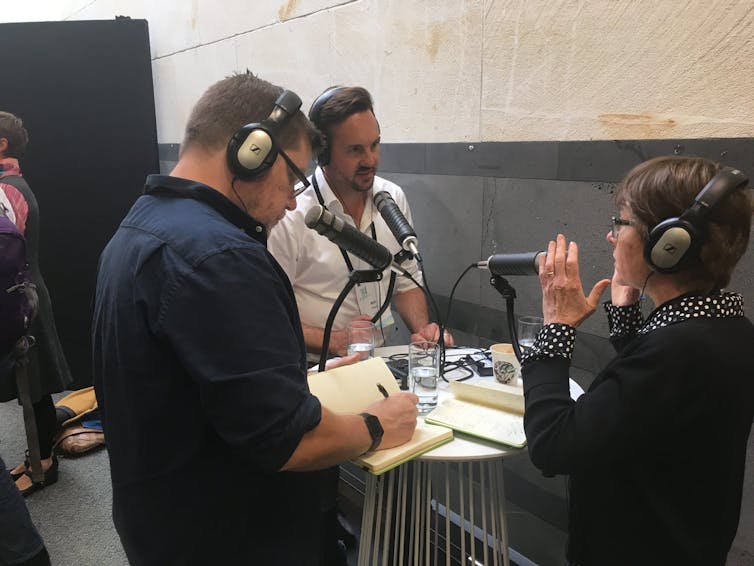 Interviewing Penny Hawe, Professor of Public Health at the Menzies Centre for Health Policy at the University of Sydney.
Will Grant and Rod Lamberts, Author provided
Interviewing Penny Hawe, Professor of Public Health at the Menzies Centre for Health Policy at the University of Sydney.
Will Grant and Rod Lamberts, Author provided
Why this approach? Two reasons.
First, by having a relaxed chat with population health practitioners and researchers, listeners get to relate to them more as people. To hear them, rather than read them, and to get a feel for what they’re like.
Second, by listening to these interviews, other population health science people might find out about aspects of their professional world that they wouldn’t necessarily see via the standard meetings, papers and policy pronouncements.
You can listen to the chats here.
So what did we find out?
As we discussed the communication of, and engagement with, population health science with a range of interviewees, several things stood out.
1. Even people with the knowledge don’t – or can’t – always practise what they preach.
This was exemplified in a great story about an international nutritionists’ conference at which the lunch was, ironically, far from the standards that nutritionists would suggest people observe. As a group they were aghast at the junk food on offer, but were eating it because that was all that was there.
2. Population health science has a naming issue.
It was often unclear to us during these chats whether we should refer to public health, population health, population health science, or epidemiology.
For people on the inside, the differences between those labels are (hopefully) clear and (definitely) important, but for us on the outside … not so much.
This name confusion probably doesn’t matter to outsiders, as long as we are getting the health guidance that we want and need. So perhaps an important question for population health folk to ask themselves here is: “does it matter if people know the differences between these interrelated areas?”
But at a deeper level, does the label “public” adequately reflect the fact that the discipline is focused on all the things that affect our health beyond the chemistry and biology of our bodies, and not just what’s in the “public” sphere? If my health behaviours affect your health outcomes – if my drinking or exercise creates norms in which it is more or less likely that you will drink or exercise – is that a matter of public health or “shared health”?
3. Population health science appears – as best as we could see – to be unreconciled in its political nature, and shy about its goals.
Emerging researchers in the field are often trained in engaging with the policy process (talking with bureaucrats and so on), but not with the political process.
Moreover, some spoke of the fact that, if they were asked to articulate a clear vision of what they’d like for society, they’d come up blank. Stepping towards improved population health is great, but it helps to first be confident that all of us (both inside and out) agree on the directions in which we should be stepping.
 Hanging with Summer May Finlay, a health and communications consultant, and University of South Australia PhD candidate .
Will Grant and Rod Lamberts, Author provided
Hanging with Summer May Finlay, a health and communications consultant, and University of South Australia PhD candidate .
Will Grant and Rod Lamberts, Author provided
Know your tribe - and others
Life in the human herd is complex, and like it or not, we are unavoidably interdependent when it comes to our health. So conversations about the roles of population health, population health science, public health, and epidemiology in this picture are critical.
Read more: Are you part of a social group? Making sure you are will improve your health
But people can’t have these conversations if they don’t know even know what members of their own tribe are thinking, let alone what’s going on in the minds of the rest of the pack, herd, mob or flock.
We aren’t suggesting that we have all the answers, but we certainly hope we have contributed to expanding the conversation - have listen and tell us what you think!
Authors: Will J Grant, Senior Lecturer, Australian National Centre for the Public Awareness of Science, Australian National University


 Daily Bulletin


