

The West increases pressure with diplomatic expulsions, but Russia is unlikely to cave
- Written by: Alexey D Muraviev, Associate Professor of National Security and Strategic Studies, Curtin University
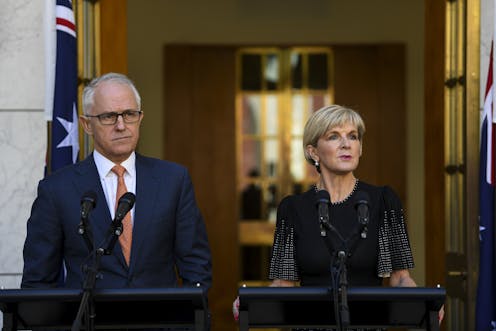
Prime Minister Malcolm Turnbull and Foreign Minister Julie Bishop have declared two Russian diplomats personas non grata – in other words, they are expelling them from Australia.
The decision to expel the pair is a show of solidarity with the UK over the assassination attempt on two Russian nationals, former Russian colonel Sergei Skripal (who was recruited by British intelligence) and his daughter Yulia, in the small city of Salisbury on March 4.
In a joint statement, Turnbull and Bishop said the two diplomats were identified as “undeclared intelligence officers”, and are now required to leave Australia within seven days.
This is a rare move. However, it is not the first time Australia has expelled Russian diplomats implicated in covert intelligence activities. In mid-1993, Australia secretly expelled six Russian diplomats on “suspicions of spying”.
Read more: Sergei Skripal and the long history of assassination attempts abroad
Historically, Australia was of strong interest to Soviet and Russian intelligence. There were several reasons for this, including Australia’s close security and defence ties to the US, the UK and other NATO countries, and its access to highly sensitive intelligence as part of the Five Eyes agreement.
Australia also has access to advanced military technology provided by its allies. It plays an important role in the US-led Asia-Pacific anti-ballistic missile defence.
In recent years, Australia’s intelligence community has expressed concern about the extent of Russian and Chinese intelligence-gathering activities in the country.
Posting a serving intelligence officer to work under a diplomatic cover is a common practice of various intelligence agencies, particularly those that do not have special agreements concerning the legal presence of intelligence personnel in a country of interest. Russian intelligence services, such as the Foreign Intelligence Service SVR (sluzhba vneshnei razvedki – political and economic intelligence) and the Main Intelligence Directorate, or GRU (glavnoe razvedyvatel’noe upravlenie – military intelligence), engage in such practices.
Diplomatic cover provides an intelligence operative not just with diplomatic immunity. It also gives an operative a legal right to engage with various groups of a targeted nation, from political and business elites to fellow diplomats, journalists, social activists, academics, and community groups.
Counterintelligence agencies have ways of identifying such operatives and tracking their activities, including contacts with key local stakeholders. Expelling identified, undeclared intelligence officers is common practice when a country wants to showcase a robust response and a clear political message to its political opponent. In this case, it is Russia.
Identifying the two diplomats as spies sends a powerful message to Russia and its intelligence services. But the world of intelligence is a never-ending game of shadows, with its own rules, codes of conduct and practices.
Australia expects that, in return, Russia will declare at least two Australian diplomats from its embassy in Moscow personas non grata. It is likely the Russians will use the same logic as Australia in choosing who to send home.
By keeping the pressure on Russia, the West is trying to alter Russia’s strategic behaviour, reducing the impact Russian President Vladimir Putin’s assertiveness has caused to the US-led rules-based order.
There is also a clear attempt to weaken Russia as a strategic competitor, as the world’s number-two military power, by making its economy bleed under sanctions. But what effect might this latest round of confrontation create?
Certainly, the expulsion of some 130 Russian diplomats/suspected intelligence operatives will curtail Russian intelligence operations across Europe, North America and Australia.
Read more: Russia not so much a (re)rising superpower as a skilled strategic spoiler
However, we should not underestimate the potential of Russian intelligence services. It is likely they will restore their intelligence-gathering capacity very quickly. Russia has a proven global intelligence-gathering capability, and the expulsion of some 130 agents will not undermine it in the long run.
Also, only 23 countries have followed the UK’s response against Russia. About half of EU member countries have not joined in the action so far. Some major powers in the Indo-Asia-Pacific, including China and India, have kept their distance. That makes this new round of Russia-West confrontation a war of yet another “coalition of the willing”.
Russia is unlikely to back down to pressure from the West, nor will it admit its alleged involvement in the assassination attempt on Skripal. The investigation into the attack continues, and no final conclusions have been drawn yet.
We should also recognise that the West has seriously underestimated the level of Russian resilience to sanctions as well as its ability to challenge the US-led rules-based order.
In terms of future steps, Australia might reconsider the level of its involvement in the upcoming football World Cup, which will be held in Russia in June-July this year. However, it is unlikely the Australian team will boycott the event.
More targeted sanctions may be imposed, but these actions are likely to trigger a counter-response from Russia. Already, Russia-Australia bilateral trade has gone down: the level of bilateral economic trade was A$687 million in 2016, down from A$1.837 billion in 2014. If Russia is to take further economic counter-sanctions against Australia, it may choose to target Australia’s agricultural exports.
Neither Australia nor Russia consider high-level political dialogue with one another a priority. Yet maintaining some form of a dialogue is important.
Russia is a permanent member of the UN Security Council. It is a member of several key international organisations that are critical to Australia, including the G20 and APEC. Russia plays a critical role in the ongoing war in Syria and crisis in Ukraine, the war against Islamic State, in curtailing the nuclear ambitions of both North Korea and Iran, and in stabilising Afghanistan.
Cutting ties with Russia or suspending dialogue with it on some key international security issues such as combating terrorism, the proliferation of weapons of mass destruction, or North Korea would not contribute to global stability.
The Australian government decided to show decisiveness, determination and strong resolve. Australia has once again shown its strong support and solidarity with its key allies such as the UK. But let’s hope the government shows the same consistency, resolve and determination next time other major powers undertake reckless activities, such as China’s strategic gaming in South China Sea.
Authors: Alexey D Muraviev, Associate Professor of National Security and Strategic Studies, Curtin University


 Daily Bulletin


