

The Syrian 'hell on earth' is a tangle of power plays unlikely to end soon
- Written by: Mehmet Ozalp, Associate Professor in Islamic Studies, Director of The Centre for Islamic Studies and Civilisation and Executive Member of Public and Contextual Theology, Charles Sturt University
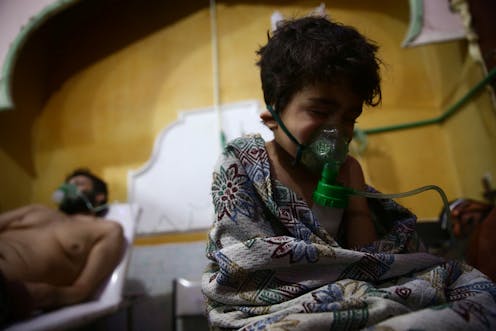
Once again, unfortunate civilians are trapped in the “hell on earth” that the Syrian civil war has become. This time it is the turn of the 400,000 residents of Eastern Ghouta, ten kilometres east of the capital Damascus. Latest reports put civilian casualties at 520 and thousands wounded under the heavy assault launched by President Bashar al-Assad’s ground forces supported by Russian air strikes.
It seems conditions in Syria are getting worse, and there is no end to the conflict.
The end to any violent conflict comes when either the warring sides realise the devastation they cause and make peace; outside intervention sways the warring parties to end the conflict; or there are clear winners delivering a crushing defeat to their enemies.
None of the warring factions seem to care about the devastation of the seven-year civil war. Almost the entire country is rubble – more than 400,000 people have died, there are 5 million Syrian refugees and more than 6 million displaced. Unfortunately, the peace option seems highly unlikely.
There had been international intervention through peace initiatives since 2013, when the then US secretary of state, John Kerry, lamented that Syria “heads closer to an abyss, if not over the abyss and into chaos”. It was a chemical attack in Eastern Ghouta that prompted the United Nations to pass a resolution in 2013 demanding the destruction of chemical stockpiles and giving impetus to peace talks in Geneva. All efforts to make progress on these talks were continually stalled. The parties failed to meet even as late as 2017, painfully expediting Kerry’s apocalyptic prediction.
Read more: Stakes are high as Turkey, Russia and the US tussle over the future of Syria
The Geneva talks were paralleled by a Russian-led peace initiative in Kazakhstan and later in Sochi. These talks could not have been expected to succeed, given that Russia’s unconditional and active support of the Assad regime hampered any attempt at brokering a peace deal.
Apart from the vested interests and insincerity, the biggest stumbling block has been disagreement over who to include in the peace process. The US does not want Assad or Iran involved; Turkey does not want the Kurdish People’s Defence Unit (YPG); and Russia does not want any of the jihadist rebel groups.
The sheer number of rebel groups is another issue. In the relatively small area of Eastern Ghouta alone, there are three rebel groups, which often bicker with one another.
Since the conflict began in 2011, nearly 200 separate rebel groups have sporadically emerged. Although most of these later merged into larger entities, there are still too many groups. Their inclusion in any peace process has been problematic, because it is unclear who actually represents the Syrian opposition, not to mention the groups’ refusal to sit at the same table.
Then there is the thorny issue of ideological and religious differences. Shiite Syrians and a segment of secular Sunni Muslims support the Assad regime, whereas the largest chunk of the rebel groups are Salafi jihadists. The exceptions are the Kurdish YPG and the largely weakened Free Syrian Army.
All along, Assad’s regime has been claiming it is fighting IS, Al-Qaeda and other Salafi jihadist groups to keep Syria a modern secular state. Putin is pushing Assad to wipe out these groups, spurred by the deep fear they could mobilise radical Muslim groups within Russia’s borders.
The US and Europe are in the cognitive dissonance of wanting neither Assad nor jihadist groups to gain control in Syria. They don’t want Assad, but they like his argument of protecting a modern secular Syria. The unspoken preference is for Assad over any Jihadi rebel group.
So, the lack of an effective peace intervention and the impossibility of parties sitting down to negotiate leaves only the option of fighting it out until clear victors emerge.
This leaves the Assad regime with a free run to assert itself as the only feasible and legitimate government in Syria, a possibility that may indeed eventuate.
This is the strategic line the Assad regime has drawn thick on the ground. It explains why Assad forces have ignored the UN’s 30-day ceasefire resolution. Putin’s disregard for the resolution, by reducing it to a farcical five-hour window, shows that neither Assad nor Putin wants the rebels to regroup and gain strength. They want a quick and absolute victory, even if it is a bloodbath.
Just as it is almost certain that the rebels of Eastern Ghouta will fall, it is equally certain Assad forces will next intensify the siege of Idlib, a northeastern city held by the Salafi jihadist rebel group Tahrir al-Sham (HTS). This pattern will continue until all rebel groups are wiped out.
Read more: Syria is a mess, but the solution is complicated too
It is unlikely there will be any fighting between Assad forces and the Kurdish YPG, as that would mean an open confrontation between Russia and the US. After the US supported the YPG, it successfully ended Islamic State’s presence in eastern Syria. The US has made it clear it is there to stay, establishing a 30,000-strong border security force as a deterrent against IS regrouping, but more importantly to stop Assad attacking Kurdish regions once he clears the ground of rebel groups in his territory.
The wild card in Syria is Turkey’s unpredictable president, Recep Tayyip Erdogan. He aims to establish Turkey in northeastern Syria as a third major player along with Russia and the US, by fighting alongside elements of the Free Syrian Army to capture the Kurdish-controlled district of Afrin.
Whether Russia and the US will allow Erdogan to realise his objectives remains to be seen. He may find he is out of his league when things get tough on the ground, forcing him out of Syria.
The Syrian conflict will end only if the Russian-supported Assad regime wipes out all Salafi jihadist rebel groups and regains control of western Syria and its most important cities. This may be before the end of 2018. In the meantime, the international community should be prepared to lament more civilian casualties.
Authors: Mehmet Ozalp, Associate Professor in Islamic Studies, Director of The Centre for Islamic Studies and Civilisation and Executive Member of Public and Contextual Theology, Charles Sturt University


 Daily Bulletin


