

Australian cities are crying out for better planning, but the research funding is missing
- Written by: Dorina Pojani, Senior Lecturer in Urban Planning, The University of Queensland
Although 90% of our population lives in cities, Australia lacks a national urban policy and our government provides insufficient funding for urban sustainability projects.
Good urban planning is important for a number of reasons. Australian cities face the possibility of significant disasters due to climate change. Air pollution kills 3,000 people a year. A housing price crisis has taken hold. Reports on the energy and oil vulnerability of Australian cities are disquieting. And food and water security often seem like policy afterthoughts.
Read more: Sidelining planners makes for poorer urban policy, and future generations will pay the price
Despite these major concerns, little funding has been provided for urban planning research, and the distribution of this funding is uneven.
Lean funding for urban planning research
Australia has a total of 48 accredited planning degrees at 24 universities, staffed by 196 planning academics. We assessed Australian Research Council (ARC) grants to urban and regional planning. The ARC is the largest and most prestigious public research funding body in Australia. It provides the lion’s share of funding for planning research, which is very little.
A total of A$31.7 million was provided for 91 planning projects between 2010 and 2018. To place these sums in perspective, consider the funding in some related fields: human geography research received A$58.8 million for 151 projects; demography research attracted A$88.7 million for 76 projects; and political science collected A$88.7 million for 229 projects.
On average, A$17,970 per academic per year was provided for planning projects. Unfortunately, this amount of funding does not go very far. For instance, conducting a travel survey of 500 participants costs about A$50,000. Hiring a part-time research assistant costs about A$50 an hour.
Meanwhile, several universities have set minimum grant funding expectations or “aspirations” for planning staff. A quick survey of our colleagues suggests these vary between A$20,000 and A$80,000 per year.
We found that departments with more staff win more research grants (as teams typically submit their proposals). But planning programs in Australia are minuscule. On average they are staffed by only six or seven academics. This is another reflection of the meagre funding provided to the planning profession.
In contrast, North American and European countries provide much more financial support to planning academics through government grants for research and salaries for staff. Departments with 15 to 20 planning academics are common. On both sides of the Atlantic, the planning discipline is more consolidated and has a longer history than in Australia.
We still plan our cities without considering planning research. Traditionally, the government has demonstrated little interest in funding planning research, possibly because the development industry is a source of income for the major political parties. This industry has often viewed planning as a constraint on its activities. As Professor Patrick Troy puts it, there is fear that rigorous research into urban Australia might reveal “too many inconvenient truths”.
And some studies suggest that few practitioners read planning research. Grant proposals involving early career planning researchers and collaborations between academic planners and industry partners have become more successful in recent years.
Big fish dominate small funding pool
While 59% of planning academics did not attract any ARC grants between 2010 and 2018, the likelihood of being awarded an ARC grant increases considerably for more senior planning academics. Professors receive more than twice as many grants as associate professors. Associate professors in turn receive about twice as many grants as senior lecturers. However, most planning programs expect junior academics to successfully lead ARC grant applications.
Senior planning academics may be more successful winning grants because they are more experienced at grant writing. They may also have larger networks of academic colleagues (with whom to form bidding teams) and industry colleagues (who might help locate matching funds).
But these data also imply that ARC grants “snowball” (holding one grant substantially affects the chances of winning another) and tend to cluster around certain individuals. Grant acquisition rates are more closely correlated with publication and citation rates in earlier career stages. The concern here is that an “old boy network” effect may be in place.
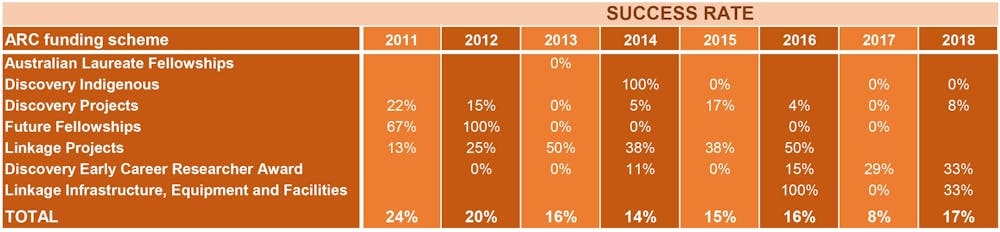 Timeline of planning research funding: 2002-2015.
Read more: Why I disagree with Nobel Laureates when it comes to career advice for scientists
Significant gender differences in grant acquisition rates appear to confirm this. While males were the lead investigators on 59 ARC grants between 2010 and 2018, females led only 32 grants. Although differences are small among lecturers, the “funding gender gap” broadens considerably at the professorial levels. Male professors hold 6.4 times as many ARC grants as female professors, although there are only 2.7 times more male professors than female professors.
Why the gender gap? International research has suggested that male-dominated grant review committees generally evaluate women, especially younger women, more harshly. In the ARC College of Experts, which evaluates grant applications, only 70 of the 176 members – 40% – are female.
Inequitable allocation of ARC research funding occurs in other disciplines too. But in planning it is more problematic due to the sexism inherent in urban development. Virtually everything in our cities – streets, squares, parks, buildings – has been designed and shaped by men. Nearly all of the references for urban best practices, as taught in Australian universities, are written by men.
Read more: Mansplaining Australian cities – we can do something about that
What would urban planning research and practice be like if it were female-led? Might women rewrite the rulebook? Might cities become less car-dependent and more cycling-friendly? Might they have fewer dark alleys and more sunlit parks and kindergartens?
We could begin to answer some of these questions if planning research was prioritised.
Authors: Dorina Pojani, Senior Lecturer in Urban Planning, The University of Queensland


 Daily Bulletin


