

Grey's Anatomy is unrealistic, but it might make junior doctors more compassionate
- Written by: Deborah Lupton, Centenary Research Professor, University of Canberra
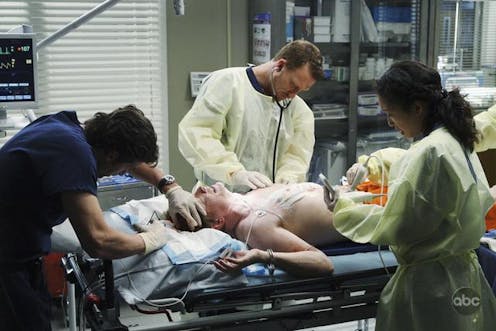
Patient experiences in the TV drama Grey’s Anatomy are, unsurprisingly, portrayed inaccurately when compared with real-life trauma cases, according to a new study.
The US-based medical team of researchers wanted to see if the long-running program, now in its fourteenth season, was realistic in showing what happens to patients when they are rushed to hospital after experiencing a major injury. They reviewed 269 episodes of the program and compared the fictional patients’ treatment and outcomes with those from a database of nearly 5,000 real patients collected in their hospital.
The study, published today in the journal Trauma Surgery & Acute Care Open, found most of the fictional patients (71%) were transferred from emergency directly to the operating theatre. This happened to only one in four of the real patients.
The fictional patients also died three times more frequently than the real patients. But if they survived their injury, they were more likely to recover quickly, without further surgeries – and be discharged early.
Fictional patients in Grey’s Anatomy died around three times more frequently than the real patients.Writing from the perspective of health-care providers working in trauma medicine, the researchers advised fans of Grey’s Anatomy who found themselves or their family members in emergency departments after traumatic injury, that they could hold unrealistic expectations of their care and recovery. But they also noted that it was difficult to know how much credence lay people placed on fictional portrayals of medical care.
Given the enduring popularity of television medical dramas, other researchers have wondered about the accuracy of depictions of medical care and illness in these programs, and what key messages viewers might take away from watching them.
Read more: Friday essay: TV's troubling storylines for characters with a mental illness
For example, several research teams have criticised medical dramas showing heart resuscitation techniques for conveying misinformation about their effectiveness, such as far higher survival rates from a heart attack, or more younger people experiencing attacks than in real life.
Numerous studies have found that such portrayals could have an effect on perceptions, but their findings are often contradictory. A review of several such studies found that viewing fictional medical TV programs had a negative influence on viewers’ health-related knowledge, perceptions or behaviour in 11% of studies, a positive influence in 32% of studies, and mixed influence in 58%.
The mixed results are indicative of what media studies researchers have long argued: that television viewers don’t passively absorb what they see on their screens. They are active audiences, drawing on other sources of information such as their own experiences, talking to others, and other forms of media to interpret what they see on television.
From god-like to human
Medical dramas have long been a staple of television, from the days of Dr Kildare and Marcus Welby in the 1960s, to the more recent ER, Casualty, Cardiac Arrest, Scrubs, House, and Grey’s Anatomy. In Australia, the likes of The Young Doctors, A Country Practice, GP and All Saints have received high ratings and long runs.
Over these decades, the portrayal of doctors has changed dramatically. The first generation of TV doctors were typically white, male, kindly and paternalistic – the “doctor knows best” archetype. Recent medical dramas, in contrast, feature both men and women in doctor roles, with a range of ages and ethnic and racial backgrounds.
Television portrayals of doctors have changed with the times.Doctors are no longer depicted as god-like creatures, but instead as regular humans who may be dedicated to their craft but suffer from insecurities. They make mistakes, succumb to stress, and have relationship problems. Some even struggle with drug addictions or personality disorders.
The eponymous House, for example, is a brilliant doctor in his diagnostic abilities. However, he is addicted to pain medication, clashes constantly with other staff members, and lacks personal interest in his patients.
Dr House is addicted to pain medication and has serious problems with his communication style.Influence on medical students
Medical shows might not just affect patients, but also aspiring or current doctors. Viewers may be inspired to become doctors by watching their favourite television characters, or develop ideas about how doctors should behave and present themselves to patients.
An Australian study of undergraduate medical students training in Sydney in 2011 found that most students had seen the series House and Scrubs, and to a lesser extent Grey’s Anatomy. Students were asked which characters on Grey’s Anatomy and House (the two major medical dramas at the time) they would most and least want to be like in their professional careers.
Some TV shows could actually teach medical students empathy.Derek Shepherd and Miranda Bailey from Grey’s Anatomy were viewed as the most positive role models. The characters viewed as most negative were Christina Yang and Meredith Grey from Grey’s Anatomy, and House himself.
Many students said they recalled the ethical issues raised in the shows. Of these, the most frequently recalled were medical mistakes (96.6%), death and dying (94.6%), professional misconduct (92%), and quality or value of life or personhood (91.1%). Many discussed these issues with their friends and family after watching the programs.
The authors suggested their research had implications for medical education and that there may be “benefit in using the shows in tutorials or lectures as case studies or examples for students”.
Read more: Scrubs, House, Grey's Anatomy: Are medical students learning bad habits?
Television medical drama, it seems, is still an important avenue for portraying the medical profession and medical care. In this digital age, future researchers should broaden the focus to investigate how doctors and patients alike present videos and images of themselves and medical procedures in online forums and social media, such as YouTube, Instagram, Pinterest and Snapchat.
Authors: Deborah Lupton, Centenary Research Professor, University of Canberra


 Daily Bulletin


