

Climate scientists and policymakers need to trust each other (but not too much)
- Written by: Rebecca Colvin, Knowledge Exchange Specialist, Australian National University
At a time when the effects of climate change are accelerating and published science overwhelmingly supports the view that humans are responsible for the rate of change, powerful groups remain in denial across politics, the media, and industry. Now more than ever, we need scientists and policymakers to work together to create and implement effective policy which is informed by the most recent and reliable evidence.
We know that trust between scientists and policymakers is important in developing policy that is informed by scientific evidence. But how do you build this trust, and how do you make sure that it genuinely leads to positive outcomes for society?
Read more: Nature v technology: climate ‘belief’ is politics, not science
In response to these questions, our recent Perspective in Nature Climate Change explores the dynamics of trust at the interface of climate science and policy.
We suggest that while trust is an important component of the science-policy dynamic, there can be such a thing as “too much” trust between scientists and policymakers.
Understanding this dynamic is crucial if we are to deliver positive outcomes for science, policy, and the society that depends on their cooperation.
What happens when there is ‘too much’ trust?
Trust between climate scientists (researchers in a range of disciplines, institutions, and organisational settings) and policymakers (civil servants in government departments or agencies who shape climate policy) is useful because it enhances the flow of information between them. In a trusting relationship, we can expect to see a scientist explaining a new finding directly to a policymaker, or a policymaker describing future information needs to a scientist.
Together, this arrangement ideally gives us science-led policy, and policy-relevant science.
But as scholars of trust have warned, there is a point beyond which these positive benefits of trust can turn sour.
Think about a hypothetical situation in which a scientist and policy-maker come to trust each other deeply. What happens if one of them starts to become loose with the facts, or fails to adhere to professional standards? Is their trusting counterpart more, or less, likely to identify the poor behaviour and respond appropriately?
Over time, a trusting relationship may evolve into a self-perpetuating belief of trustworthiness based on the history of the relationship. This is where scientists and policymakers may find themselves in a situation of “too much” trust.
We know that science advances by consensus, and that this consensus is shaped by rigorous research and review, and intense debate and scrutiny. But what if (as in the hypothetical example described above) a policy-maker’s trust in an individual scientist means they bypass the consensus and instead depend on that one scientist for new information? What happens if that scientist is – intentionally or unintentionally – wrong?
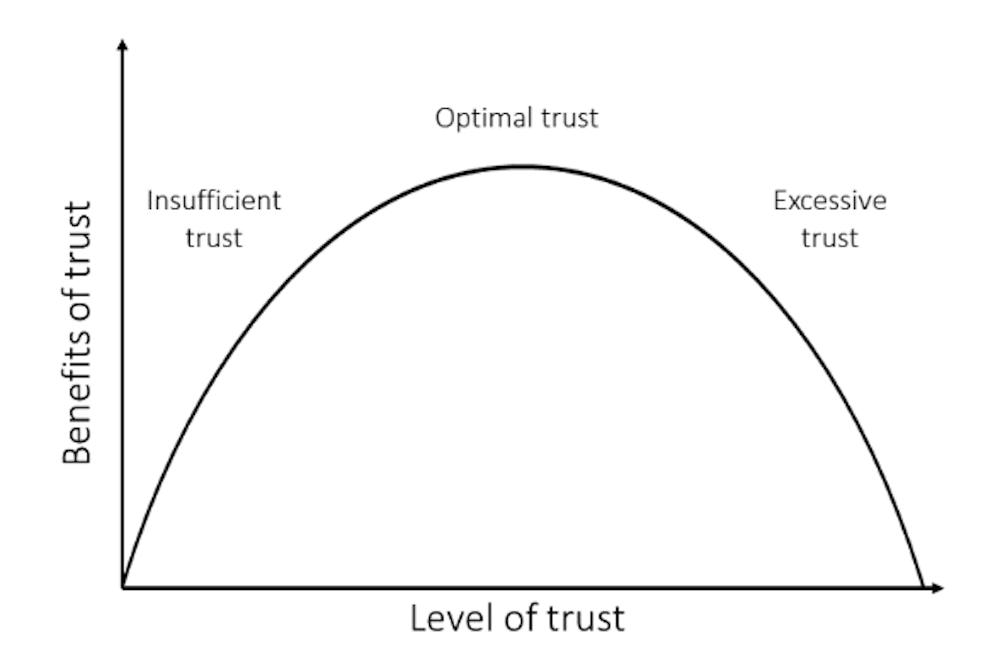 More trust is not always best. ‘Too much’ trust can cause perverse outcomes at the science-policy interface.
Adapted from Stevens et al. (2015)
More trust is not always best. ‘Too much’ trust can cause perverse outcomes at the science-policy interface.
Adapted from Stevens et al. (2015)
When you have “too much” trust, the benefits of trust can instead manifest as perverse outcomes, such as “blind faith” commitments between parties. In a situation like this, a policymaker may trust an individual scientist so much that they do not look for signs of misconduct, such as the misrepresentation of findings.
Favouritism and “capture” may mean that some policymakers provide information about future research support only to selected scientists, denying these opportunities to others. At the same time, scientists may promote only their own stream of research instead of outlining the range of perspectives in the field to the policymakers, narrowing the scope of what science enters the policy area.
“Cognitive lock-in” might result, where a policymaker sticks to a failing policy because they feel committed to the scientist who first recommended the course of action. For example, state-of-the-art climate forecasting tools are available in the Pacific but are reportedly underused. This is partly because the legacy of trusting relationships between scientists and policymakers in the region has led them to continue relying on less sophisticated tools.
“Too much” trust can also lead to overly burdensome obligations between scientists and policymakers. A scientist may come to hold unrealistically high expectations of the level of information a policymaker can share, or a policymaker may desire the production of research by an unfeasible deadline.
What’s the right way to trust?
With this awareness of the potentially negative outcomes of “too much” trust, should we abandon trust at the climate science-policy interface all together?
No. But we can – and should – develop, monitor, and manage trust with acknowledgement of how “too much” trust may lead to perverse outcomes for both scientists and policy-makers.
We should aim for a state of “optimal trust”, which enjoys the benefits of a trusting relationship while avoiding the pitfalls of taking too trusting an approach.
We propose five key strategies for managing trust at the climate science-policy interface.
Be explicit about expectations for trust in a climate science-policy relationship. Climate scientists and policy-makers should clarify protocols and expectations about behaviour through open discussion as early as possible within the relationship.
Transparency and accountability, especially when things go wrong, are critical to achieving and maintaining a state of optimal trust. When things do go wrong, trust repair can right the relationship.
Implement systems for monitoring trust, such as discussion groups within scientific and policy organisations and processes of peer review. Such approaches can help to identify the effects of “too much” trust – such as capture, cognitive lock-in, or unrealistically high expectations.
Manage staff churn in policy and scientific organisations. When scientists or policy-makers change role or institution, handing over the trusting relationships can help positive legacies and practices to carry on.
Use intermediaries such as knowledge brokers to facilitate the flow of information between science and policy. Such specialists can promote fairness and honesty at the science-policy interface, increasing the probability of maintaining ‘optimal trust’.
Read more: Is this the moment that climate politics and public opinion finally match up?
Embracing strategies such as these would be a positive step toward managing trust between scientists and policymakers, both in climate policy and beyond.
In this time of contested science and highly politicised policy agendas, all of us in science and policy have a responsibility to ensure we act ethically and appropriately to achieve positive outcomes for society.
Authors: Rebecca Colvin, Knowledge Exchange Specialist, Australian National University
&media=https://dailybulletin.com.au/https://images.theconversation.com/files/199635/original/file-20171218-17869-1r8dla.png?ixlib=rb-1.1.0&q=45&auto=format&w=754&fit=clip&description=Climate%20scientists%20and%20policymakers%20need%20to%20trust%20each%20other%20(but%20not%20too%20much) "Pin It")

 Daily Bulletin


