

Looking beyond the sandstone: universities reinvent campuses to bring together town and gown
- Written by: Bree Trevena, PhD Researcher, Research Unit in Public Cultures, University of Melbourne
Curtin University has a redevelopment plan to transform 114 hectares of its Bentley campus in Perth into a “city of innovation”. Its stated vision is to provide an “urban context that supports constant exchange between education, research, industry and government … where knowledge and innovation extend beyond buildings”.
Also in Perth, the University of Western Australia is heading towards the tail end of its decade-long Campus Plan 2010. Its ambitions are to create a “university in a town” that cultivates a distinct sense of place while knitting itself into the local community. The project hinges on adaptable spaces that promote social contact.
In Victoria, Melbourne’s laneway culture and the idea of the 24-hour city inspired RMIT University’s A$220 million New Academic Street. In Canberra, the Australian National University’s A$220 million revitalisation of Union Court has kicked off with a pop-up village, with student accommodation, a student services hub, learning spaces and an events centre to come.
What’s driving this transformation?
Historically, European ideas of the campus as a place apart, shielded from the unruly city, shaped Australia’s “sandstone” university campuses. Postwar planning continued the separation of the campus from the city by putting it in the suburbs.
However, in an increasingly deregulated global market, universities must change tack and become more inclusive. Competition to attract the best and brightest students and researchers is increasing. Universities are vying for industry and social partnerships, research grants and a seat at the policy table. The digital revolution has also transformed study habits.
In this climate, being able to create an engaging experience on a real-world campus can set an institution apart, potentially offering social and educational benefits that can’t be had online or on other universities’ campuses.
The focus on the public realm taps into today’s urban planning orthodoxies of porous boundaries and programmed public spaces combined with statement architecture. Campus-centred public programming might involve inviting the “neighbours” over not only for public lectures, but also for summer day parties and winter footy matches. Private-sector tenants might include farmers’ markets and lifestyle retailers, making the quad more like a local high street.
With its public programming, mixed-use planning and the insertion of small-to-medium private enterprises, campus design strategy has begun to mirror many Australian urban regeneration strategies. We can already see an “urbanisation” of campus buildings. In particular, new student accommodation resembles share houses, boutique hostels or luxury condos.
Campuses are going downtown
As well as bringing urban design principles onto campus, universities are taking the campus to the city. Different schools, research clusters and faculties are being dispersed into the city.
Curtin University Law School is nestled in Perth’s legal district, exposing students to the cut and thrust of the judicial world. Similarly, Newcastle University relocated its Faculty of Business and Law from the main Callaghan campus to its A$95 million NeW Space CBD campus.
These satellite campuses in city centres are also developing a civic sensibility.
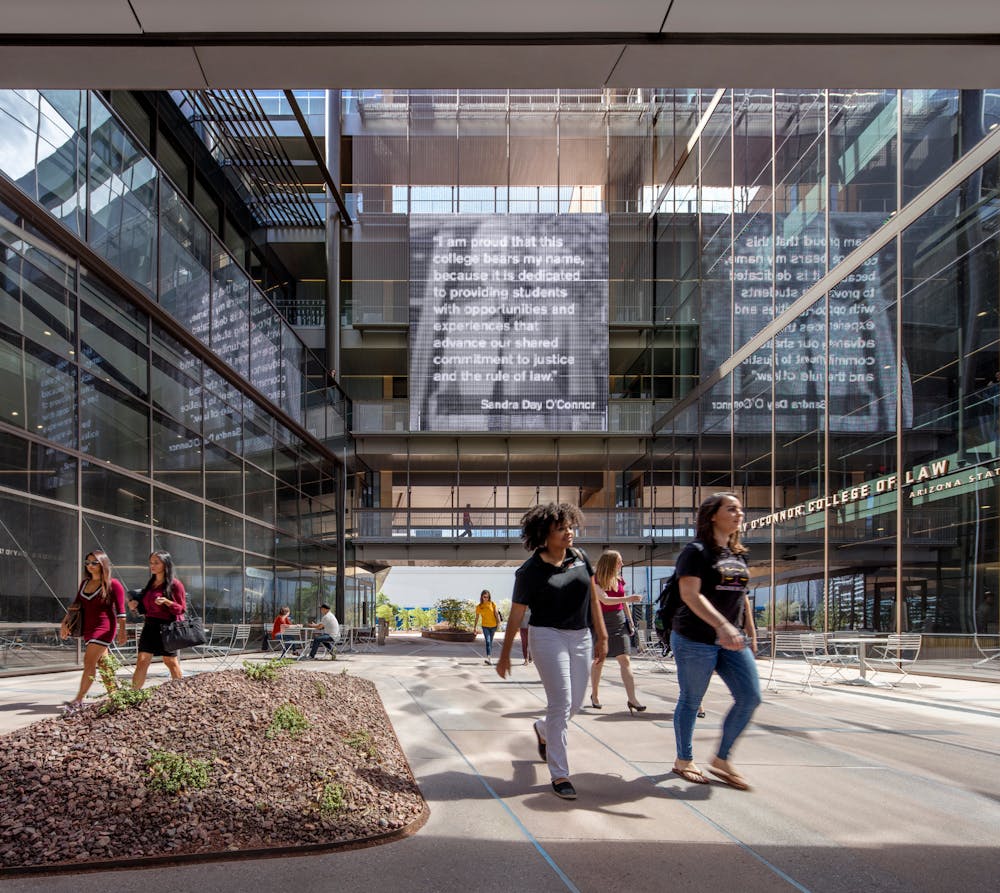
A key international example can be found in the United States. In 2016, the Beus Center for Law and Society (BCLS), the new home of Arizona State University’s Sandra Day O’Connor College of Law, opened in downtown Phoenix, next to the legal and government precincts. (The main campus is in suburban Tempe.)
 The Sandra Day O’Connor College of Law’s new home, the Beus Center for Law and Society, is in downtown Phoenix.
Arizona State University, Author provided
The Sandra Day O’Connor College of Law’s new home, the Beus Center for Law and Society, is in downtown Phoenix.
Arizona State University, Author provided
The mission of the law college is to “raise the bar” through ethical legal practices. This includes helping the local community – many of whom are struggling with poverty and a lack of citizenship documentation – to understand their rights and how the law shapes society.
The college invites the neighbourhood into a space that, for most, is intimidating. Lines between campus and city are made intentionally hazy through the form and function of spaces, programming and public-facing services. The campus houses small to medium-sized social enterprises, including the Arizona Justice Project, which reviews and assists in cases of innocent or wrongly imprisoned individuals.
 More than 90% of students at the Beus Center for Law and Society take part in pro bono activities and public service.
Arizona State University, Author provided
More than 90% of students at the Beus Center for Law and Society take part in pro bono activities and public service.
Arizona State University, Author provided
The college encourages students to engage with the community. More than 90% of them take part in pro bono activities and public service. Some work with review teams at the Arizona Justice Project.
In a climate of economic, social and environmental challenges, universities are well placed to take on this kind of public leadership role. By reorienting a networked research culture towards the broader community, universities can become catalysts for social development.
Creating a critical mass of innovation
Another way universities can increase their impact is by physically clustering together students, researchers, social-impact businesses and startups. The Melbourne Innovation Districts partnership between the University of Melbourne, RMIT University and the City of Melbourne was announced in August 2017. The initiative seeks to drive investment in the knowledge economy by leveraging the knowledge in Melbourne’s northern CBD.
The district, which includes the two universities’ main campuses, accounts for 21% of knowledge-sector jobs in the city. According to the Mapping Victoria’s Startup Ecosystem report, commissioned by LaunchVic and released in August 2017, Victoria is home to most of the startups in Australia that have a value of more than A$1 billion. However, only 34% of Victorian startups partner with universities or research institutions.
An explicit ambition of Melbourne Innovation Districts is to attract more small businesses, startups and social enterprises to build the talent pool that feeds innovation. Public spaces and resources designed with civic participation in mind – cycling networks, free Wi-Fi and smart-sensor technologies – are part of the plan.
Transformation starts with procurement
The project shows how universities might employ innovative processes to create innovative places. Universities need only look in their own backyards for expertise in designing campuses.
Importantly, procurement processes could better reflect the aspirations of the diverse neighbourhoods and innovation districts universities seek to emulate. The focus should be on the value of emergent and smaller players in driving change.
Australia’s design sector is largely made up of small-to-medium-sized businesses. However, risk-averse processes mean they are rarely involved in campus planning in a meaningful way.
Campus procurement could build in mechanisms, such as large offices partnering smaller offices, to help smaller, younger and newer practices to scale up. Redefining risk to include them in funded competitions and merit-based tender selection would support a local industry while capturing new ideas.
Innovation in procurement would help reshape universities as open platforms for shared discovery. This would expand the opportunities to plan memorable, distinctive campuses textured with local character.
The Conversation is co-publishing articles with Future West (Australian Urbanism), produced by the University of Western Australia’s Faculty of Architecture, Landscape and Visual Arts. These articles look towards the future of urbanism, taking Perth and Western Australia as its reference point, with the latest series focusing on the public domain. You can read other articles here.
Authors: Bree Trevena, PhD Researcher, Research Unit in Public Cultures, University of Melbourne


 Daily Bulletin


