

Why there should be no room in the law for celebrants to discriminate on same-sex marriage
- Written by: Becky Batagol, Senior Lecturer in Law, Monash University
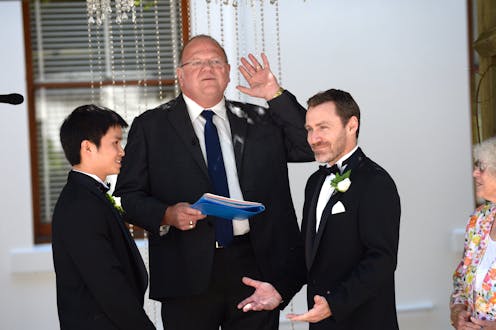
The process of legislating for marriage equality is underway. Marriage celebrants are looking forward to Australia’s busiest-ever wedding season. However, with the proposed laws now on the table, not all marriages will be equal.
The private member’s bill sponsored by Liberal Dean Smith is being debated today in the Senate. Attorney-General George Brandis has said he wants to amend the bill to extend religious protections to civil celebrants.
If it goes through, the amendment would permit civil celebrants to refuse to conduct a marriage ceremony because of their conscientious or religious beliefs (as another marriage amendment bill did earlier this year).
Permitting non-religious, civil marriage celebrants to discriminate is a bad idea. This goes far beyond protecting religious freedom.
My research into Australia’s marriage laws and civil marriage celebrants leads me to believe that Brandis’ proposed changes will undermine Australia’s flourishing civil marriage system by sanctioning discrimination against LGTBIQ clients. They will weaken marriage equality and will permit humiliating, unnecessary discrimination.
Providing the right to refuse to solemnise marriages to civil marriage celebrants undermines the aims and nature of Australia’s world-leading civil marriage celebrant program. It also compromises Australia’s long-established pluralistic system of marriage, as inherited from England.
Unique weddings and quirky celebrants: Australia’s contribution to the world
To understand the marriage equality law, it is helpful to know a little about the history of marriage in Australia.
Until 1973, when Australia’s world-first civil celebrant program was created, most civil wedding ceremonies were dry, brief and formal procedures conducted by state officials in registry offices.
Read more: As Australians say ‘yes’ to marriage equality, the legal stoush over human rights takes centre stage
The civil celebrancy program was initially set up by the Whitlam-era attorney-general, Lionel Murphy. It went under the publicity radar, unlike the no-fault divorce reforms debated and passed by the federal parliament at the same time.
According to one of Australia’s first civil celebrants, Dally Messenger, the civil celebrant program allowed for a civil alternative to religious marriage ceremonies that was dignified. Marrying couples could choose a ceremony at a place with symbols, dress and a celebrant consistent with their beliefs.
Murphy initially appointed just a small group of civil marriage celebrants in 1973 and 1974. Today, there are around 9,000 civil marriage celebrants registered in Australia. The civil celebrancy program, alongside the secularisation of Australian society, has made civil marriage ceremonies attractive and accessible to brides and grooms.
In other words, before Elvis’ Little Wedding Chapel in Vegas, we had Australia.
It is easy to find celebrants across Australia advertising services for garden weddings, weddings at family homes, beach weddings, skydiving weddings, underwater weddings, helicopter weddings and almost nude weddings (the celebrant said their nudity showed “there was nothing you wouldn’t do to be together”).
Allowing civil marriage celebrants to refuse to conduct a marriage ceremony because of their conscientious or religious beliefs against the marriage of partners of the same sex would undermine a key aim of the civil celebrancy program – to allow for a non-humiliating alternative to religious marriage ceremonies.
It is degrading for anyone to be told that they will not be able to be married by a celebrant because of the celebrant’s personal beliefs about them. The law should not authorise this humiliation.
Religious or civil wedding? The value of choice
The proposed exemption for civil marriage celebrants also undermines the long tradition of a pluralistic system of marriage law in Australia.
Since colonial times, Australians have been able to choose a religious ceremony or a non-religious civil ceremony. Both will be validly recognised as a marriage under law.
This system was inherited from England, where both religious (Church of England, Jewish and Quaker marriages) and civil marriages have been recognised since 1836.
Today in Australia, religious marriages must be conducted by law in accordance with the rites and practices of a broad range of religions. Civil marriages must be performed in accordance with the Marriage Act, and are far more heavily regulated by law than religious marriages.
Read more: The marriage equality survey is won, but the battle against discrimination continues
Most Australians choose to have a non-religious wedding. For nearly two decades, civil marriage has been overwhelmingly the most popular way to be married in Australia. In 2015, almost 75% of all marriages were performed by a civil celebrant rather than a minister of religion.
Over the last half of the 20th century, there was a major shift towards civil weddings. In 1959, just 11.4% of marriages were civil marriages. Civil marriages have outnumbered religious marriages in Australia since 1999.
Providing civil marriage celebrants with the right to refuse to marry a couple based upon their sexuality or the religious beliefs of the celebrant brings an element of religiosity to civil marriage. It reverses the historical separation of civil and religious marriage in England and Australia that has been in place since 1836.
The exemption will limit the ability of Australians to opt into a wedding that is not governed by religious values, defying the trend towards civil marriage.
Discrimination on the basis of sexuality or gender has no place in contemporary Australian law and society. If we are to achieve true marriage equality, then prejudice cannot be permitted in the delivery of secular wedding services. Our anti-discrimination laws exist to ensure equal treatment of all Australians, regardless of personal attributes.
Brandis’ proposed changes go beyond ensuring religious freedom. By introducing a new basis for discrimination by civil wedding celebrants, the proposed laws undermine Australia’s existing human rights framework and Australia’s long history of civil marriage.
Authors: Becky Batagol, Senior Lecturer in Law, Monash University


 Daily Bulletin


