

Alexander Dugin, Eurasianism, and the American election
- Written by: Matthew Sharpe, Associate Professor in Philosophy, Deakin University
Electoral affinities
Until the last fortnight, an unhappy sequence of natural disasters and North Korean sabre-rattling have kept the investigations concerning Russian interference in last year’s American election out of the international headlines.
At issue, the world knows, is the existence, nature and extent of this interference. Then there is the possible collusion in it of people close to Mr Trump and his bid for the Oval Office.
Commentators consider less often why the Russian government might want to intervene in the US elections in favour of a candidate appealing to forms of Americanism long married to depictions of their own nation as heading an “evil empire”.
To be sure, the times have changed. The Iron Curtain has fallen. Putin is a former KGB man. And reading dissidents like Garry Kasparov is an education in how his government continues the darker legacies of Soviet rule. But the ideological foundations of the new regime are very different.
We can get an idea of the kind of thinking at stake here by looking at the thought of the philosopher sometimes (inevitably) dubbed “Putin’s Rasputin”, Alexander Dugin.
Dugin’s relationship with Putin and his inner circles has changed over time. Its extent is contested. Certainly, both men came to maturity within the former Soviet Russia. Both men were shocked at the regime’s collapse. Both rued Russia’s ensuing fall from superpower status. Both men are now committed to ‘making Russia great again’.
Dugin thus came out publicly in favour of Putin’s controversial 2008 invasion of Georgia. During the 2014 Russia-Ukraine conflict, he bullishly called for the annexation of all Ukrainian lands that were part of the former Russian Empire.
And in 2015-16, Dugin vocally championed Mr Trump’s Presidential bid in the US. Trump, the philosopher enthused, is “tough, rough … rude, emotional and, apparently, candid”. Despite being a billionaire, Trump embodied the “real” America, in heroic insurgency against the “globalist” beltway elites.
But Dugin’s virtual vote for Trump in 2016, and his new-found concern for the American heartland, come tethered to a decidedly ‘un-American’ worldview, to turn another phrase.
“It is especially important to introduce geopolitical disorder into internal American activity,” Dugin was advising Russian elites as early as the 1990s, laying out what looks like a blueprint for the kinds of activities presently under CIA investigation:
encouraging all kinds of separatism and ethnic, social and racial conflicts, actively supporting all dissident movements – extremist, racist, and sectarian groups, thus destabilizing internal political processes in the US. It would also make sense simultaneously to support isolationist tendencies in American politics …
Almost as soon as you rub the bottle, in fact, the elective affinities between Dugin’s support for Messrs Trump and Putin begin to give way to asymmetries of global proportions.
For if the isolationism of the American superpower is to be encouraged, for Dugin and those who follow him, this is to clear the ground for a newly-interventionist imperial Russia.
Impact and philosophy
In Western nations, there is much talk presently about the need for philosophy to “impact” wider societies. But there is impact and there is impact. In truth, philosophers have a long but highly ambiguous history of “impacting” wider culture which Alexander Dugin continues.
On the one hand, political regimes have always called upon philosophical or religious legitimations, particularly in times of crisis. Philosophers have sometimes obliged them, by writing on directly political subjects.
On the other hand, philosophers from Socrates onwards have been in the business of questioning accepted communal pieties, often at their own peril. One lineage beginning with Plato has thus seen philosophers repeatedly attracted to forms of tyrannical government. For in these regimes, their controversial wisdom can directly shape policy, by-passing any need to court popular consent.
The most influential 20th century figure in this lineage of ‘Platonic political philosophy’ is Alexander Dugin’s philosophical hero, the German philosopher Martin Heidegger.
“A different, special, exclusive place in the history of philosophy that can be set aside for Heidegger should be recognized,” Dugin has proclaimed:
in the case that we fully trust Heidegger, immerse ourselves in his thinking, and make him our highest authority, … even in the event that his deeds went beyond the accepted norms of common morals. Geniuses are forgiven by everyone.
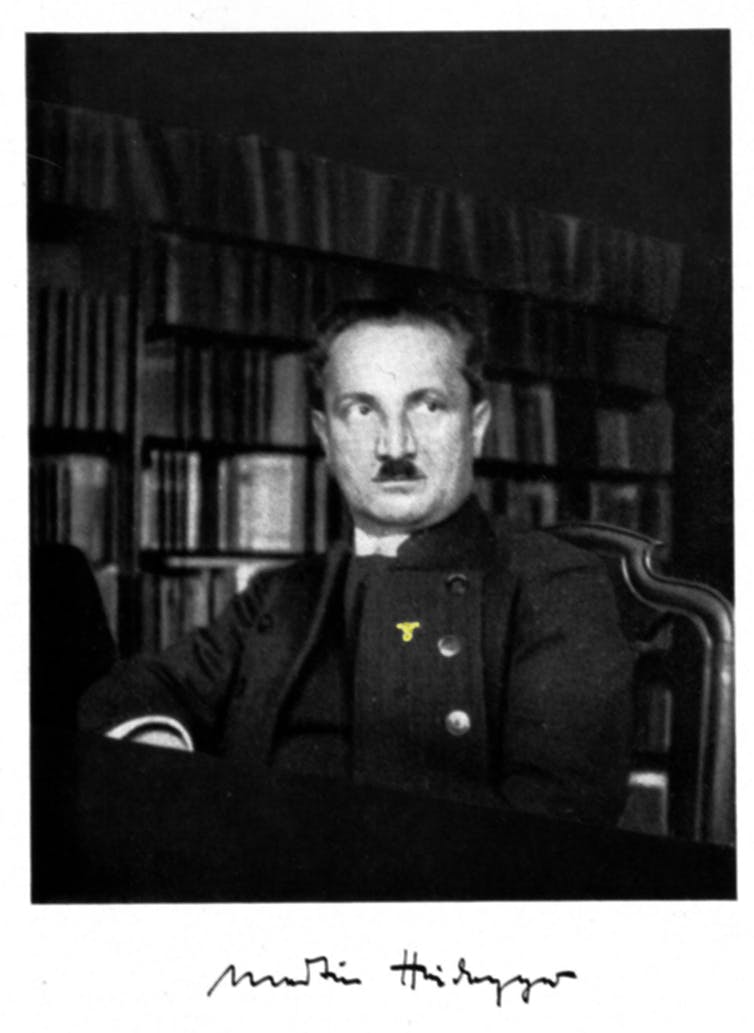 Martin Heidegger, about the extent of whose Nazi engagement scholars continue to learn.
In the early 1930s, the philosopher had looked to Adolf Hitler and the National Socialists to enable not simply the renewal of a defeated, depleted and divided Germany. Heidegger had hoped that his own philosophy of Being could “lead the [new] leaders” and inspire a “second beginning” to Western thought and culture more widely.
At issue in the advent of Nazi rule, in the philosopher’s ponderings, was nothing short of a total “overcoming” of the modern world, in both its liberal-democratic and communist forms.
Heidegger’s post-war reception in the liberal nations has been predicated on an increasingly-untenable denial of the extent and significance of his Nazism.
Alexander Dugin is unhindered by any residual liberal-democratic loyalties. He castigates much of this Western reception of Heidegger as an understandable but regrettable “caricature.”
For Dugin, it is precisely Heidegger’s translation into a philosophical idiom of many leading motifs of the reactionary European milieu that legitimised Nazism’s rise, which makes him essential reading today—at least for thoughtful Russians.
Western philosophers have since Socrates mostly seen reason as the means to temper the passions, balancing their imperious demands against larger considerations. Reasoning of different kinds has also been cultivated by philosophers to enable people to discern the often obscure or hidden natures of things, and their causes.
For Dugin as for Heidegger, by contrast, rationality less uncovers the truth of things than uproots its adherents from the true sources of existential significance which reveal themselves through other, more primordial means.
Dugin for his part thus enthusiastically embraces Heidegger’s monolithic depiction of the course of Western culture after Socrates as one of unending decline, ending in today’s gilded but ‘nihilistic’ age.
“The contemporary West is universal, but in the way that decomposition and death are universal,” the Russian thinker ponders. “Heidegger saw the most profound form of this degeneracy in ‘Americanism’, which he thought of as ‘planetarism’ (today we would say ‘globalism’ and ‘globalization’).”
If the tenor of these sayings already sounds as much prophetic as philosophical, this is not by chance. For Dugin, “Heidegger is … an eschatological figure, … the final interpreter … of the deepest and most enigmatic themes of world philosophy and the creator of a radically new thinking.”
This radically new thinking saw Heidegger postulate, on the basis of an alleged linguistic connection between modern German and the preclassical Greek, that a second, postmodern beginning of the West could spring only from the German volk, its leaders, thinker(s) and poets.
Heidegger’s Germanism might then seem to pose a sizeable problem for a Russian ethno-nationalist like Dugin. But the latter’s fidelity to Heidegger sees him proposing to carry the German thinker’s anti-modernist project forwards, by relocating it on different “Indo-European”, Slavic or Russian soil.
For Dugin, the “putrefaction” of the West diagnosed by Heidegger meant that Nazism could not break out from modernity. One needed to look further East: to the untapped telluric riches of the Russian narodi (very roughly, “people”) and its language. Dugin’s post-Heideggerian package even comes complete with a proposed reanimation of an idealised, specifically Russian antiquity:
Perhaps it is the very time to take part in the process of real philosophizing and to unseal the virgin treasure of Slavic, Russian speech for the creation of new meanings and new intellectual horizons, based on newly interpreted [or “comprehended”] Russian antiquity.
What Russia needs, says Dugin, is a “genuine, true, radically revolutionary and consistent, fascist fascism.” Its horizon is nothing less than what political theorist Eric Voegelin called the “immanentizing of the eschaton”. As Dugin directly enjoins us:
The end times and the eschatological meaning of politics will not realize themselves on their own. We will wait for the end in vain … If the Fourth Political Practice is not able to realize the end of times, then it would be invalid. The end of days should come, but it will not come by itself. This is a task, it is not a certainty. It is an active metaphysics. It is a practice.
From the end of the world to Eurasianism and back again
As unlikely as it may sound, then, Dugin’s prophetic prognostications about bringing on the end of the world have practical geopolitical corollaries.
If Dugin has influenced on the military elites surrounding Putin, indeed, it is not primarily based on his Russian refitting of the recondite motifs of the German conservative revolutionaries. It is largely on the basis of Dugin’s 1997 work, The Foundation of Geopolitics.
According to both Foreign Policy and the thinker himself, The Foundation of Geopolitics is required reading at Russian military academies.
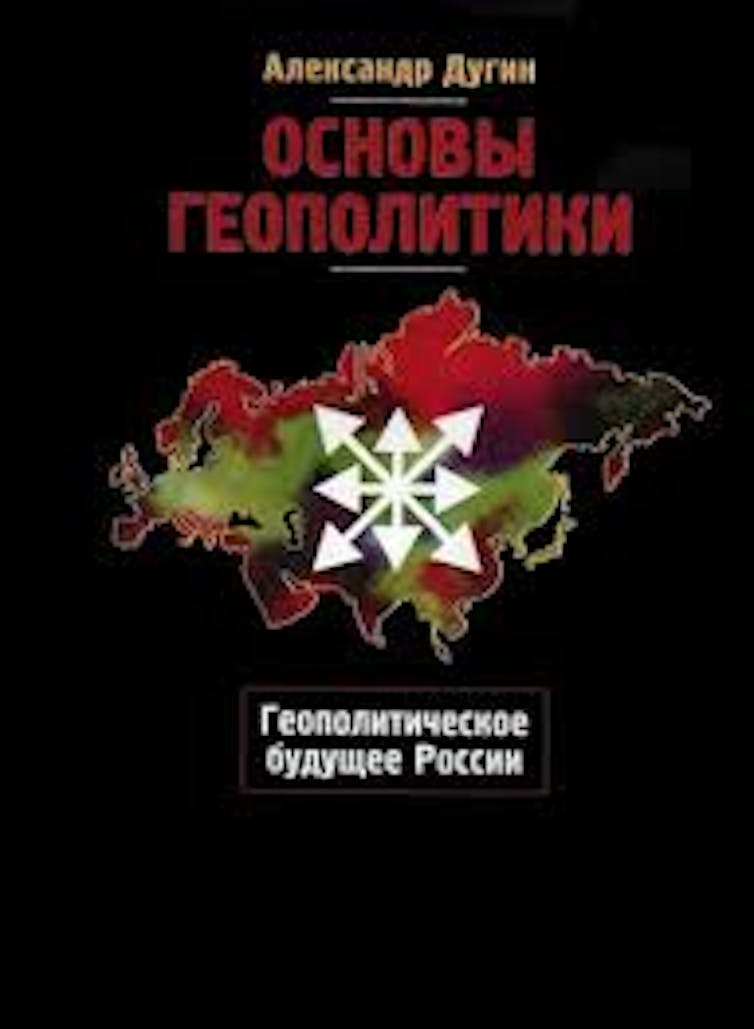 Dugin s Foundations of Geopolitics a blueprint for a new Russian imperialism.
The book sets out a vast vision of a future, land-based Eurasian bloc. This empire will be led by “ethnic Russians” and span all the nations from Dublin to Vladisvostok.
“The repudiation of the empire-building function,” Dugin warns his fellows, “would signify the end of the Russian people as a … civilizational phenomenon. Such a repudiation would be tantamount to national suicide”.
In an evocative choice of words, Dugin thus proposes the formation of three “axes” between Moscow-Berlin, Moscow-Tokyo, and Moscow-Teheran.
The means whereby such axes should be created are not necessarily military. Dugin rather calls for a combination of subversion and disinformation by the Russian special services (as above), the strategic use of Russia’s natural resources (notably, gas and oil), and the destabilisation of the American-led global order.
Within Europe, Dugin advises that:
[t]he task of Moscow is to tear Europe away from the control of the U.S. (NATO), to assist European unification, and to strengthen ties with Central Europe under the aegis of the fundamental external axis Moscow-Berlin.
Readers can see here why Dugin might have warmed to Mr Trump’s petering 2016 promises to shelve NATO, leaving aside any alleged philosopher’s love for the ‘real’, anti-liberal America.
The fact that liberal-democratic nations like Germany, France or Japan might seem unlikely to assume their roles in Dugin’s Russian-led Eurasian empire is an obstacle, not a roadblock. These nations must be prodded into becoming less liberal, and less bound to their cross-Atlantic ally.
“In Germany and France,” Dugin advises, “there is a firm anti-Atlanticist tradition …” This tradition is embodied in ethno-nationalist movements like Marine Le Pen’s Front Nationale, whose cause Dugin urges Russia to promote by all means.
Readers can see here a script for the alleged Russian interference in now-President Macron’s 2017 election campaign, leaving aside any newfound love of the philosopher for a ‘real’, non-republican France.
Besides, in another leitmotif of the far Right, “the principle of a common enemy” should be played upon to cement new Eurasian alliances.
At the basis of Dugin’s geopolitical thought, that is, we find a further metapolitical mythology. This time it is drawn less from Martin Heidegger than kindred thinkers like Karl Haushofer, Carl Schmitt, and Arthur Moeller van den Bruck.
According to this mythology, all human history has involved a primordial, nigh-Manichean conflict between sea-faring civilizations—which are characteristically more open, but also expansionist and dynamic—and more closed, existentially “rooted”, land-based narodi.
The forces of the former Dugin calls “Atlanticist”, and associates today with the US and the UK (America’s “extraterritorial floating base”). The rightful champion of the forces of the latter, called upon presently to cast down “Atlanticism” in the coming global struggle which will end the world as we know it, is of course Mr Putin’s revitalised Russia.
When the Cause is so Great, buying the odd deceptive Facebook advertisement in roubles, or hacking the odd Democratic email account is very small fare indeed.
“Carthage must be destroyed”?
But do Vladimir Putin and his senior aides buy into the tenets of Alexander Dugin’s extraordinary vision - one which seems to have proven prophetic at least about suspected Russian interference in several recent Western elections?
This is less clear.
With characteristic moderation, the thinker himself celebrated Mr Putin’s November 2000 claim that “Russia has always perceived of itself as a Eurasian country.” This was, for the philosopher, nothing less than “an epochal, grandiose revolutionary admission which, in general, changes everything … There will be a Eurasian millennium.”
However that may be, viewers of the extraordinary 2015-16 interviews between Mr Putin and filmmaker Oliver Stone might have been surprised at how, when describing the staunchly anti-Russian, American Senator John McCain, the Russian President evoked a celebrated episode from the West’s classical past.
McCain was like the Roman Senator Cato the Elder, Putin said. For Cato would finish every speech by declaiming grimly that Carthage, Rome’s seafaring rival, “must be destroyed”.
This discordant moment stuck with me. I only later discovered that Cato’s “Carthago delenda est” is not simply a saying that readers can find repeated on many a Right-wing blog or ‘under the line’ on web-published articles today—where it prompts us to picture America as the new Carthage, set against Russia as the incipient new Rome.
It is also the epigraph of the Eurasianist website geopolitica.ru, on which Alexander Dugin’s “guidelines”, “directives”, lectures and interviews can be openly viewed.
Authors: Matthew Sharpe, Associate Professor in Philosophy, Deakin University
Read more http://theconversation.com/alexander-dugin-eurasianism-and-the-american-election-87367


 Daily Bulletin


