

Three reasons why the decisions of Joyce and Nash may be difficult to challenge
- Written by: Anne Twomey, Professor of Constitutional Law, University of Sydney
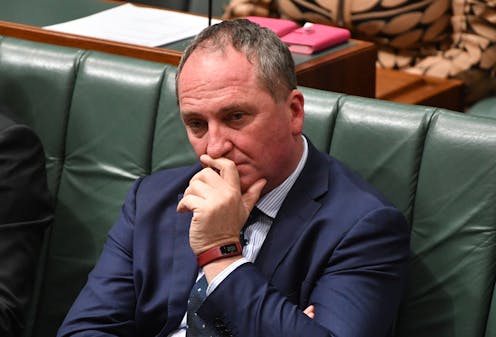
Now that Barnaby Joyce, Fiona Nash and three other senators have been declared invalidly elected, questions are being asked about whether close parliamentary votes still stand and decisions made by the disqualified ministers can be challenged.
As the issue has not arisen in Australia before, there is no direct judicial authority on the question. We can, however, draw some reasonable conclusions based on how the courts have dealt with analogous issues in the past.
Parliamentary votes
Over the years, quite a few MPs have been disqualified at both the Commonwealth and state levels, but no-one has ever challenged the validity of a law passed in reliance on the vote of a disqualified member.
The only Australian authority is the 1907 case of Vardon v O’Loghlin. In this case, Chief Justice Griffith and Justices Barton and Higgins stated that even though a senator was disqualified at the time of his election, “the proceedings of the Senate as a House of Parliament are not invalidated by the presence of a senator without title”.
Justice Isaacs added that while Vardon had not been validly elected, the “validity of his public acts as a senator prior to the declaration is, of course, unaffected”.
Although neither statement directly addressed the effectiveness of his vote in the house, the case has been taken as sufficient authority to suggest that past votes will stand, even though disqualified senators or MPs participated in them.
This view is supported by the general principle that a court will not interfere in the internal proceedings of parliament. Although courts will enforce “manner and form” requirements for a special majority to pass a particular type of bill, the courts will not look behind the parliamentary record of the votes, even when those records may be inaccurate.
If, therefore, anyone challenged the validity of a law on the basis that it was not passed by a majority of qualified MPs, it is most unlikely that a court would be prepared to hear the case and strike down the law.
Ministerial decisions
Section 64 of the Constitution provides that “no minister of state shall hold office for a longer period than three months unless he is or becomes a senator or a member of the House of Representatives”.
During the entirety of Joyce’s ministerial career – starting on September 18, 2013 – he was not validly a member of either house. Similarly, Nash was not validly a senator at any time during which she was assistant minister from 2013 and minister from 2015.
When each was first sworn in as a minister, and sworn in again after the July 2016 election, the three-month period would have run. But, after that, both Joyce and Nash would have been ministers invalidly.
Further reading: If High Court decides against ministers with dual citizenship, could their decisions in office be challenged?
Does this mean that the decisions they made during this period could be challenged? There are three important factors at play.
Standing
First, a person would have to have legal standing to bring a challenge. This means they would have to have a special interest in the decision, above that of the rest of the community, which goes beyond a mere intellectual or emotional interest in the matter.
For example, if the property or financial interests of a person are affected by a decision, then they may have standing.
There is uncertainty as to whether simply being an MP is enough to gain standing to challenge government decisions. This issue was raised in the case concerning the postal survey on same-sex marriage, but the High Court did not need to resolve it because the challenge failed anyway.
So, there is doubt as to whether opposition MPs would have the standing to challenge any decisions made by Nash or Joyce in their ministerial capacities.
The source of the decision-making power
Second, the decision would have to be one made by Joyce or Nash in accordance with a power conferred upon them as ministers by statute or another legal source.
The waters have been muddied by statements concerning the fact that ministerial decisions are often approved by cabinet.
The cabinet is a policymaking body. It does not have the power to give legal effect to its decisions. This is done through other bodies or persons. A decision to enact legislation is given effect by parliament. Many other decisions concerning appointments, the compulsory acquisition of property, and the making of regulations are given effect by the governor-general through the Federal Executive Council.
It is only those decisions made directly by Joyce or Nash on the basis that they were exercising a power conferred upon them in their capacity as a minister that could be challenged.
Timing and the de facto officer doctrine
The third issue concerns timing and the possible application of the “de facto officer” doctrine.
This is a common law doctrine that protects the validity of decisions made by a person who is clothed with the authority of an office, but is later found not to have been validly appointed to it.
If that person acts under the “colour” of the office, there is public acceptance of that authority and the government holds out that person as having the authority to exercise that power, then the doctrine is likely to give a measure of protection to exercises of that power, if they were otherwise validly made.
Further reading: The High Court sticks to the letter of the law on the ‘citizenship seven’
The doctrine is directed at protecting those who rely on the decisions in good faith, rather than protecting the decision-maker. The policy behind it is to avoid the chaos that might ensue if decisions are invalidated due to a defect in the appointment of the decision-maker.
For example, when the governor-general of the Solomon Islands was held to have been invalidly appointed as he did not meet the required qualifications, the High Court of the Solomon Islands relied on the de facto officer doctrine to uphold his actions, including the dissolution of parliament and the appointment of ministers.
In 1938, Owen Dixon wrote that there “are questions outstanding as to the limits of this principle or the conditions controlling its operation”. That remains true today. One of those questions is whether the doctrine operates when the disqualification of the office-holder is a result of a breach of the Constitution.
In 2000, the High Court unanimously held in Bond v The Queen that a question arising under the Constitution as to the powers exercisable by an officer of the Commonwealth “cannot be resolved by ignoring the alleged want of power on some basis of colourable or ostensible authority”.
The doctrine also ceases to apply when the mantle of authority is removed by the public expression of doubt as to the validity of the office of the decision-maker.
Accordingly, the decisions made by Joyce and Nash that would be most vulnerable to challenge are those made after they were referred to the Court of Disputed Returns, due to doubts as to the validity of their election to parliament. One would expect, however, that they were sufficiently prudent not to make contentious decisions during that period.
Where does this leave us?
It is most unlikely that any challenge to a law on the basis of votes in parliament by disqualified members would succeed in the courts.
There is a greater risk that a challenge to a ministerial decision, made by a disqualified MP when he or she did not validly hold a ministerial office, could be successfully challenged. But this would depend upon the action being brought by individuals or corporations that have a sufficient interest to attract standing and whether the decision was actually made by the disqualified minister (as opposed to another body, such as the Federal Executive Council).
It would also depend on the extent to which the de facto officers doctrine applied.
It may be the case that no decisions fall into this category, despite the feverish speculation. We can only wait and see.
Authors: Anne Twomey, Professor of Constitutional Law, University of Sydney


 Daily Bulletin


