

Is there such a thing as a 'true self'?
- Written by: Nick Haslam, Professor of Psychology, University of Melbourne
“To thine own self be true”, the saying goes. It is often taken as sage advice, a remnant scrap of Elizabethan life coaching, but Shakespeare may have meant it to be heard as a stale platitude. He puts it in the mouth of Polonius, a windbag given to hackneyed pronouncements. But what is this true self to which we should be true?
The idea that we have true selves has been contentious. For every bright-eyed humanist urging us to shed our social conditioning and discover the authentic self within there is a jaundiced philosopher telling us it is an illusion. Jean-Paul Sartre wrote that he “had no true self” and his self was in fact “an empty palace of mirrors”.
Whether the true self is fact or fiction, many people believe in it. Those beliefs have been explored by a number of social psychologists and “experimental philosophers”. Their work has begun to clarify why the idea of the true self matters, regardless of whether it is real.
True self beliefs
A key finding of this research, reviewed in a recent article, is that people don’t merely develop a sense of self that is distinct from others and the external world – a distinction between what is psychologically inner versus outer. They also readily distinguish between those aspects of the self that are central and those that are peripheral.
The more central elements of the self are understood variously as being relatively deep, authentic, intrinsic or essential. My own group’s research indicates that they are the parts of our selves that we see as the most defining of who we are and the ones that endure over time. They compose our personal identity.
Research on people’s true self beliefs finds that these central aspects of the self tend to be moral in nature. They involve our values and virtues more than our other mental capacities, personality traits or bodily features. The true self is fundamentally a good self.
Losing the true self
One intriguing demonstration of this finding comes from a 2015 study that examined caregivers’ perceptions of family members suffering from three neurodegenerative diseases: Alzheimer’s disease, amyotrophic lateral sclerosis and frontotemporal dementia (FTD). The first two of these diseases primarily impair memory and voluntary movement, respectively. FTD, in contrast, leads to morally relevant impairments such as socially inappropriate behaviour, loss of inhibition and diminished empathy.
The three groups of patients were disabled to similar degrees overall. However caregivers of FTD patients were much more likely to report that their family member seemed deeply changed since the onset of their disease, as if they were a different person underneath. Caregivers were more likely to think they no longer really knew their FTD-suffering relatives, who now seemed like strangers.
Identity appeared to be most disrupted by alterations in morality, much more than deteriorations of memory or movement. The apparent loss of the FTD patient’s true self revealed by their moral deficits often profoundly impaired their relationship with their carer.
The true self is a good self
People view the true self as positive in a general way, not merely as morally good. They believe their deep inner selves have overwhelmingly desirable features even if their real present selves are flawed. In the words of one large green philosopher (Shrek): “Onions have layers. Ogres have layers.” And the inner layers of ogres are less monstrous than the outer ones.
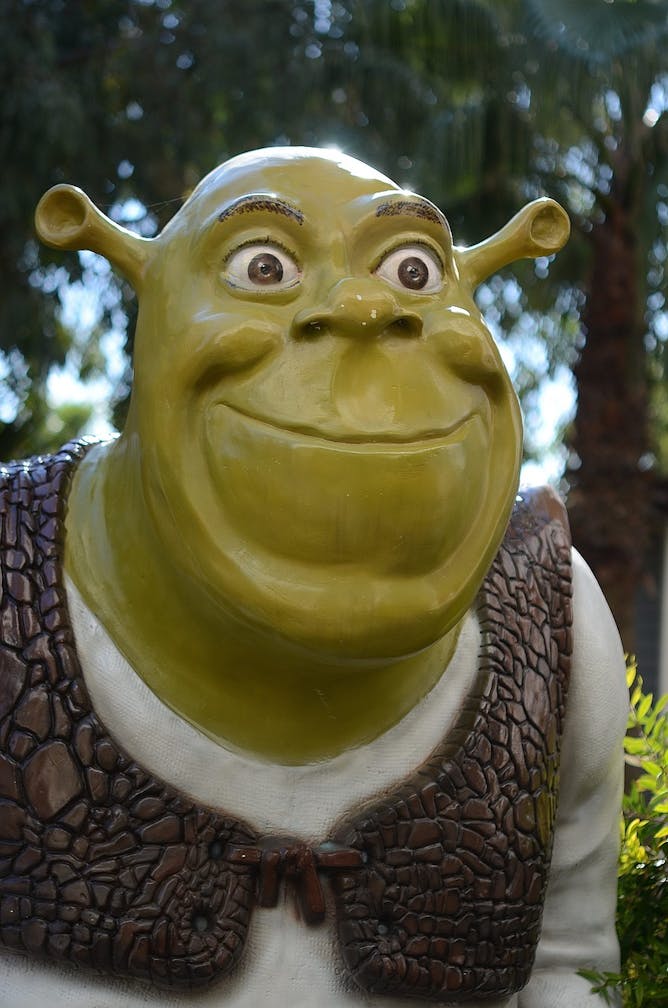 Shrek claimed that ogres had layers, just like onions.
pixabay
Shrek claimed that ogres had layers, just like onions.
pixabay
Intuitively we might expect that people’s beliefs about their true selves would differ depending on their personalities or cultural backgrounds. People with a bleaker outlook on life might hold a greyer view of their true self than those whose dispositions are sunny. Equally, people from cultures that do not celebrate the uniqueness of the person to the same extent as individualistic Americans or Australians might hold less relentlessly positive beliefs about the true self.
Surprisingly neither of these claims appears to be true. One study showed that unsociable people were just as likely as others to hold very positive views of their true self. It also found that people from three collectivist cultures – Colombians, Singaporeans and the famously gloomy Russians – were just as likely as Americans to believe the true self to be good.
Discovering the true self
One implication of the belief that the true self is good is that we respond differently to positive and negative changes in people’s behaviour. Studies suggest that when people undergo positive change we tend to see it as revealing their true self. Self-improvement is viewed as discovering who one truly is. Negative change, in contrast, is seen as a corruption or obscuring of the true self. It is in the nature of caterpillars to become butterflies, not the reverse.
The idea of the true self might seem slippery and nebulous, but it may have important implications. Believing that deep down we are fundamentally good may anchor a sense of personal identity and self worth. Pursuing goals that are intrinsic to our selves may lead to greater well-being than pursuing those that are more peripheral, such as materialistic desires.
Similarly, holding a belief that other people have morally good true selves may be a crucial foundation of interpersonal trust. This belief in a benevolent social world may be a basic assumption which, when traumatically violated, can have dire psychological consequences.
Deep thinkers will question whether the idea of an authentic true self passes philosophical muster. But even if it is an illusion, it may be a useful one.
Authors: Nick Haslam, Professor of Psychology, University of Melbourne
Read more http://theconversation.com/is-there-such-a-thing-as-a-true-self-81817


 Daily Bulletin


