

Platform co-ops offer urban communities a bigger say in their lives
- Written by: Liam Magee, Senior Research Fellow, Digital Media, Western Sydney University
This is one of a series of articles to coincide with the 2017 Ecocity World Summit in Melbourne.
Digital platform companies like Facebook, Uber and Google regulate our likes, updates, schedules, locations, photos, jobs and trips. In the “world of the platform”, the power and control of these proprietary systems commodify our habits, attitudes and movements. These platforms inundate our lives in many ways, delivering a daily deluge of data and applications.
Despite recent financial penalties and calls for regulatory oversight, the growth and reach of these platforms show few signs of slowing. Today, Facebook’s active user community of more than 2 billion is greater than that of any country.
In some cities, the statistic of “active Facebook users” seems to be a proxy for the urban population itself. Digital marketing company Hootsuite recently reported Bangkok registered 30 million such users, followed by Dhaka and Jakarta, with 22 million each.
While these counts include confounds – duplicate, dummy and visitor accounts – they register the daunting pervasiveness of Facebook in South and South-East Asian cities, as well as the scale of their digital populations.
This produces complex social effects. Patterns of inclusion and exclusion are both perpetuated and manipulated into new forms. Distinctions between urban infrastructures and new media platforms are rapidly collapsing.
Creating alternative platforms
The concerning power of platform companies has led some to seek alternative models, such as platform co-operatives.
Building on the successes of open source software, the co-operative model creates digital platforms in ways that directly benefit creators, members and users. If, for example, a platform co-operative sold advertising, any proceeds might be distributed equitably to its members, rather than to a much smaller group of company shareholders.
Such co-operatives are examples of new organisational forms that look to overcome inequities in the world’s megacities. We recently participated in an example, a Dhaka-based project called Kolorob, that has developed a small-scale platform for mapping services in informal settlements.
Kolorob has built a custom Android application and database of schools, legal centres, health clinics, government offices and commercial businesses in the northern district of Mirpur. Save the Children in Bangladesh funds and operates the project.
Kolorob aims to transform the lives of poor urban dwellers by improving their access to local services.The need for directories and maps of services is growing. Digital maps deliver real-time information through front-end, consumer-focused services in global cities. Google Maps, for example, offers reviews of businesses, traffic updates and even warnings on parking availability in 25 US cities.
Meanwhile, informal settlements in many megacities lack basic information on essential services. These are expensive to map, and their communities represent limited markets for advertising and other services.
As spatial information tools to manage megacities increase, citizen participation and collaborative decision-making can help meet the need for access to services while deciphering the noisy complexity of unplanned urban settlements.
The Kolorob project began by recruiting young people to map services into OpenStreetMap, a freely accessible global database of locations. Using their local contacts, project staff collaborated with communities to co-ordinate the mapping of more than 2,000 local businesses and services.
To search and navigate the database, local developers built an Android app that has been downloaded more than 10,000 times.
Exploring co-operatives’ potential
We reported on the aims and progress of the project in 2016. We are now interested in how crowdfunding, volunteerism, hybrid business models, local partnerships and grant applications can sustain the project’s outcomes.
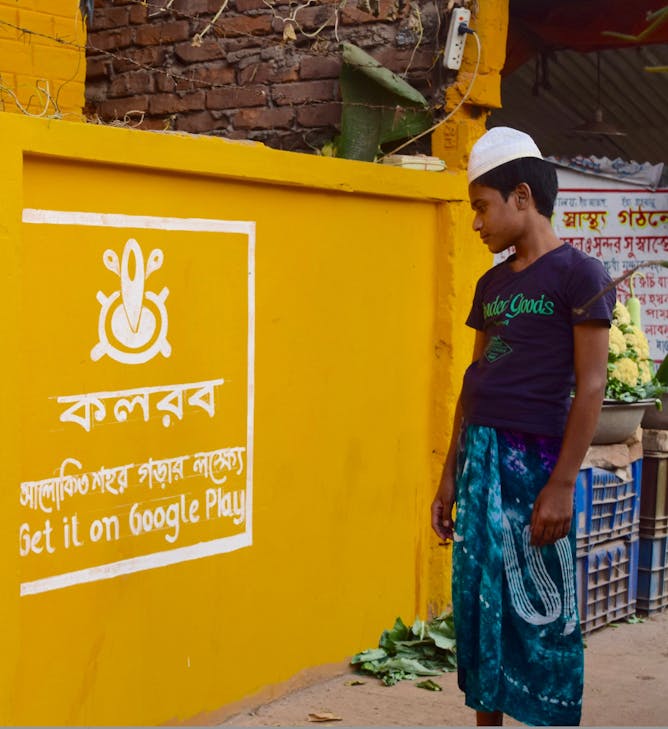 How can co-operative community platforms survive and compete against the global corporate giants?
www.kolorob.info
How can co-operative community platforms survive and compete against the global corporate giants?
www.kolorob.info
At stake are wider questions. Can examples of platform co-operativism – community-led, owned and operated digital infrastructure – overcome urban information gaps? And how, in doing so, might they sustain themselves to compete against corporate alternatives?
These stakes involve long-term networks and commitments, well beyond the scope of NGO funding cycles. With the rise of an “innovation for impact” agenda in the NGO sector, agility, cross-sectoral collaboration and “shared value” partnerships with the private sector become essential components of this new orientation.
As community co-operatives begin to establish themselves as stakeholders in the digital infrastructure of cities, traditional project evaluation needs to move from the language of “success or failure” to a more calibrated understanding of their short and long-term effects.
Kolorob has highlighted some of these: greater participant learning, emergent citizen science, and political literacy and representation.
There are risks in ceding complete control of our cities’ digital lives to market or state interests. These include not only the monopolisation of information, but a shift in our roles from active citizens to the relative passivity implied in the term “user”.
Despite close scrutiny of the social erosion associated with “platform capitalism”, these platforms continue to proliferate. They already influence – in complex ways – city infrastructure developments and prospects for wider urban participation.
We need to build and sustain urban platforms that are no longer simply lock-in and proprietary. Instead, we should embrace open source software, participatory design and a more inclusive distribution of proceeds.
Even without fully realising their potential, platform co-operatives and allied models offer us new ways to think about who does – and who ought to – benefit from the labour and data we invest in city and digital infrastructure.
You can read other articles in the series here. The Ecocity World Summit is being hosted by the University of Melbourne, Western Sydney University, the Victorian government and the City of Melbourne in Melbourne from July 12-14.
Authors: Liam Magee, Senior Research Fellow, Digital Media, Western Sydney University
Read more http://theconversation.com/platform-co-ops-offer-urban-communities-a-bigger-say-in-their-lives-80675


 Daily Bulletin


