

Indigenous girls missing school during their periods: the state of hygiene in remote Australia
- Written by: Nina Lansbury Hall, Lecturer, Environmental Health Unit, School of Public Health, The University of Queensland
Basic sanitary products can be unaffordable, unavailable or too shameful to buy for girls and women in Australia’s remote Indigenous communities. A report released today, containing interviews with organisations working in multiple remote Australian communities, reveals anecdotal evidence girls are missing school during their periods.
The interviews indicate women and girls may use toilet paper, socks and rags instead of expensive sanitary products, which were reported to cost A$10 a packet. Girls and women might not buy the items if a male relative is serving in the shop. Underwear is expensive, and there are some cultural taboos around washing and drying underwear in a visible place.
A representative from one of the 17 organisations interviewed told us:
they don’t want to change [pads] at school … [at schools] often there’s no soap, … there are often no rubbish bins or there’s one rubbish bin outside the toilet, which is really embarrassing to use. In terms of the infrastructure that we can put in place to help girls, it’s rubbish bins, it’s soap, it’s running water and toilets that flush, and privacy.
Complicating the picture might be the difficulty of changing or bathing in privacy because the toilet or shower might not work, or bathroom door might not lock. Girls don’t always receive traditional or conventional education about their bodily changes and functions, and how to manage menstruation hygienically. Contraceptive implants, which often cause disruptions in the monthly cycle, can lead to girls being unfamiliar with their cycle, particularly those who had them inserted before they began menstruating.
The report on remote communities in mainland Australia, conducted by the University of Queensland in partnership with WaterAid, has been released to coincide with NAIDOC (National Aboriginal and Islander Day Observance Committee) Week. We found local health services had a limited capacity to respond to these challenges due to the focus on higher-priority diseases, such as rheumatic heart disease and diabetes. Perpetuating the situation is non-functioning hardware (toilets and taps) as a result of poor-quality materials, lack of maintenance and overcrowding in homes.
Australia is a signatory to the United Nations Sustainable Development Goals, which include targets for access to adequate and equitable sanitation and hygiene for all; as well as ending open defecation and paying special attention to the needs of women and girls.
Access to sanitary items, water and washing facilities, as well as education about menstruation are basic human rights. Water and toilets are essential for women to manage menstruation. Yet it’s shocking to find not all Australians enjoying the same access to these fundamentals.
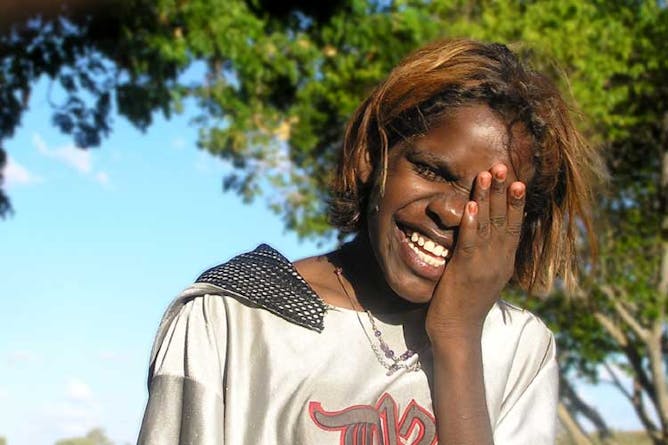 Indigenous Australian girls are being denied basic human rights.
Kristy/Flickr, CC BY
Indigenous Australian girls are being denied basic human rights.
Kristy/Flickr, CC BY
The situation isn’t difficult to address, but the connections between the various aspects are crucial to understand first. The logistical, financial, cultural and educational barriers are similar to those experienced in developing countries around the world. These are covered by UNICEF under its menstrual hygiene management campaigns.
In Australia, programs are already under way that address pieces of this puzzle. The community group Central Australian Youth Link-Up Service has created a practical toolkit aimed at developing more “girl friendly” spaces. These include girls having access to privacy, toilet paper, running water and informed staff who are conscious of the problems.
The service works with clinics, local youth programs and schools to ensure access to information, pads, underwear and safe disposal bins. One teacher at a school in central Australia’s Barkly region told the service:
I have tampons and pads, and undies available for the girls in the classroom, and I have a key which some girls get from me so they can get pads or tampons from the cabinet in the toilet.
The NSW government’s Housing for Health program has repaired taps, toilets and showers in almost 3,500 houses, to support health living practices. The NSW Aboriginal Land Council has partnered with the state government to provide water and sewerage infrastructure operation and maintenance to 61 communities. This is funded with A$200 million for 25 years.
The Queensland government is building new homes and upgrading others in 34 remote communities.
 There are many programs already in place in Australia addressing hygiene issues in remote communities.
CAYLUS growing up painting, Author provided (No reuse)
There are many programs already in place in Australia addressing hygiene issues in remote communities.
CAYLUS growing up painting, Author provided (No reuse)
These and other programs need to work together to address the bigger social and economic picture, including the links between overcrowding, housing infrastructure and health living practices. These operate in the context of cultural, social and political imperatives of Aboriginal people who wish to live on country, which can mean living very remotely. There also remains a traumatic legacy from colonisation that continues to impact these communities.
The interviewees in our report stated it was time to raise our expectations for the standard of services in all Australian locations. One interviewee said:
Non-Indigenous people who go out to communities quickly lower their expectations to what’s the prevailing norm … You’re in Australia … the benchmark [should be] an urban clinic in Darwin or Sydney.
We will celebrate Australian Indigenous culture during this year’s NAIDOC Week and continue to work towards the UN’s Sustainable Development Goals for water and hygiene. When doing so, let’s act to ensure girls have access to affordable sanitary items, girl-friendly toilets and washing facilities. This will enable them to manage their monthly periods hygienically, privately and with dignity.
This article was co-authored with Chelsea Huggett, WaterAid Australia, and Leyla Iten, Central Australian Youth Link Up Service.
Authors: Nina Lansbury Hall, Lecturer, Environmental Health Unit, School of Public Health, The University of Queensland


 Daily Bulletin


