

Energy solutions but weak on climate – experts react to the Finkel Review
- Written by: Hugh Saddler, Honorary Associate Professor, Centre for Climate Economics and Policy, Australian National University
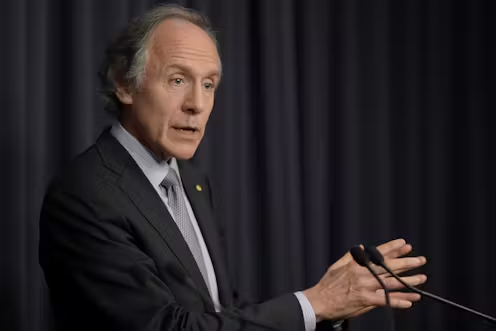
The keenly anticipated Finkel Review, commissioned in the wake of last year’s South Australian blackout, has made a range of recommendations aimed at delivering a reliable, secure and sustainable National Electricity Market.
Among the proposals is a new Clean Energy Target to boost investment in low-carbon electricity generation, as well as moves to require high-emitting power stations to give three years’ notice before shutting down.
Below, our experts react to the measures.
“Security and reliability are first”
Hugh Saddler, Honorary Associate Professor, Australian National University
With so much focus on the design of a mechanism to support a shift towards lower-emissions generation, it is easy to forget that the primary purpose of the Review, commissioned following the “system black” event in South Australia on September 28, 2016, was “to develop a national reform blueprint to maintain energy security and reliability”. It is thus appropriate that security and reliability are the first topics to be addressed in the main body of the report.
System security is defined as the ability of the system to tolerate disturbances. Maintaining security requires the system to be able to prevent very high rates of change of frequency. At present the system has no explicit mechanism for doing this, but relies implicitly on the inertia provided, effectively as a free service, by existing large thermal generators.
The report recommends a series of regulatory energy security obligations to provide this service by various additional means, falling on the transmission network service providers in each of the five NEM regions (states), and also on all new generators connecting to the system.
System reliability is defined as the ability of the system to meet consumer demand at all times. In the old system, this is achieved by “dispatchable” generators, meaning coal and gas generators that can vary their output as required to meet demand.
In the new system, with large amounts of variable wind and solar generation, other supply sources are needed to meet demand at times of low wind speed and/or lack of sun – that is, to act as complements to wind and solar. Existing hydro and open-cycle gas turbine generators are ideally suited to this task, but with the growth in wind and solar generation, this capacity will very soon be insufficient for the task across the NEM (and is already insufficient in SA).
The Report recommends what it calls a Generator Reliability Obligation, which would be triggered whenever the proportion of dispatchable generation (which could include batteries and other forms of storage) in a region is falling towards a predetermined minimum acceptable level. The obligation would fall on all new renewable generators wishing to connect thereafter and, in the words of the Report “would not need to be located on site, and could utilise economies of scale” through multiple renewable generation projects “pairing” with “one new large-scale battery of gas fired generation project for example”.
If implemented, this recommendation would seem certain to greatly complicate, slow down and add to the administrative overhead cost of building new renewable generation. It would involve putting together a consortium of multiple parties with potentially differing objectives and who would otherwise be competing with one another in the wholesale electricity market.
A far better approach would be to recognise that dispatchable generation provides a distinct and more valuable product than non-dispatchable generation. There should be a separate market mechanism, possibly based on a contracting approach, to provide this service. If well designed, this would automatically ensure that economies of scale, as may be realised by pumped hydro storage, for example, would be captured. This approach would be far more economically efficient, and thus less costly to electricity consumers, than the messy processes required under the Report’s obligation approach.
“Energy efficiency is effectively handballed to governments”
Alan Pears, Senior Industry Fellow, RMIT University
The Review’s approach to the demand side is very focused. Demand response, the capacity to reduce demand at times of extreme pressure on the supply system, is addressed thoroughly. The past under-utilisation of this approach is acknowledged, and the actions of the Australian Energy Market Operator (AEMO) intended to capture some of its potential in time for next summer are outlined.
However, the deep cultural problems within the Australian Energy Markets Commission regarding demand response are not tackled. Instead, the AEMC is asked (yet again) to develop facilitation mechanisms in the wholesale market by mid-2018.
Energy efficiency is effectively handballed to governments. After making some positive comments about its valuable roles, recommendation 6.10 states that governments “should accelerate the roll out of broader energy efficiency measures to complement the reforms recommended in this Review”.
This is a disappointing outcome, given the enormous untapped potential of energy markets to drive effective energy efficiency improvement. But it clearly shows governments that they have to drive energy-efficiency initiatives unless they instruct energy market participants to act.
“It follows the wrong path on greenhouse emissions”
David Karoly, Professor of Atmospheric Science, University of Melbourne and Member, Climate Change Authority
The Finkel Review says many sensible things about ways to improve the security and reliability of Australia’s electricity sector. However, it follows completely the wrong path in what it says about lower greenhouse emissions from the electricity sector and Australia’s commitments under the Paris Agreement. This is disappointing, as Alan Finkel is Australia’s Chief Scientist and a member of the Climate Change Authority.
All economy-wide modelling shows that the electricity sector must do a larger share of future emissions reductions than other sectors, because there are easier and cheaper solutions for reducing emissions in that sector. However, this review’s vision is for “emissions reduced by 28% below 2005 levels by 2030” – exactly the same as Australia’s target under the Paris Agreement. It should be much more.
Australia’s commitments under the Paris Agreement are “to undertake ambitious efforts” to limit global warming “to well below 2℃ above pre-industrial levels”. The Targets Report from the Climate Change Authority in 2015 showed that this means Australia and the electricity sector must aim for zero emissions before 2050, not in the second half of the century, as suggested in the Finkel Review.
Authors: Hugh Saddler, Honorary Associate Professor, Centre for Climate Economics and Policy, Australian National University


 Daily Bulletin


