

Bob Dylan's Nobel speech: a splendidly eccentric performance
- Written by: David McCooey, Professor of Writing and Literature, Deakin University
When Bob Dylan was awarded the Nobel Prize for Literature in late 2016, it ruffled a few feathers. Characteristically, Dylan kept everyone guessing as to whether he would even accept the award. But after a suitably cryptic period of waiting, he did. And yesterday Dylan finally, and in the nick of time, undertook the one hurdle required to receive the $1 million associated with the prize: to give a speech within six months of the prize’s announcement. The speech, which was presented in written and audio form (but not in person in Sweden, as is customary) is marvellously Dylanesque in its oddness, and worthy of attention.
The recorded version of the speech presents Dylan’s old-timer delivery against the sonic backdrop of a jazzy, cocktail-bar piano. In a speech about Dylan’s musical and literary influences, this is almost comically inappropriate. True, it might have the utilitarian purpose of making it harder for musicians to sample Dylan’s spoken-word performance (and there are some moments that could sound great in the right musical context). Still, the style of the music seems deliberately eccentric.
But the words are the really eccentric thing about Dylan’s speech. He begins by promising to reflect on how his songs relate to literature, and for those who were critical of Dylan’s Nobel win, this cuts to the chase. But listeners are immediately informed (or warned) that this will happen in a “roundabout way”.
After a brief sketch of his musical lineage (Buddy Holly, Lead Belly, and folk music), Dylan moves on to literature. He name-checks a handful of classics — such as Don Quixote and Ivanhoe — which he describes as “typical grammar school reading”, and from there moves on to three books that have stuck with him: Herman Melville’s Moby Dick, Erich Maria Remarque’s All Quiet on the Western Front, and The Odyssey by Homer. Dylan’s long synopses of this seemingly random list of books makes up the bulk of his speech.
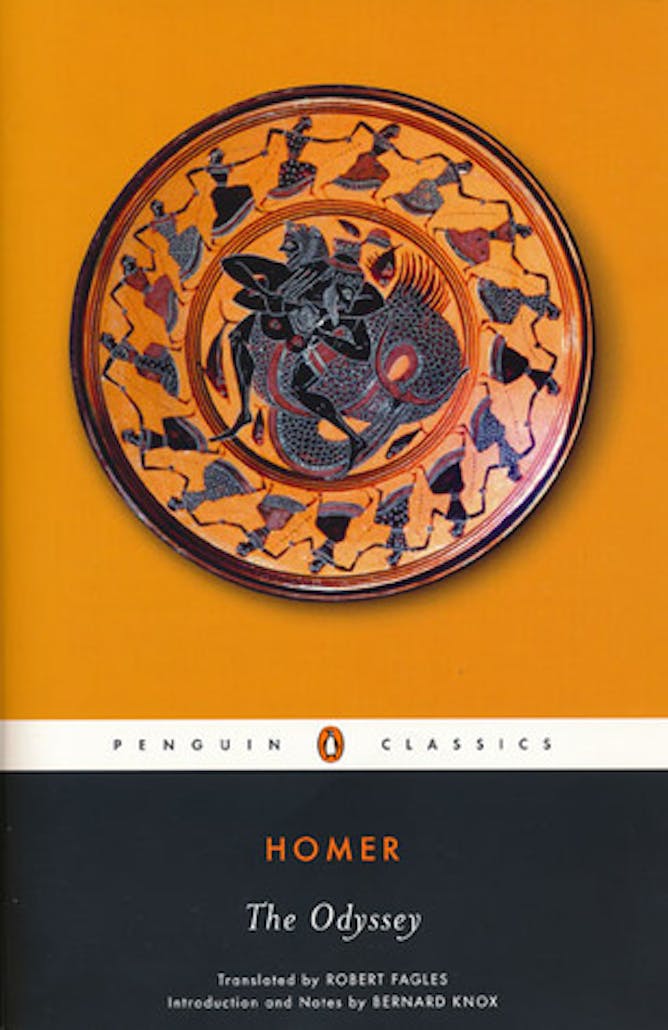 It is hard to know how seriously we should take Dylan’s retelling of these classics of Western literature, which, one might point out, are a long way from lyric poetry, the mode we might expect to hear about from a song writer. (While The Odyssey was written in verse, it is a narrative poem, and most English speakers would read prose translations of it.) Are we listening to redundant re-tellings of three old books, or do Dylan’s accounts offer allegories of the main themes in his own work? He does vaguely refer to the themes of his chosen books as being related to his songs, but the comparisons are rarely clear. The clearest link Dylan makes is between All Quiet on the Western Front and his anti-war songs (such as Masters of War).
Or are Dylan’s re-tellings in his speech bizarre revisionary prose poems? Are they literary performances in themselves, in which the author takes pre-existing works and fashions, in a quasi-improvisatory way, something altogether new? That is, after all, what Dylan has done throughout his songwriting career (as the title of Love and Theft, his 2001 album, suggests). As many critics have noted, for instance, the question-and-answer refrain of A Hard Rain’s a-Gonna Fall owes a debt to the English Ballad Lord Randall.
Just as with his singing, there is certainly something hypnotic at times about Dylan’s delivery in his Nobel speech. And his re-tellings are artful renderings, not really synopses at all, as seen, for instance, when Dylan compares himself with Odysseus, the homeward-bound hero of Homer’s Odyssey. When Dylan says of the hero that “courage won’t save him, but his trickery will”, it’s not just a good (and accurate) description of Odysseus - it could also be a masterpiece of micro self-portraiture.
It is hard to know how seriously we should take Dylan’s retelling of these classics of Western literature, which, one might point out, are a long way from lyric poetry, the mode we might expect to hear about from a song writer. (While The Odyssey was written in verse, it is a narrative poem, and most English speakers would read prose translations of it.) Are we listening to redundant re-tellings of three old books, or do Dylan’s accounts offer allegories of the main themes in his own work? He does vaguely refer to the themes of his chosen books as being related to his songs, but the comparisons are rarely clear. The clearest link Dylan makes is between All Quiet on the Western Front and his anti-war songs (such as Masters of War).
Or are Dylan’s re-tellings in his speech bizarre revisionary prose poems? Are they literary performances in themselves, in which the author takes pre-existing works and fashions, in a quasi-improvisatory way, something altogether new? That is, after all, what Dylan has done throughout his songwriting career (as the title of Love and Theft, his 2001 album, suggests). As many critics have noted, for instance, the question-and-answer refrain of A Hard Rain’s a-Gonna Fall owes a debt to the English Ballad Lord Randall.
Just as with his singing, there is certainly something hypnotic at times about Dylan’s delivery in his Nobel speech. And his re-tellings are artful renderings, not really synopses at all, as seen, for instance, when Dylan compares himself with Odysseus, the homeward-bound hero of Homer’s Odyssey. When Dylan says of the hero that “courage won’t save him, but his trickery will”, it’s not just a good (and accurate) description of Odysseus - it could also be a masterpiece of micro self-portraiture.
 A 4th Century BC pottery wine cup depicting Odysseus at sea on a raft of amphoras.
Ashmolean Museum/Wikimedia images
And then, in a quintessentially Dylanesque move, he pulls the rug from under us, to say that meaning in literature, in art generally, is not important. The only important things are if songs move you, and if they sound good. This appeal to the affective and aesthetic over the rational is, of course, a literary move. And, almost finally, he casually admits that “songs are unlike literature” after all.
In referring to the multimedia, performative nature of song, Dylan is of course correct. Songs aren’t like the books he’s been talking about. Except, of course, all poetry — the source of literature — was once performed orally, and sometimes it was accompanied by music.
The Swedish academy invoked the Ancient Greek poets Homer and Sappho when awarding Dylan his Nobel prize, and Dylan appropriately ends his acceptance speech with a reference to Homeric invocation — the poet’s request at the beginning of his epic poems for the muse to inspire him. Suitably, Dylan offers his own version of Homer’s famous beginnings:
Sing in me O muse, and through me tell the story.
This appeal to inspiration, within a speech that implies the importance of learning the craft of one’s predecessors, brings to the fore the contradiction of creativity itself: that it is both mysterious and individual, and a skill that others teach us.
Of course, I might be taking this all too seriously, as the cheesy piano in the audio version reminds me. Either way, this extraordinarily eccentric Nobel speech might well be the singer’s most Dylanesque performance. It is certainly consistent with the young man who said in 1966 that,
People have one great blessing – obscurity – and not really too many people are thankful for it.
A 4th Century BC pottery wine cup depicting Odysseus at sea on a raft of amphoras.
Ashmolean Museum/Wikimedia images
And then, in a quintessentially Dylanesque move, he pulls the rug from under us, to say that meaning in literature, in art generally, is not important. The only important things are if songs move you, and if they sound good. This appeal to the affective and aesthetic over the rational is, of course, a literary move. And, almost finally, he casually admits that “songs are unlike literature” after all.
In referring to the multimedia, performative nature of song, Dylan is of course correct. Songs aren’t like the books he’s been talking about. Except, of course, all poetry — the source of literature — was once performed orally, and sometimes it was accompanied by music.
The Swedish academy invoked the Ancient Greek poets Homer and Sappho when awarding Dylan his Nobel prize, and Dylan appropriately ends his acceptance speech with a reference to Homeric invocation — the poet’s request at the beginning of his epic poems for the muse to inspire him. Suitably, Dylan offers his own version of Homer’s famous beginnings:
Sing in me O muse, and through me tell the story.
This appeal to inspiration, within a speech that implies the importance of learning the craft of one’s predecessors, brings to the fore the contradiction of creativity itself: that it is both mysterious and individual, and a skill that others teach us.
Of course, I might be taking this all too seriously, as the cheesy piano in the audio version reminds me. Either way, this extraordinarily eccentric Nobel speech might well be the singer’s most Dylanesque performance. It is certainly consistent with the young man who said in 1966 that,
People have one great blessing – obscurity – and not really too many people are thankful for it.
Authors: David McCooey, Professor of Writing and Literature, Deakin University
Read more http://theconversation.com/bob-dylans-nobel-speech-a-splendidly-eccentric-performance-78998


 Daily Bulletin


