

3D-printed ‘ghost guns’ are not as untraceable as criminals think – new study
- Written by: Georgina Sauzier, Senior Lecturer in Forensic Chemistry, Curtin University
3D-printed guns are a growing threat to public safety. The blueprints used to make these firearms can be found online, making them easily accessible. With a relatively cheap 3D printer and a quick web search, anyone could print their own unlicensed gun.
These guns have been called “untraceable”. Research is now putting this claim to the test.
Our new study, published in the journal Forensic Chemistry, has found some filaments – the materials used in 3D printers – have distinct chemical profiles that could help link seized 3D-printed guns to their source.
The threat of ‘ghost guns’
Last October, an Australian Border Force operation uncovered 281 3D-printed firearms or components.
3D-printed components can be combined with common hardware store parts to create “hybrid” weapons, increasing their strength and durability. Both fully 3D-printed and hybrid 3D-printed guns can be just as lethal as factory-made firearms.
Recent events have led to calls for retailers to help stem the flow of 3D-printed guns. Suggestions have included placing blocking technology on 3D printers or flagging the purchase of items that could be used to make hybrid firearms.
But what can be done about the weapons already circulating in the community?
3D-printed guns have earned the nickname of “ghost guns”, as they are difficult to trace through standard firearms analysis. With law enforcement struggling to trace the source of seized ghost guns, it falls to researchers to find an alternative solution.
Chemical analysis of the filaments used to print these weapons may be the ticket to ending their “untraceable” reputation.
What are 3D-printing filaments?
3D-printing filaments are made up of various polymers, or plastics.
The main polymer used in at-home 3D printing is polylactic acid or PLA, a bioplastic used to make compostable waste bags. Other common filaments are those made from ABS – the main material used to make LEGO bricks due to its toughness – and PETG, a flexible polymer found in sports water bottles.
Some specialist filaments are made by combining different polymers. Many also have additives – extra ingredients to improve toughness, flexibility or appearance.
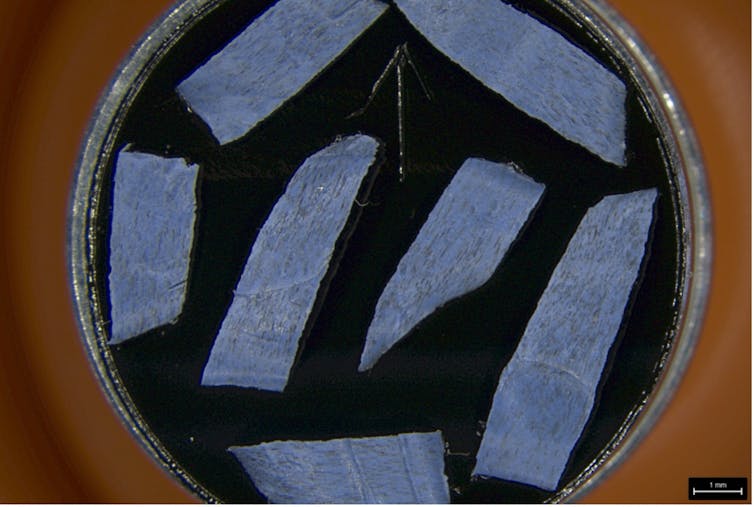
As 3D-printing filaments are usually patented to protect their individual formulations, additives and other minor ingredients are typically not listed on the product packaging. It is these ingredients that could hold the key to tracing ghost guns.
The mix of ingredients used in 3D-printing filaments gives each type of filament a particular chemical signature. We can identify these signatures using a method called infrared spectroscopy, which records how the filament absorbs infrared light. This pattern of absorbance – an infrared profile – changes based on what molecules are present in the filament.

What we found
In our research, conducted in collaboration with ChemCentre – a statutory forensic laboratory in Western Australia – we analysed more than 60 filaments sourced from the Australian retail market. We discovered that many of these filaments could be distinguished using their infrared profile, despite looking identical to the eye.
Filaments made of PLA, ABS and PETG can be easily set apart due to large differences in the chemical make-up of each polymer.
However, we were also able to separate some filaments made of the same polymer, due to minor additives creating differences in their infrared profile.
In one filament for example, we found signs of a compatibiliser – an additive that helps two polymers to mix together. This ingredient was not found in other filaments of the same base polymer, meaning it could be a distinct part of the brand’s formulation. It also suggests this filament contained two different polymers, despite only one being listed on the packaging.
These findings highlight why chemical analysis of filaments is useful, despite them being a widely available consumer product.
Tracing the seemingly untraceable
Being able to distinguish or identify different 3D-printing filaments could allow forensic investigators to create links between a seized gun and seized filament, or guns seized from different cases.
These links can help lead law enforcement to the suppliers of these guns, ultimately disrupting supply chains and future production.
While our research shows some 3D-printing filaments could be distinguished, this was not the case for all filaments. We are now conducting further research using more analytical techniques that will provide complementary information, such as the elements contained within the filaments.
Combining different techniques will allow us to complete a full chemical picture of each filament. We hope this information will help us to make links between a seized 3D-printed firearm, the filament it was printed from, and the 3D-printer used to print it.
By tracing the chemical fingerprint of 3D-printed guns, criminals can no longer feel safe under their “untraceable” veil.
Authors: Georgina Sauzier, Senior Lecturer in Forensic Chemistry, Curtin University


 Daily Bulletin


