

The ultra-processed foods problem is driven by commercial interests, not individual weakness. Here’s how to fix it
- Written by: Phillip Baker, ARC Future Fellow and Sydney Horizon Fellow, School of Public Health, University of Sydney, University of Sydney
Ultra-processed foods are displacing traditional foods and meals globally, degrading diet quality, and contributing to the rise of diet-related chronic diseases.
And despite the combined advertising spend of the leading ultra-processed food companies dwarfing even the total budget of the World Health Organization, there is plenty that governments, communities and health professionals can do about it.
These are the findings, published today in the journal The Lancet, of our three landmark papers on ultra-processed foods.
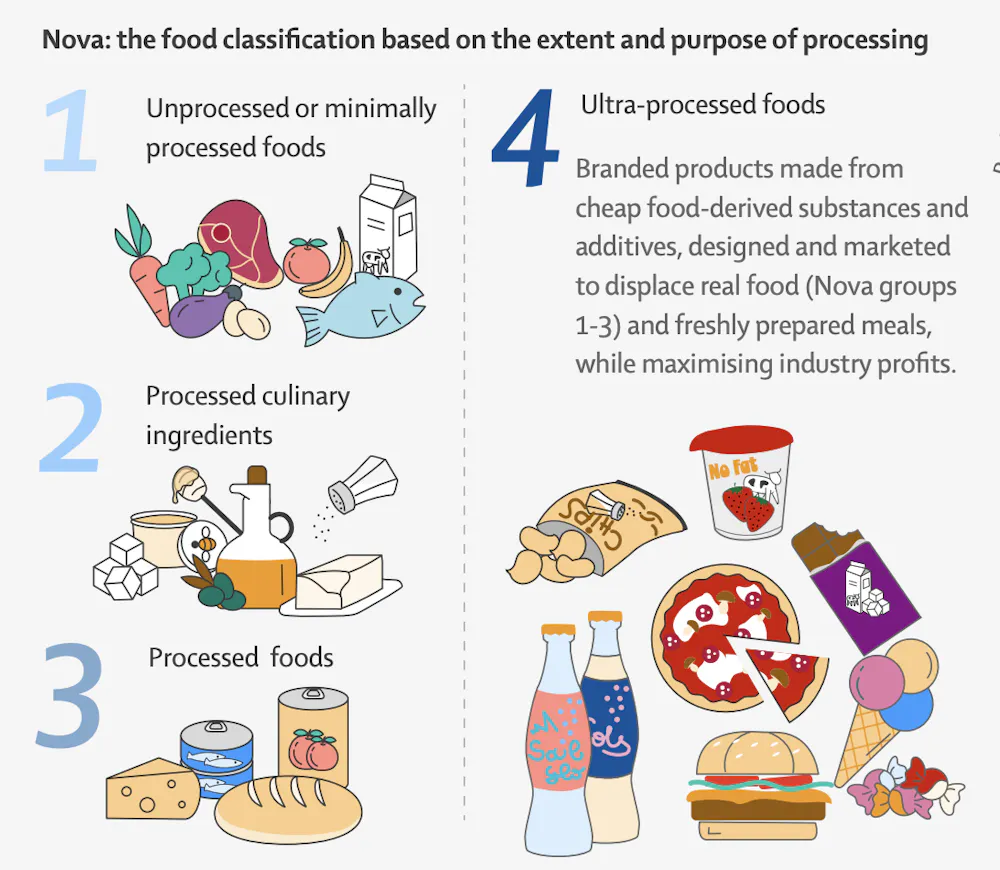
These are products engineered from industrial ingredients and cosmetic additives, typically containing few or no intact ingredients. Examples include soft drinks, chips, and many breakfast cereals.
The problem, we argue, is not a lack of willpower on the part of individuals but rather is primarily commercially driven – the result of a powerful industry.
The evidence
The first paper summarises the evidence, showing that ultra-processed foods are spreading globally. The share of ultra-processed foods in diets has climbed over decades in countries across the world.

In the United States, United Kingdom and Canada, it’s been consistently high for decades (around 50% of daily energy). Ultra-processed foods are essentially the national diet. The same goes for Australia.
Second, this paper shows diets high in ultra-processed foods induce overeating and are nutritionally poor: more sugars, saturated fat and energy density, less fibre and key vitamins and minerals, and fewer whole foods.
Third, this paper summarises the health risks. A systematic review we carried out, which included 104 long-term studies, found 92 reported greater associated risks of one or more chronic diseases. Meta-analyses of these studies confirmed associations for obesity, type 2 diabetes, high blood pressure, high cholesterol, cardiovascular disease, chronic kidney disease, Crohn’s disease, depression, and early death from all causes.
Crucially, it’s not just about “too much sugar, salt and fat”. Clinicaltrials show that when adults eat diets heavy in ultra-processed foods, they consume about 500–800 extra calories per day, gain weight and fat mass, and eat more rapidly, when compared with eating a non-ultra-processed diet with the same proportions of macronutrients. This is likely because of higher energy density, tastiness, and soft textures that make overeating ultra-processed foods easy.
More research is clearly needed. However, the evidence is now strong enough to justify a global public health response.
Policy options
Our second paper outlines policy options for governments that wish to address the problem. Four stand out:
1. Changing the products: reformulation – when sugar is swapped for sweeteners or fat is swapped for additives that provide a fat-like texture – does not solve the problem. Instead, governments could set limits on selected additives and use “ultra-processed food markers” such as colours, flavours and non-sugar sweeteners (as well as high levels of sugar, fat and salt) to identify ultra-processed products for regulation.
2. Fixing food environments: evidence-based policy options include:
adopting mandatory front-of-pack warning labels, which work well to inform consumers and reduce purchasing
protecting children under 18 – especially on digital platforms – from ultra-processed food marketing and extend protections beyond “kids’ hours”
taxing sugary drinks (by at least 20%) and selected ultra-processed foods; use revenue to subsidise fruits, vegetables and freshly prepared meals for lower-income households
removing ultra-processed foods from schools, hospitals and other public institutions, limiting the share of ultra-processed foods on supermarket shelves, and curbing availability of ultra-processed foods near schools.
3. Curbing corporate power: governments could do more to regulate companies’ portfolios and monitor and constrain the proportion of sales from ultra-processed foods; strengthen competition policy and consider tax reforms that curb excessive market power.
4. Addressing subsidies and supply chains: governments could redirect agricultural subsidies away from monoculture commodity ingredients for ultra-processed foods (such as corn, soy and sugar), and align environmental policies (on issues such as plastics reduction or water use) with nutrition goals.
Success will come from tailored, coordinated packages – there’s no silver bullet.
Countering the ultra-processed food industry
Our third paper asks why ultra-processed foods are taking over human diets and how to mobilise a global public health response.
The answer: address corporate power and profitability. Ultra-processing food is the food sector’s most profitable business model. The largest transnationals sit atop global supply, marketing and lobbying networks that expand markets, shape science and public debate, and block regulation.
Ultra-processed food manufacturers can use profits to spend much more on marketing, build factories and spread ultra-processed foods globally, and to fund lobbyists.
For instance, in 2024 leading food companies spent vastly more on advertising than the World Health Organization’s entire operating budget.
Corporations and their connected groups follow the same playbook as the tobacco and fossil fuel industries: lobbying, litigation, self-regulation, and sponsored science to delay policy response.
Our paper calls for a global public health response:
disrupt the ultra-processed food business model, by taxing ultra-processed foods production, mandating corporate plastics recycling, and redirecting resources to support healthy food producers and families
protect policymaking and science from interference, with conflict-of-interest safeguards and clear rules of engagement for industry. We should end reliance on industry self-regulation and use public policy and law
build coalitions to advocate to policymakers and drive policy change, from legal support to strategic communications.
 Our papers argue ultra-processed foods are displacing traditional foods and meals globally.
Alan Pope/Unsplash
Our papers argue ultra-processed foods are displacing traditional foods and meals globally.
Alan Pope/Unsplash
Our papers show that without policy action and a coordinated global response, ultra-processed foods will continue to rise in human diets, harming health, economies, culture and planet. The time to act is now.
Authors: Phillip Baker, ARC Future Fellow and Sydney Horizon Fellow, School of Public Health, University of Sydney, University of Sydney


 Daily Bulletin


