

Asbestos has been found in children’s coloured sand. What’s the risk to kids?
- Written by: Brian Oliver, Professor, School of Life Sciences, University of Technology Sydney
Multiple schools and early learning centres in the Australian Capital Territory have shut on Friday after asbestos was found in coloured sand used for children’s art and sensory play. At least one school in Brisbane has also closed due to potential exposure.
On Thursday, WorkSafe ACT issued a contamination notice after laboratory testing confirmed traces of chrysotile, a type of asbestos, in Kadink Decorative Sand.
It follows a recall notice by the Australian Competition and Consumer Commission (ACCC) for Educational Colours Rainbow Sand (1.3kg), Creatistics Coloured Sand (1kg) and Kadink Sand (1.3kg) in various colours. This was because of a different type of asbestos, tremolite.
The sand subject to the recall was manufactured in China and sold by several Australian retailers, including Officeworks and Woolworths.
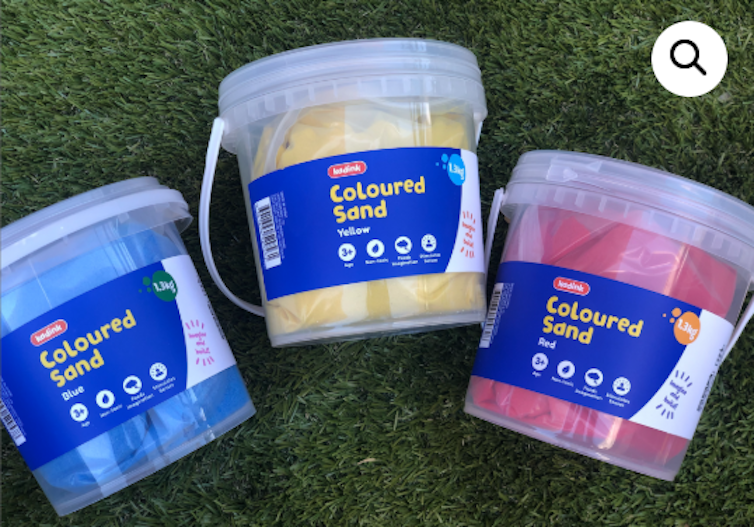
Parents will understandably be feeling worried about kids’ potential exposure to asbestos, which has been banned in Australia since 2003. But the risks in this case are low. Here’s what you need to know – and how to get rid of contaminated sand safely.
What was found in the sand?
There are six different types of asbestos. All are dangerous.
Information about which kind was found in these sand products differs according to the agency issuing the alert:
the ACCC recall says the products “may contain tremolite asbestos”
WorkSafe Qld says they “contain a low level of tremolite and/or chrysotile asbestos”
WorkSafe ACT says its testing (of Kandink Sand) found it “contains chrysotile”.
Fortunately, the most dangerous type – crocidolite asbestos or “blue” asbestos – has not been reported as a contaminant.
According to the ACCC, the recalled products have been sold throughout Australia between 2020 and 2025. But if regular testing has occurred it’s likely the contamination is more recent, and could be limited to a single batch. However we do not have the information at this stage.
How could it end up in sand?
The children’s play sand was manufactured overseas, and we don’t know how it was contaminated. But there are several possibilities.
If the sand was taken from a beach then it is unlikely to be contaminated with asbestos. But if the sand was manufactured by crushing rocks, then potentially asbestos – which is a naturally occurring mineral – could have been in the source product.
Asbestos is still used as a heat-shielding material or as a building product in many places in the world. So it’s also possible the processes used to dye the sand could also be another potential source of contamination.
What are the health risks? Are kids more vulnerable?
Asbestos is most dangerous when it becomes airborne and can be inhaled, for example during demolitions and renovations of older homes, where it was a common building material.
Inhaling any form of asbestos (fibres, dust, microparticles) can cause mesothelioma – a cancer that affects organ tissue, particularly the lungs – as well as lung cancer and asbestosis, a chronic lung disease that causes shortness of breath.
There is no safe level of exposure. However the risks increase with the amount you’re exposed to.
This means a small amount can be dangerous. But those who encounter asbestos once or twice in small amounts have a far lower risk of developing health complications, compared to people continually exposed to large quantities, as we’ve seen in the construction and mining industries.
We don’t have much research about the impact in children. But we know the younger someone is when exposed, the greater the risk is they will develop cancer or asbestosis. This is because the health effects can take decades to develop. So younger people have a higher chance of living long enough to see them emerge.
So, what is the risk?
WorkSafe ACT hasn’t released the levels it found through lab testing. But a statement on its website says: “The risk of exposure to traces of chrysotile is low.” This suggests very low levels were found.
The potential of exposure should be taken very seriously, as asbestos can be deadly. But it is not a cause for panic; the risk in this case is low.
Remember, it is likely everyone has been exposed to asbestos at some point, but most of us report no health complications as a result.
How should I dispose of the sand safely?
Detailed instructions are available at WorkSafe ACT.
You should wear:
- disposable gloves, tucked into cuffs, and any gaps sealed with tape
- a P2-rated face mask (not a standard dust mask)
- protective eyewear.
When disposing of the sand:
- do everything you can to prevent dust or fibres becoming airborne
- carefully double-wrap the sand, its container, and related materials in heavy duty (200-micron) plastic bags
- seal with tape and clearly label the package as asbestos waste.
Information about asbestos disposal in your state or territory is available at the Asbestos and Silica Safety and Eradication Agency website.
If you are worried about your exposure or your child’s, contact your GP.
Authors: Brian Oliver, Professor, School of Life Sciences, University of Technology Sydney


 Daily Bulletin


