

Switching off the huge Gladstone coal station in 2029 will cause problems. It needs a longer, smarter phase-out
- Written by: Alexander Klimenko, Director, Centre for Multiscale Energy Systems, The University of Queensland
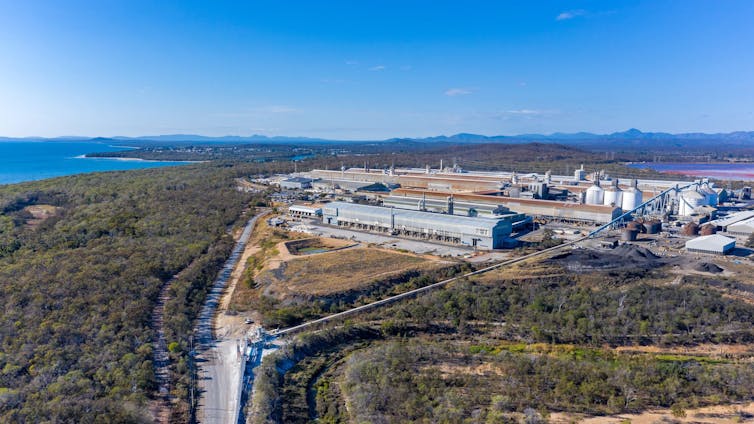
This month, Rio Tinto announced plans to bring forward the closure of Gladstone Power Station to 2029, six years ahead of schedule. The move was welcomed by environmental groups, as Gladstone is Queensland’s oldest and largest coal-fired station. It has struggled to compete with emerging renewable generation in recent years and outages have become more frequent.
The large 1.6 gigawatt plant feeds much of its power to the nearby Boyne aluminium smelter, which uses roughly the same amount of power as all of residential Sydney or twice the demand of residential Brisbane.
To fill the gap, Rio Tinto has secured about 3GW of renewable power capacity. That may seem impressive, but the variability of renewables means the actual power produced will be roughly a quarter of this.
More renewables can be built, but the smelter won’t be able to run safely until there’s enough energy storage available to ensure it can keep running overnight and through rainy or low-wind periods. Any interruption can cause irreparable damage to the smelter.
Closing the plant in four years’ time is unrealistic. Far better to begin a staged phase-out, where new thermal energy storage is built on the coal plant site while new energy capacity comes online.
This might appeal to the current Queensland government, which last week released its energy road map. The plan dials back renewable ambition, puts a question mark over pumped hydro, supports more gas plants and opens the door to keeping ageing coal plants open longer.

Energy storage and grid stability are essential
Australia’s aluminium industry is built on natural advantages, such as bauxite ore resources and moderately priced power.
Even if all existing grid-scale batteries and those coming online by 2029 were devoted just to the Boyne smelter, their combined capacity would be still be far below what would be required to carry the smelter through a single day and night. Batteries make most commercial sense over short periods where prices are high, but they do not solve the problem of long-duration storage.
Pumped-hydro schemes can offer energy storage at scale. If the 2GW Borumba pumped-hydro project was built by 2029 and largely dedicated to the smelter, it could, in principle, fill the gap left by Gladstone.
But this is unlikely. The government is reviewing Borumba. If the project proceeds, it will be needed to support Queensland’s broader energy transition and to recover its substantial capital cost. Large smelters tend to buy power with direct contracts substantially below the average market price. Construction is likely to extend out at least to 2033.
Coal power stations don’t just produce power. Their large spinning turbines and rotors create synchronous inertia – a key way the grid is kept stable. Retiring Gladstone would also mean removing a large source of synchronous inertia. If this is done too fast, planned replacements such as synchronous condensers wouldn’t be in place. This would risk grid stability.
We face a paradox of transition. Coal generation has to wind down to avert the worst of climate change. But it has to be done carefully so the lights stay on and industries can run without interruption. Storage and grid-stabilising measures will be essential.
What should be done? To ensure reliability for the Boyne smelter, authorities must complement renewables with a range of energy storage options.
A thermal solution?
A realistic option is to phase down Gladstone Power Station rather than switching it off at a set date. To do this, one option is to supplement coal-fired generation with thermal energy storage.
This type of storage relies on storing heat in molten salts or other materials. The heat can be turned into electricity later. The technology is well established – the world’s largest thermal battery, Dubai’s Noor Energy 1, stores almost 6 gigawatt-hours of energy.
Coal stations don’t work well alongside the variability of renewables, as it takes time for coal plants to start up and shut down. This is where thermal storage could help.
When renewable output was high, the coal plant would continue operating. But instead of directing steam to spin turbines to produce electricity, it would burn coal to heat molten salts. The heat could then be converted to electricity when power prices are high and solar stops producing, such as during evening peaks and overnight.
This would decouple the coal station from fluctuating grid demand. It would also reduce coal use and pollution while improving the economics of the coal plant.
During periods of excess renewable production, Gladstone could become a heat battery. It could store excess power in molten salts at low or even negative cost and sell it back to the grid when prices rise.
Other measures could be added, such as installing solar-thermal arrays to heat up the molten salts, meaning still less need for coal. Over time, Gladstone’s role could evolve to spend more time as an energy store and less as a coal-fired generator.
Eventually, the generation units could stop burning coal routinely but keep their capacity to use coal during an emergency.

A true transition isn’t off or on
There’s an appeal to simply switching off a large coal plant and ending a big source of emissions. But for large stations tied to smelters, it’s not that easy.
Adding new features to an ageing coal station may seem like a kludge. But transitions are messy. It would make sense to use this asset cleverly, keeping the useful elements and phasing out the part we don’t want: burning coal.
Storing energy as heat isn’t as efficient as storing power in batteries. But efficiency isn’t the only thing that matters. The system also needs to work during the transition.
Thermal storage plants have lifespans of more than 30 years, even when used daily. Workers could use their skills at the new facilities. If there was an energy emergency or lengthy dip in renewable production, the old coal warhorse could be fired up as a backup generator.
Adding thermal storage to Gladstone could help the entire state grid make the shift from coal and gas to renewables and storage.
Authors: Alexander Klimenko, Director, Centre for Multiscale Energy Systems, The University of Queensland


 Daily Bulletin


