

Billions in private cash is flooding into fusion power. Will it pay off?
- Written by: Matthew Hole, Professor, Mathematical Sciences Institute and School of Computing, Australian National University
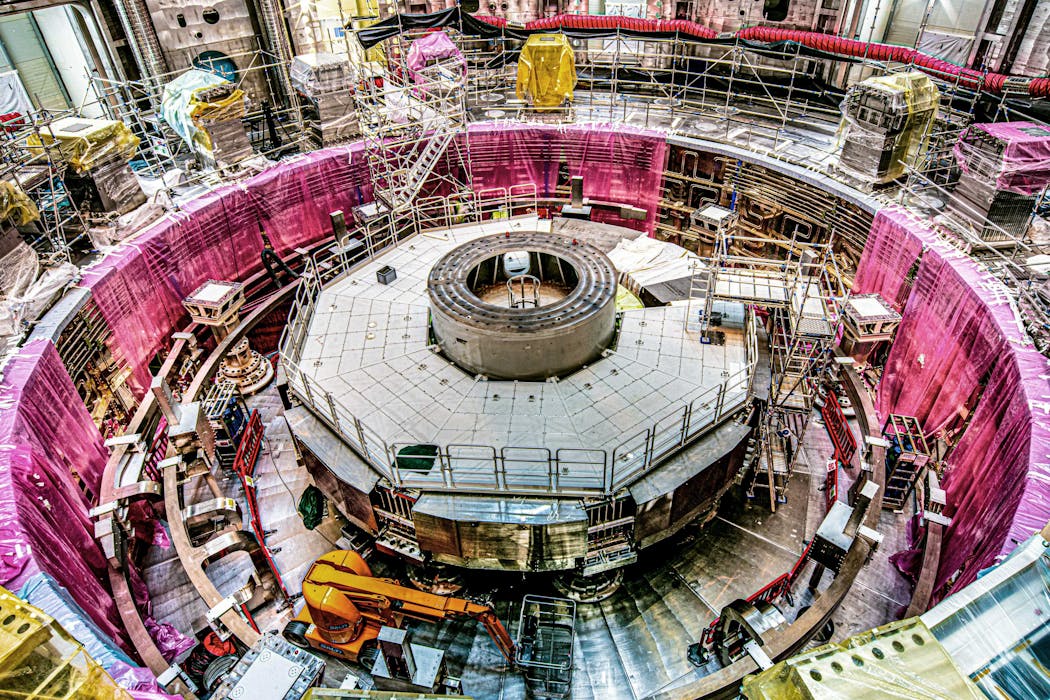
Over the past five years, private-sector funding for fusion energy has exploded. The total invested is approaching US$10 billion (A$15 billion), from a combination of venture capital, deep-tech investors, energy corporations and sovereign governments.
Most of the companies involved (and the cash) are in the United States, though activity is also increasing in China and Europe.
Why has this happened? There are several drivers: increasing urgency for carbon-free power, advances in technology and understanding such as new materials and control methods using artificial intelligence (AI), a growing ecosystem of private-sector companies, and a wave of capital from tech billionaires. This comes on the back of demonstrated progress in theory and experiments in fusion science.
Some companies are now making aggressive claims to start supplying power commercially within a few years.
What is fusion?
Nuclear fusion involves combining light atoms (typically hydrogen and its heavy isotopes, deuterium and tritium) to form a heavier atom, releasing energy in the process. It’s the opposite of nuclear fission (the process used in existing nuclear power plants), in which heavy atoms split into lighter ones.
Taming fusion for energy production is hard. Nature achieves fusion reactions in the cores of stars, at extremely high density and temperature.
The density of the plasma at the Sun’s core is 150 times that of water, and the temperature is around 15 million degrees Celsius. Here, ordinary hydrogen atoms fuse to ultimately form helium.
However, each kilogram of hydrogen produces only around 0.3 watts of power because the “cross section of reaction” (how likely the hydrogen atoms are to fuse) is tiny. The Sun, however, is enormous and massive, so the total power output (1026 watts) and the burn duration (10 billion years) are astronomical.
Fusion of heavier forms of hydrogen (deuterium and tritium) has a much higher cross section of reaction, meaning they are more likely to fuse. The cross-section peaks at a temperature ten times hotter than the core of the Sun: around 150 million °C.
The only way to continuously contain the plasma at temperatures this high is with an extremely strong magnetic field.
Increasing the output
So far, fusion reactors have struggled to consistently put out more energy than is put in to make the fusion reaction happen.
The most common design for fusion reactors uses a toroidal, or donut-like, shape.
The best result using deuterium–tritium fusion in the donut-like “tokamak” design was achieved at the European JET reactor in 1997, where the energy output was 0.67 times the input. (However, the Japanese JT-60 reactor has achieved a result using only deuterium that suggests it would reach a higher number if tritium were involved.)

Larger gains have been demonstrated in brief pulses. This was first achieved in 1952 in thermonuclear weapons tests, and in a more controlled manner in 2022 using high-powered lasers.
The ITER project
The public program most likely to demonstrate fusion is the ITER project. ITER, formerly known as the International Thermonuclear Experimental Reactor, is a collaborative project of more than 35 nations that aims to demonstrate the scientific and technological feasibility of fusion as an energy source.
ITER was first conceived in 1985, at a summit between US and Soviet leaders Ronald Reagan and Mikhail Gorbachev. Designing the reactor and selecting a site took around 25 years, with construction commencing at Cadarache in southern France in 2010.
The project has seen some delays, but research operations are now expected to begin in 2034, with deuterium–tritium fusion operation slated for 2039. If all goes according to plan, ITER will produce some 500 megawatts of fusion power, from as little as 50MW of external heating. ITER is a science experiment, and won’t generate electricity. For context, however, 500MW would be enough to power perhaps 400,000 homes in the US.
New technologies, new designs
ITER uses superconducting magnets that operate at temperatures close to absolute zero (around –269°C). Some newer designs take advantage of technological advances that allow for strong magnetic fields at higher temperatures, reducing the cost of refrigeration.
One such design is the privately owned Commonwealth Fusion System’s SPARC tokamak, which has attracted some US$3 billion in investment. SPARC was designed using sophisticated simulations of how plasma behaves, many of which now use AI to speed up calculations. AI may also be used to control the plasma during operations.

Another company, Type I Energy, is pursuing a design called a stellarator, which uses a complex asymmetric system of coils to produce a twisted magnetic field. In addition to high-temperature superconductors and advanced manufacturing techniques, Type I Energy uses high-performance computing to optimally design machines for maximum performance.
Both companies claim they will roll out commercial fusion power by the mid-2030s.
In the United Kingdom, a government-sponsored industry partnership is pursuing the Spherical Tokamak for Energy Production, a prototype fusion pilot plant proposed for completion by 2040.
Meanwhile, in China, a state-owned fusion company is building the Burning Plasma Experimental Superconducting Tokamak, which aims to demonstrate a power gain of five. “First plasma” is slated for 2027.
When?
All projects planning to make power from fusion using donut-shaped magnetic fields are very large, producing on the order of a gigawatt of power. This is for fundamental reasons: larger devices have better confinement, and more plasma means more power.
Can this be done in a decade? It won’t be easy. For comparison, design, siting, regulatory compliance and construction of a 1GW coal-fired power station (a well understood, mature, but undesirable technology) could take up to a decade. A 2018 Korean study indicated the construction alone of a 1GW coal-fired plant could take more than 5 years. Fusion is a much harder build.
Private and public-private partnership fusion energy projects with such ambitious timelines would have high returns – but a high risk of failure. Even if they don’t meet their lofty goals, these projects will still accelerate the development of fusion energy by integrating new technology and diversifying risk.
Many private companies will fail. This shouldn’t dissuade the public from supporting fusion. In the long term, we have good reasons to pursue fusion power – and to believe the technology can work.
Authors: Matthew Hole, Professor, Mathematical Sciences Institute and School of Computing, Australian National University


 Daily Bulletin


