

Business Blockbuster - Helpng business to be more visible on Google

Daily Bulletin

12,000-year-old rock art marked ancient water sources in Arabia’s desert

  • Written by: Maria Guagnin, Director, Ha’il Archaeology Identification Project, University of Sydney; Max Planck Institute of Geoanthropology
12,000-year-old rock art marked ancient water sources in Arabia’s desert

About 12,000 years ago, high up on a cliff in the desert of northern Arabia, an artist – or perhaps artists – was hard at work.

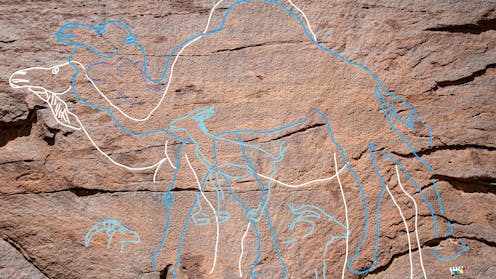
Standing on a narrow ledge and with primitive tools, they engraved into the rock an image of a life-sized camel. This wasn’t the first artwork of its kind: in fact, there was already an entire row of fresh camel engravings on the 39-metre-high cliff face, below which a shallow lake sparkled in the sunshine.

Over thousands of years, these engravings weathered the elements. They gradually eroded until they were almost invisible and had been forgotten.

That is, until our international team discovered them and more than 170 others while on a field trip to the region, which sits near the southern edge of the Nefud Desert in Saudi Arabia, roughly two years ago.

As we explain in a new study, published today in Nature Communications, the engravings would have marked important desert water sources – and demonstrate the resilience and innovation of people who lived in such a harsh, arid environment.

A barren, rocky desert under a clear blue sky.
The engravings are near the southern edge of the Nefud Desert in Saudi Arabia. Sahout Rock Art and Archaeology Project

Searching for clues

Our earlier research had shown that between 10,000 and 6,000 years ago Arabia was much wetter than it is today.

Grasslands had spread into areas that are now desert, and cattle herders used these pastures for their herds.

The rock art they left behind is well known from two UNESCO World Heritage sites.

We could see there was also older rock art at these UNESCO sites. It was much larger and more detailed, showing life-sized and naturalistic camels and wild donkeys. But it was not clear how old it was. So in May 2023 we set out to find more of this ancient rock art in the hope of finding clues about its age.
A sand-coloured rock face, featuring an engraving of a large camel.
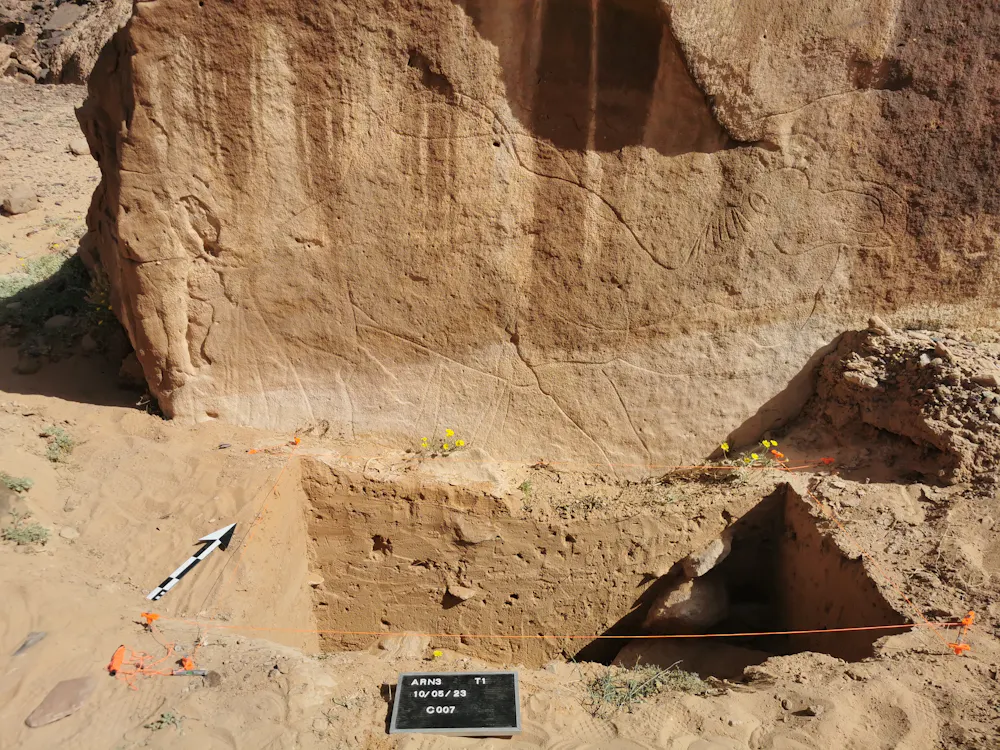
The newly discovered engravings include 130 images of large, life-sized animals – camels, ibex, wild donkeys, gazelles and aurochs. Sahout Rock Art and Archaeology Project

Life-sized engravings

In total, we identified more than 60 rock art panels containing 176 engravings in three previously unexplored areas – Jebel Arnaan, Jebel Mleiha and Jebel Misma. The engravings include 130 images of large, life-sized animals – camels, ibex, wild donkeys, gazelles and aurochs. Some are almost three metres long and more than two metres high.

We reached the first panel via a long off-road track which cut through a beautiful mountain landscape. A cool breeze made the heat of the emerging Saudi summer bearable.

The rock art panel showed two large camels, one on top of the other. The older camel looked as though it was in motion and about to stand up, the other like it was striding across the rock surface.

We were excited to find undisturbed archaeological layers directly beneath the engraved camels. In one sealed layer we even found an engraving tool that was once used to make rock art.

Luminescence dating – a dating method that measures when sediment was last exposed to sunlight – revealed the layer in which the tool was found is about 12,000 years old.

The same layer also contained artefacts that are typical for this time, including small arrowheads, stone beads and even a bead made from a seashell.

A hand holding a small arrowhead. An arrowhead uncovered during excavations. Michael Petraglia

A far-reaching network

These artefacts tell us the people who made the rock art were part of a far-reaching network. They used the same stone tools and jewellery as communities in the Levant, 400 kilometres further north.

Significantly, our team also discovered the rock art was placed near ancient seasonal lakes.

At the end of the last ice age, during the Last Glacial Maximum, the climate was extremely dry.

These lakes, dated at roughly 15,000 years, are the first evidence of surface water returning to Arabia following the extremely arid period. And they move the timeline of the returning humid conditions back thousands of years, enlarging the opportunity window for humans to settle in these dry inland conditions.

Our results show 12,000 years ago, humans were able to use these seasonal lakes to survive in the desert. They marked these water sources, and the paths leading to them, with monumental rock art.

We don’t know why they did this. But even for us today, the camel is a striking symbol for survival in the desert.

Authors: Maria Guagnin, Director, Ha’il Archaeology Identification Project, University of Sydney; Max Planck Institute of Geoanthropology

Read more https://theconversation.com/12-000-year-old-rock-art-marked-ancient-water-sources-in-arabias-desert-266144

Business News

The Growing Demand for Durable Plastic Packaging Supplies Across Australia

Why Do Australian Businesses Need Reliable Plastic Packaging Supplies? Businesses need packaging that can withstand everyday handling, storage, and distribution without creating avoidable delays. Pla...

Daily Bulletin - avatar Daily Bulletin

Office Cleaning Melbourne: Choosing the Right Scope for Your Office

A well-planned office cleaning Melbourne arrangement starts with a clear understanding of the premises and the people who use it. An office may include private work areas, shared desks, reception, mee...

Daily Bulletin - avatar Daily Bulletin

How Businesses Can Prepare for Unexpected Power Outages

Power failures can occur quickly. The supply may be interrupted by bad weather, issues with the electricity network, damaged equipment or local construction work. This can be just a hassle for a fam...

Daily Bulletin - avatar Daily Bulletin

How Chatswood Tutoring Can Fit Into a Student’s Weekly Routine

Create a Predictable Weekly Structure A consistent weekly routine can make study easier to manage when students are balancing several subjects. Chatswood tutoring can provide a fixed learning point a...

Daily Bulletin - avatar Daily Bulletin

The Rise of Digital Marketplaces in the Australian Trade Sector

For decades, the Australian trade and construction sector operated almost entirely on word-of-mouth recommendations and local community networks. Small business owners typically relied on local newspa...

Daily Bulletin - avatar Daily Bulletin

How Immigration Lawyers Can Help

Introduction Visa decisions can shape employment, family life, study plans, travel, and future residence. A small omission can lead to delay, added expense, or refusal. Immigration lawyers assess l...

Daily Bulletin - avatar Daily Bulletin

How Industrial Drying Equipment Supports Efficient Processing

Many industrial processes require moisture to be removed from compressed air, products or process materials before they move to the next stage. Excess moisture can affect equipment performance, produc...

Daily Bulletin - avatar Daily Bulletin

Practical Ways a Whiteboard Can Improve Workplace Communication

Effective communication helps teams stay organised, share ideas and keep track of important information. While digital tools are now common in many workplaces, a whiteboard continues to provide a simp...

Daily Bulletin - avatar Daily Bulletin

Designing Eco-Friendly Custom Water Bottles for Your Next Event

The Evolution of Sustainable Event Merchandise Event planning has undergone a massive transformation over the last decade. Gone are the days when organizers could hand out cheap, single use plastic...

Daily Bulletin - avatar Daily Bulletin

The Daily Magazine

Work Boots vs Safety Shoes: Which Footwear Is Right for Your Workplace?

Not every job calls for a heavy pair of boots. Walk through a modern warehouse, factory floor or dis...

Master Bedroom Wall Decor Guide: Sizing, Layouts and Styling Ideas for Every Space

The main bedroom is often the last room in the house to get any attention. The living room gets the ...

What to Consider Before Installing a Built-In Wardrobe

Living in a modest home teaches you a lot. You learn how to keep a small kitchen tidy, where to hi...

Top 5 Mortgage Brokers in Sydney: How to Choose the Right One in 2027

Finding a mortgage broker in Sydney is not particularly difficult. Finding one who understands your ...

How Much Life Does Your Roof Have Left? Recognizing When Replacement Becomes Necessary

A roof can age quietly for years. From the street, everything may look reassuringly ordinary, even w...

How Australian Drivers Can Make Their Cars Harder to Steal

Most people don't think much about car theft until it happens to them, or to someone they know. Th...

The Short-Term Rental Rules Australian Owners Can’t Afford to Guess At

A holiday let looks simple from the outside: a spare property, a listing, some guests. Underneath ...

The Risks Of Removing Ear Wax Without Professional Guidance

Ear wax is an essential component of the hygiene process since it acts as a barrier between the ea...

Plumbing Call-Out Fees in Perth Explained

When you hire a plumber to fix a problem with a dripping tap, leaking pipe, or whatever it might be...