

To save in-person lectures, unis need to provide lessons worth showing up for
- Written by: Hugh Gundlach, Lecturer in Education, The University of Melbourne
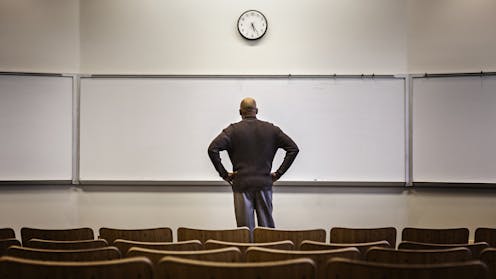
In-person lectures have been a staple of university learning for centuries.
But for more than a decade, there has been increasing debate about the relevance of lectures in modern higher education. Some academics and institutions argue they are no longer needed in the same way.
But research shows in-person lectures can be an important way to keep students connected to their peers and what they are learning.
If we want to keep the in-person lectures, we need to change the way they are delivered.
What’s happening to lectures?
Changes to in-person lectures were accelerated by COVID lockdowns, where everyone learned from home, alongside the rise of online learning platforms.
In the post-pandemic era, universities have increasingly offered online, “asynchronous” learning. This allows students to choose when they engage with course resources and tasks. There is a growing acceptance of online learning as a preferred option, rather than a lockdown necessity.
There are financial benefits for universities. Online lectures can increase enrolments through people who may not otherwise be able to attend due to where they live, or to work commitments. It also removes class size restrictions.
There can also be reduced overhead costs of in-person facilities.
More controversially, universities might reuse lectures across semesters, employ fewer faculty, or outsource teaching to external providers.
‘Speed-watching’ and learning from home
Online lectures cater to different learning preferences. Recorded lectures allow students, particularly those for whom English is an additional language, to watch with subtitles or transcripts. Students can pause to make notes or check reference material.
Some students “speed-watch” lectures on faster playback speed or listen to them like podcasts while exercising or commuting.
This flexibility is also helpful for students who do not live near their university or who have mobility issues, illnesses, or care responsibilities.
But a lack of campus attendance can deprive students of valuable in-person interactions with their peers and teachers. This is particularly crucial for certain fields, such as healthcare, education and service-based industries, where professional socialisation plays a vital role in career preparation.
Research suggests online only courses do not suit students who are weaker academically or who have poor self-discipline or time management.
So there is a difficult balance to strike between convenience and educational quality.
But something else is going on
Beyond the convenience aspects, there could be other reasons lectures are dying out.
Lecturers need to update their teaching style.
Reading dot points on slides, reciting essays, and delivering content in a monotone voice do not cut it in the age of TED talks, TikToks and short format media.
Lectures should not be lonely
I’ve been looking at how students engage with both in-person and online learning as part of a scoping review and routine quality assessment. Academics can see how many students download lectures, which pages they visit, how long they visit for, and how much they contribute in online forums.
Internal data from a number of large higher education institutions indicates up to 60% of students are not attending in-person lectures in some faculties. Despite the accessibility and convenience of online learning, up to 40% of students are not accessing lecture recordings at all. This data aligns with similar studies in the field.
This means students are missing out on opportunities to chat about ideas with classmates and lecturers. They’re missing the chance to make friends and professional contacts in their field. They’re not having their ideas challenged or supported. And they are not being exposed to key curriculum content.
It’s a domino effect. When fewer people engage with lectures, smaller in-person tutorials suffer too, because students do not have the curriculum knowledge to engage at a meaningful level.
For students who do show up, it can feel pretty lonely. Lecturers find it less satisfying too.
How can we encourage students to come back?
So maybe it’s not just about preserving lectures. It’s about reinventing them for today’s students.
Just as the corporate world is facing the challenge of enticing workers back to the office, we need to think about how to attract students to in-person lectures.
Lectures must offer unique experiences that can only be done in-person.
Research suggests the key is to make lectures more personal, experiential, engaging and interactive.
Though university positions are called “lecturers”, let’s reimagine what a “lecture” can be. It may encompass formats such as debates, Q&A sessions, or “Ask Me Anything” formats. It can be case studies, role-plays, mock activities, panels, hands-on workshops, competitions, or pitches. It may even be as simple as using slideshows better.
Technology can help lecturers engage with students who are attend in-person via polls, live questions and chat threads on their phones or devices.
What’s the point here?
Of course, different courses, subjects, and groups of students will need different approaches.
While breaking content into small modules might be beneficial in some subjects, the ability to follow an argument or concentrate for longer periods is still important in many others.
With students too, some international students come from learning cultures of quiet listening, which is quite different from the less formal, opinionated style we’re used to in English-speaking countries.
But we need to be upfront about what we’re trying to achieve.
The goal isn’t simply get students sitting in a theatre. It’s about creating a learning experience worth showing up for, and facilitating more engaged and interactive learning.
Authors: Hugh Gundlach, Lecturer in Education, The University of Melbourne


 Daily Bulletin


