

Tiny crystals in Earth’s crust have captured the movement of the Milky Way’s spiral arms
- Written by: Chris Kirkland, Professor of Geochronology, Curtin University
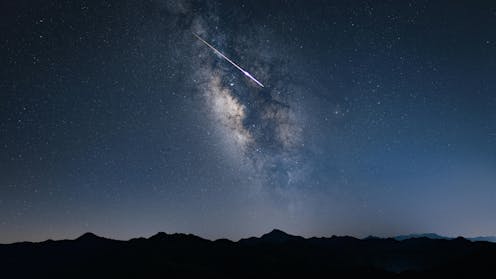
When most of us think about what shaped our planet, we probably picture volcanoes, earthquakes, and huge continents slowly drifting apart (or back together again) over millions or billions of years. We also know meteorite impacts were important; our crater-packed Moon is clear evidence of that.
But what if Earth’s geological story was also written further afield in the stars – specifically, in the spiral arms of our home galaxy, the Milky Way?
That’s the bold idea that has been resonating behind some recent research that links astrophysics with geology. So far, these controversial ideas have been based on models, limited by gaps in Earth’s geological record and the uncertainties in our Solar System’s galactic path.
But our new study, published this week in Physical Review Research, takes a different approach by comparing maps of hydrogen gas in the Milky Way with chemical fingerprints in ancient crystals on Earth. The findings support the view that Earth’s crust may have been influenced by the Solar System’s journey around the galaxy.
Reading the galaxy through hydrogen
Astronomers often use neutral hydrogen, the simplest atom of one proton and one electron, as a cosmic marker.
This atomic hydrogen emits radio waves at a wavelength of 21 centimetres, which cut through the dust and gas that obscure much of the Milky Way from our view. These emissions, from higher density regions of hydrogen, reveal the sweeping spiral arms of the galaxy, even when visible-light telescopes cannot.
The spiral arms aren’t solid structures. Instead, they’re density waves – like traffic jams of stars, gas and dust that move around the galactic disc more slowly than individual stars themselves.
As the Solar System orbits the galactic centre faster than the arms, it periodically overtakes them, roughly every 180–200 million years. Passing through a spiral arm could increase the number of comets and asteroids striking Earth.
Zircon crystals: tiny time capsules
How can we know if Earth really felt the consequences of these galactic encounters? The answer may lie in zircon, a hardy mineral commonly found in Earth’s crust, that can survive for billions of years.
Zircon crystals form in magmas and are like tiny time capsules. Not only can they be dated, but they also carry chemical clues about what Earth was like at the moment they grew.
Inside these crystals, the oxygen atoms occur in slightly different forms, called isotopes, that have the same chemistry but different masses. These isotopes act as tracers, showing whether the magma came from deep inside Earth or had contact with surface water.
As the Solar System travels around the galaxy, it passes through spiral arms where hydrogen gas is more concentrated. If there is unusual variability in zircon oxygen isotopes at the times of high atomic hydrogen density, then this suggests something disrupted the normal balance of crust formation on Earth.
Matching Earth’s rocks with galactic maps
The new study directly compared this zircon isotope record with radio frequency-measured hydrogen density along the Solar System’s galactic orbit. The result? Striking correlations.
Periods when the Solar System passed through spiral arms – regions with denser hydrogen – line up with spikes in zircon oxygen variability.
In other words, Earth’s crust seemed more “chaotic” at the same times the Solar System was embedded in star-forming arms of the Milky Way.

A galactic fingerprint on Earth’s crust
What could explain this connection?
One idea is that when the Solar System moves through a spiral arm, it can shake up the distant icy region of space known as the Oort Cloud, a giant reservoir of comets far beyond Pluto.
Some of these comets may then hurtle toward Earth.

Each impact delivers enormous energy – enough to melt rock, trigger geological upheaval and leave lasting marks in the planet’s crust.
Crucially, this record is preserved over billions of years, much longer than the impact craters we can still see on Earth, which are often erased by erosion or plate tectonics.
Zircons may therefore offer a deep-time archive of galactic influences that we can’t observe directly through astronomy.
A cosmic connection
If Earth’s geology really responds to the rhythms of the galaxy, it expands our view of what drives planetary evolution. It suggests that to fully understand Earth, we must look beyond it, to the vast structures of the Milky Way that periodically reshaped our Solar System’s environment.
Recognising astrophysical fingerprints in planetary geology could provide new clues about crustal growth, habitability, and even the emergence of life.
Of course, caution is warranted. Correlation doesn’t always mean causation, and disentangling the effects of galactic arm crossings from Earth’s internal processes is tricky. But the emerging evidence is compelling enough to take seriously.
For now, zircon crystals, tiny grains often smaller than a sand particle, are helping us glimpse a connection between Earth and the cosmos.
Authors: Chris Kirkland, Professor of Geochronology, Curtin University


 Daily Bulletin


