

How do flowers know it’s spring? A botanist explains
- Written by: Gregory Moore, Senior Research Associate, School of Agriculture, Food and Ecosystem Sciences, The University of Melbourne
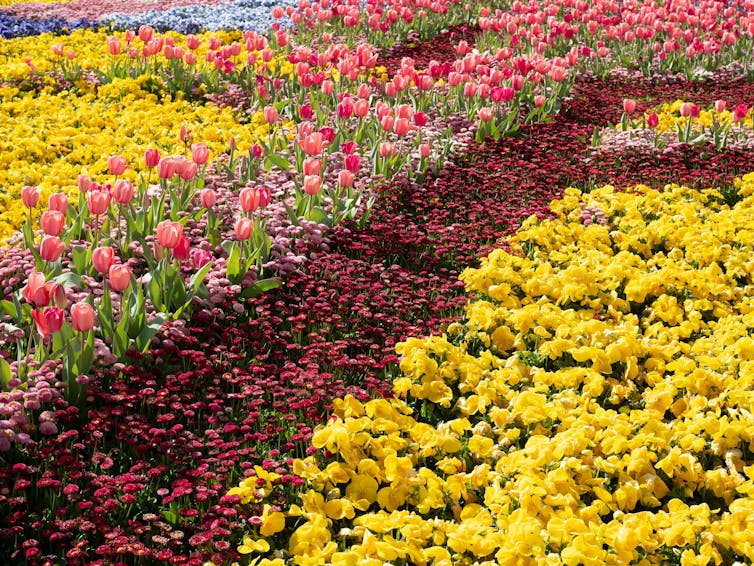
For many plants, spring is just a really good time. They have endured a cold, dark, hard winter and in some places, winters can be murderously tough for plants.
It makes sense that when spring comes around, plants are ready to take advantage of warmer temperatures, longer days and more sunshine. They resume growth after their winter dormancies and many rapidly produce flowers.
You’ve probably been spotting the sudden springtime explosion of flowers everywhere on your neighbourhood walks, your commute or in your own garden.
But why exactly do flowers go crazy in spring, and how do they know exactly when to show up for duty? Here’s the science.
Letting loose in a big rush
For many plants, the conditions for growth in spring are close to ideal. Water, warmth and sunlight are suddenly readily available.
Plants don’t have to hold back anymore. They can resume almost unconstrained growth and have the energy and resources to invest in flowering.
Your garden (or a patch of natural bush) is, in fact, a highly competitive environment.
Plants will rush to produce masses of flowers in the hope this will give individual plants an advantage in the reproductive race that ultimately might lead to seed and reproduction. This, after all, is the universal goal of biological success.
There is another factor, however, that also influences spring flowering.
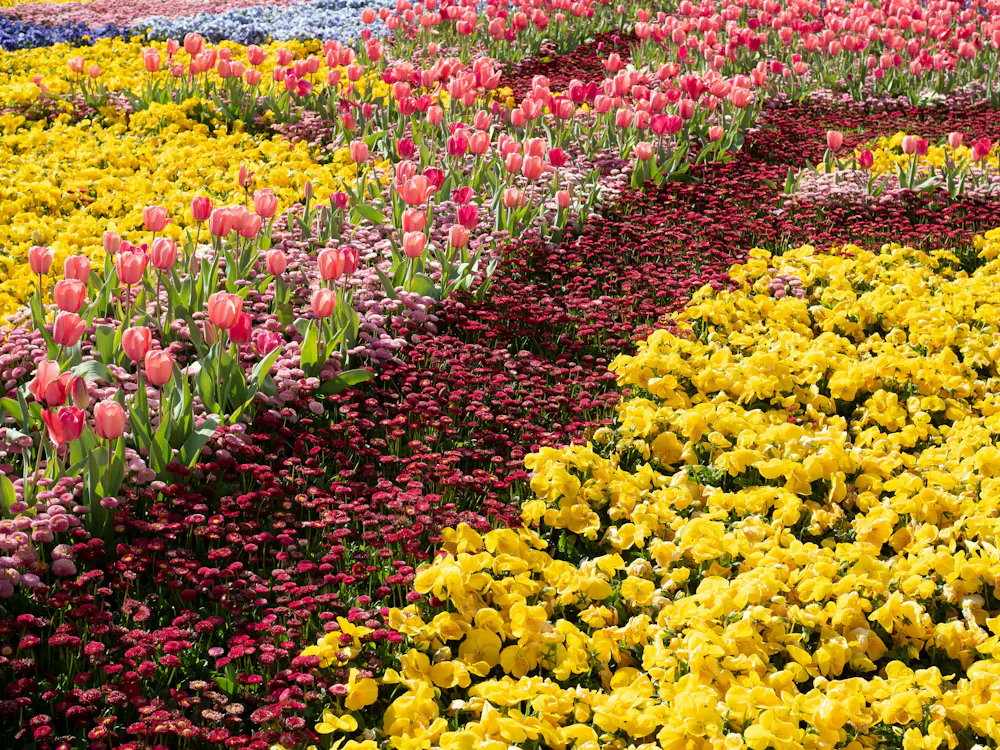
The birds and the bees (and other insects)
Flowering plants (known as angiosperms) are relatively recent arrivals on the evolutionary time line. They first became significant during the Cretaceous Period, about 100 to 120 million years ago.
By then, insects had already been on the scene and evolving for millions of years. Birds had evolved more or less at the same time as these flowering plants, becoming more common during the Cretaceous Period too, but a few million years earlier.
These creatures, the plants noticed, were excellent at dispersing pollen and seeds. Many flowering plants evolved to use their helpful services.
Before the angiosperms, ancient plants used spores for reproduction. Conifers, which had evolved hundreds of millions of years before angiosperms, used wind to disperse their pollen. Seed dispersal was often limited, unreliable and slow.
Flowering plants needed to attract pollinators and seed dispersal vectors, such as insects and birds. Many developed flashy and showy flowers: the epitome of good advertising.
So flowering in spring coincides with the return of migratory birds and the life cycles of insects (insect activity usually declines over winter).
It makes great sense that many plants flower when the insects and birds so vital to their reproductive success are also getting active (and getting busy).
It is a matter of great timing that benefits all involved.

Timing is everything
The way flowering plants time their flowering is superb biology.
Many people assume warmer temperatures trigger spring flowering. But temperature is renowned for its variability and unpredictability. Temperature is not a good indicator of season or time.
So most plants measure day length using a green pigment called phytochrome (literally plant colour). This exists in two forms, one of which is active in triggering plant metabolism.
This phytochrome system enables plants to measure, with remarkable accuracy, both day length (also known as photoperiod) and the night length.
The ratio of the two forms allows plants to measure time like a biological clock.
Photoperiod is a very accurate and reliable measure of time and season and so plants nearly always get their flowering times in spring right.
In some plants there is an extra feature that can affect flowering, where the plants produce an inhibitor (abscisic acid) before winter that keeps them dormant.
Abscisic acid is cold-sensitive. So when spring comes, the inhibitor level is low. This, combined with photoperiod, helps initiate flowering.
The two mechanisms combined are a very reliable and consistent trigger for flowering.
Advantages to being a flower in spring
Flowering in spring means plants can use insects and birds to facilitate pollination and disperse seeds.
The pollen can be spread effectively and in a targeted way to other flowers of the same species. Less valuable pollen is wasted than if you’re relying on wind dispersal.
The seed can spread over much greater distances. The seed for many species will germinate during spring when growth conditions are highly favourable.
It’s not a coincidence flowering plants with this type of reproductive biology spread around the globe very quickly after their emergence during the Cretaceous Period.
They are highly efficient and successful plants.
Not everyone can be a flower in spring
So why don’t all flowering plants bloom in spring?
It is one of the delights of biology that there is nearly always room for contrarians and exceptions.
Some plants flower in autumn or perhaps during winter and some in summer, but there is always advantage in them doing so.
Sometimes it’s to avoid the fierce competition from all those other spring flowers in attracting pollinators.
Sometimes it’s because they are focused on a particular insect or bird vector that another season suits better.
Sometimes it’s because the plants can only survive in a highly competitive environment by not flowering in spring.
In the complex web of plant biology, a one-size-fits all approach never works.
Spring flowering has a lot going for it – as the current profusion of flowers attests – but many plants have made success of being different.
Authors: Gregory Moore, Senior Research Associate, School of Agriculture, Food and Ecosystem Sciences, The University of Melbourne
Read more https://theconversation.com/how-do-flowers-know-its-spring-a-botanist-explains-264782


 Daily Bulletin


