

Soft plastics recycling looks set to return to supermarkets. Cutting back on plastic would be even better
- Written by: Louise Grimmer, Associate Professor of Marketing, Tasmanian School of Business and Economics, University of Tasmania
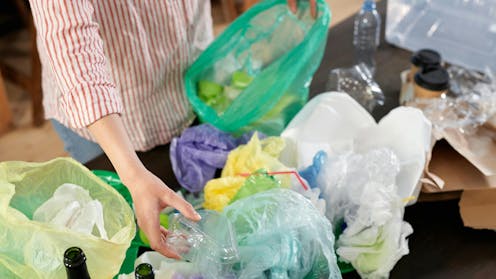
Imagine the weight of three Sydney Harbour Bridges. Between 2022 and 2023, product manufacturers were responsible for 540,000 tonnes (or three Sydney Harbour Bridges) of soft plastic packaging in Australia. Even worse, only 6% was recovered for recycling.
Following the spectacular collapse of REDcycle’s recycling program a few years ago, Australians discovered that instead of being recycled as promised, huge stockpiles of soft plastics had been secretly stockpiled in warehouses.
The consumer watchdog, the Australian Competition and Consumer Commission, is proposing a new voluntary scheme where supermarkets and manufacturers work together to collect and recycle soft plastics. Public submissions on the scheme are due by next Monday, August 25.
So what’s being proposed? And how could buying more food without plastic packaging potentially save you money?

How the new recycling scheme would work
The commission’s proposed industry-led scheme aims to collect and recycle more soft plastic packaging from consumers, such as shopping bags and food packaging. Once approved, the program is proposed to run for eight years, with an initial review after three.
Australia’s three largest supermarket chains – Woolworths, Coles and Aldi – are all involved, along with multinational food manufacturers Nestle, Mars and McCormick Foods. It would be run by Soft Plastics Stewardship Australia, a not-for-profit industry body overseen by a board of senior supermarket and manufacturing executives.
It would be funded through a levy on the companies involved. For example, when a manufacturer sells its product to a supermarket, the manufacturer will have “placed” the soft plastic on the market – so they would pay.
The levy would start at A$160 per tonne of soft plastic and is expected to increase over time.
The companies involved may decide to pass on the cost of the levy through the supply chain, including to consumers. So it remains to be seen who’ll end up paying.
Other countries have taken a different approach. For example, in Germany producers have to take back and recycle any packaging from consumers free of charge.
Why soft plastics are hard to recycle
“Soft” plastics are used by manufacturers, suppliers and supermarkets to package everything from fresh produce, frozen foods, chip packets, muesli bar wrappers and deli counter film, to the inner and outer packaging on countless other supermarket items.
Soft plastics are made up of multiple layered and flexible materials, making them difficult to recycle.
They are often contaminated with food, and their “soft” nature tends to jam conventional sorting and processing machinery. They also take up a lot of space without yielding much usable material, making the whole process uneconomical for recycling organisations.
Why is so much supermarket food pre-packed?
For stores, it keeps things moving: pre-weighed packs speed up checkouts, cut staff time, and prolong shelf life for some products. That thin film on a cucumber can stretch its life from 3 days to 14.
Packaging also standardises portions, allows for company branding and promotion, and makes stock easier to store, stack and transport.
For shoppers, the appeal is convenience and familiarity.
When you’re in a hurry, it’s often simpler to grab what’s ready to go than to think about how much food you actually need, and the extra plastic you’ll bring home.
Read more: Why 'best before' food labelling is not best for the planet or your budget
Buying unpackaged food could save you money
Commendable as it is, on its own the proposal for a new recycling scheme is not a long-term fix. Technical solutions to environmental problems – such as recycling soft plastics – can stop us dealing with the ultimate cause: our own behaviour.
Economists call this “moral hazard”. A classic example is drivers who are insured take greater risks when driving. Or in this case, knowing the plastic will be recycled means many of us could feel we don’t need to reduce our plastic use.
But while systematic change is clearly needed, as shoppers we can do our bit – and there can be payoffs for doing so.
Selecting loose fresh fruit and vegetables allows you to check for ripeness and avoid hidden spoilage.
It’s often also cheaper. Last year, Choice compared supermarket unit prices of a range of foods sold both loose and pre-packed. They found loose produce was cheaper 50% of the time, while prepackaged was cheaper 35% of the time (15% it was about the same).
Thinking beyond recycling
We need more profound changes to tackle our local and global packaging waste crisis.
One example is zero-waste shops that sell everything loose, from fresh food to dry goods and liquids.
We can start by changing our behaviour from the bottom up, avoiding pre-packaged goods as much as practical.
But manufacturers and supermarkets need to do their part too, giving shoppers more choice with more loose products and less plastic.
A sustainable solution to too much plastic has to go beyond recycling, otherwise our Harbour Bridge-sized stockpiles will continue to grow.
Authors: Louise Grimmer, Associate Professor of Marketing, Tasmanian School of Business and Economics, University of Tasmania


 Daily Bulletin


