

Read The Times Australia

Daily Bulletin

‘There’s no such thing as someone else’s children’ – Omar El Akkad bears witness to the destruction of Gaza and the West’s quiet assent

  • Written by: Clare Corbould, Associate Professor of History and Associate Head (Research) of the School of Humanities and Social Sciences, Deakin University
‘There’s no such thing as someone else’s children’ – Omar El Akkad bears witness to the destruction of Gaza and the West’s quiet assent

Omar El Akkad does not want you to look away. An award-winning journalist and novelist, El Akkad was born in Egypt, lived as a teenager in Qatar and Canada, and migrated as an adult to the US, where he now lives with his family in the Pacific Northwest.

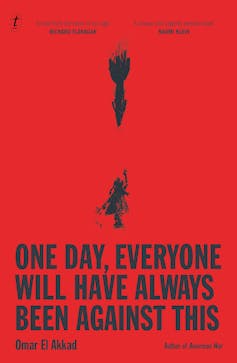
His essay collection, One Day, Everyone Will Have Always Been Against This, draws on his life, from childhood to new fatherhood. He combines these reflections with a sharp grasp of modern history to examine responses in the West to “the world’s first livestreamed genocide” in Gaza.

Finding that response wanting, he urges readers to watch, listen, reflect and act.

Review: One Day, Everyone Will Have Always Been Against This – Omar El Akkad (Text Publishing)

As someone whose parents migrated to the West for the freedoms and opportunities it would afford their children, El Akkad has an acute sense of the past events, ideas and structures that have shaped the present. He pays keen attention to the legacies of colonial rule.

Witnessing history

El Akkad’s descriptions of atrocity are not easy to read. Nor is his blunt demand to do something. Yet the force of his observations and the bite of his prose make it hard to turn away. His purpose is akin to many famed witnesses in history. Contemporaneous statements about violence often serve later as testimony in determining what happened, who was responsible, and what recompense is due. Think of George Orwell on propaganda in Spain. Or British journalists Gareth Jones and Malcolm Muggeridge exposing famine in 1930s USSR, while other western communists looked away. Or Victor Klemperer’s diaries, published after the war, which tracked how the Nazis twisted everyday speech. Above all, this kind of testimony guards against future claims of innocence, against the reassuring assertion that “they didn’t know what was going on” or “they were of their time”. Less well-known to Australian readers may be American journalist Ida B. Wells, but El Akkad’s fire and fury also brought her to mind. In the 1890s, Wells fiercely attacked lynching in her own newspaper, the Memphis Free Speech. She investigated specific instances of ritualised mob violence. Wells also catalogued how news outlets told those stories. They minced words to protect the perpetrators, while smearing the reputations of the dead, who were always named. El Akkad also pays close attention the way the violence in Gaza is framed and described. He observes how reporters use the passive voice, which not only hides the names of killers but implies mass death came about by accident or magic. “Palestinian Journalist Hit in Head by Bullet During Raid on Terror Suspect’s Home,” read one Guardian headline, he notes. Both Wells and El Akkad show how victims of racist and colonial violence are cast as already guilty. With lynching, the pretext was often an accusation of rape, though that was rarely the actual spark. Far more common were disputes between men over land, pay, labour organising, business competition or voting drives. In the case of Gaza, the media mimics the claims of Israeli politicians, its military and allies of both. They all cast civilians as terrorists or terrorists-in-waiting, even children. The words clean the consciences of onlookers. They launder harm as if it were cash.
A Palestinian man carries the body of his 7-year-old nephew, Alaa Al-Toum, killed in an Israeli airstrike, during his funeral at Shifa Hospital, Gaza City, August 16, 2025. Jehad Alshrafi/AAP

Modes of resisting

As the book’s title, which began life as a viral tweet, goes: One Day, Everyone Will Have Always Been Against This.

Bearing witness to the atrocities and the gutless responses, El Akkad reminds liberal readers that if Gaza had happened in the past, they would condemn the violence. What’s more, they would imagine that, had they been alive at the time, they would have firmly resisted the wrong or even taken a heroic stance against it.

One blistering passage will hit very close to home for Australian readers:

I read an op-ed in which a writer argues that the model for Palestinian-Israeli coexistence is something like Canada’s present-day relationship with the Indigenous population, and I marvel at the casual, obvious, but unstated corollary: that there is an Indigenous population being colonized, but that we should let this unpleasantness run its course so we can arrive at true justice in the form of land acknowledgments at every Tel Aviv poetry reading.

As well as diagnosing the problem, El Akkad surveys and evaluates modes of resisting what is happening in Gaza. He discards as ineffective the old appeal to westerners’ self-interest. Pointing out that horrors they permit elsewhere will eventually come for them just doesn’t work.

His essays were written between the Hamas attack on Israel on October 7, 2023, and August 2024, when the US presidential campaign was in full swing. Much of his energy goes to addressing the “lesser of two evils” debate about voting in a democracy where the options are far right and, at most, centre-a-bit-left. Only from a relatively protected position, he observes, could one vote for the Democratic Party on the grounds that the other side “would be so much worse”.

Making this case, El Akkad says, rests on a quiet assent to mass death. He calls this a “reticent acceptance of genocide” and asks liberals in the United States (and by implication in other western democracies) to examine their consciences.

Palestinians walk through the destruction caused by the Israeli air and ground offensive in Jabaliya, Gaza Strip, January 29, 2025. Mohammad Abu Samra/AAP

The remedying action El Akkad proposes is widespread negation, or “walking away”. People, en masse, must refuse to accept that the meagre promises of the less conservative political parties are the best options on offer.

This will require sacrifices. El Akkad provides examples of people he admires: the writer who refused a prize from an organisation that had been silent about Gaza; the teacher brave enough to talk with teenage students about the intolerable rate of children and civilians (not “noncombatants”) dying. Most starkly, he writes of Aaron Bushnell, the US Air Force veteran, whose last words before setting himself on fire outside the Israeli embassy in Washington D.C. were “free Palestine”.

Systematic violence

Like Wells, El Akkad links systematic violence to the structures that underpin the modern world. Chief among them is capitalism. Real change, he suggests, will come when enough of us, to use the old 1960s parlance, “drop out”, though he prefers “negation”, a word that that implies there is something to defy.

Omar El Akkad. Text Publishing

It is time, he argues, for a well-educated western citizenry to say “enough”. Our phones are smart enough; we are (collectively) rich and sated enough.

It might be hard at first, but we will learn that “maybe it’s not all that much trouble to avoid ordering coffee and downloading apps and buying chocolate-flavored hummus from companies that abide slaughter”.

Doing so might just halt a genocide. In time, this kind of collective action might also stop other looming calamities, not least climate collapse. El Akkad’s steady focus throughout the book on the death, maiming and immeasurable psychic injury to the children of Gaza makes that case feel urgent.

If that sounds hyperbolic, El Akkad might ask what children you had in mind when you flinched from his diagnosis and prognosis. Your answer likely turns on the location, colour and wealth of the children you have in mind. Children in Tuvalu, for example, know he is not exaggerating.

In one of the book’s most arresting lines, El Akkad asks: “How does one finish the sentence: ‘It is unfortunate that tens of thousands of children are dead, but …’”

Better, he suggests, that we all behave in a way whose ethics is grounded in the claim: “there’s no such thing as someone else’s children.”

Omar El Akkad will be appearing at the Wheeler Centre, Melbourne, on October 22, 2025

Authors: Clare Corbould, Associate Professor of History and Associate Head (Research) of the School of Humanities and Social Sciences, Deakin University

Read more https://theconversation.com/theres-no-such-thing-as-someone-elses-children-omar-el-akkad-bears-witness-to-the-destruction-of-gaza-and-the-wests-quiet-assent-251615

Business News

How Immigration Lawyers Can Help

Introduction Visa decisions can shape employment, family life, study plans, travel, and future residence. A small omission can lead to delay, added expense, or refusal. Immigration lawyers assess l...

Daily Bulletin - avatar Daily Bulletin

How Industrial Drying Equipment Supports Efficient Processing

Many industrial processes require moisture to be removed from compressed air, products or process materials before they move to the next stage. Excess moisture can affect equipment performance, produc...

Daily Bulletin - avatar Daily Bulletin

Practical Ways a Whiteboard Can Improve Workplace Communication

Effective communication helps teams stay organised, share ideas and keep track of important information. While digital tools are now common in many workplaces, a whiteboard continues to provide a simp...

Daily Bulletin - avatar Daily Bulletin

Designing Eco-Friendly Custom Water Bottles for Your Next Event

The Evolution of Sustainable Event Merchandise Event planning has undergone a massive transformation over the last decade. Gone are the days when organizers could hand out cheap, single use plastic...

Daily Bulletin - avatar Daily Bulletin

Why Choosing a Professional Florist Melbourne Makes Flower Delivery Impactful

Flowers have a great power to speak when humans cannot express their feelings with right words. Flowers are the best gifts when you are celebrating a birthday or welcoming a newborn child into your fa...

Daily Bulletin - avatar Daily Bulletin

The Business Case for Choosing Australian Fabricators Over Imported Alternatives

For a long time, you might have defaulted to overseas suppliers when sourcing fabricated metal components for a project. The unit price was lower on paper, and the maths seemed straightforward. That...

Daily Bulletin - avatar Daily Bulletin

Australian organisations are relying on business continuity plans built for a far more predictable world

Tariff escalations, supply chain fragility, geopolitical events, and the ongoing threat of cyber disruption have reshaped the risk environment facing Australian organisations. The problem is that ma...

Daily Bulletin - avatar Daily Bulletin

How to Rent a Car for Uber in Melbourne: What Every New Driver Needs to Know

Starting out as an Uber driver in Melbourne is not as complicated as it sounds but getting the vehicle right is where most new drivers get stuck. Uber has strict requirements around vehicle age, condi...

Daily Bulletin - avatar Daily Bulletin

When Should You Speak to a Lawyer About a Legal Issue?

Legal issues can begin with a simple question, then become harder to manage once formal steps are involved. Many people wait until a matter feels urgent before seeking guidance, even though earlier ...

Daily Bulletin - avatar Daily Bulletin

The Daily Magazine

Choosing an ELISA Format That Matches Your Target

A colorimetric ELISA ends with a plate that has developed color, and the instinct is to read more ...

Why Accurate Measurements Matter When Ordering Flatpack Cabinets

Ordering flatpack cabinets can make a renovation or storage project more manageable, but the proce...

How Long Does Interstate Freight Take in Australia?

If you have ever arranged for stock, equipment or materials to travel from one Australian state to a...

How AEC Firms Can Scale Faster Without Sacrificing Project Quality

Growth presents a fundamental dilemma for architecture, engineering, and construction firms: expan...

What Makes an Aesthetic Clinic Worth Going Back To?

Trying an aesthetic clinic for the first time can feel like a bit of a gamble. You can read review...

Elevate Your Morning Routine with Cafe-Style Coffee at Home with the Right Coffee Machine

There's something magical about that first sip of coffee in the morning. It’s more than just a bev...

Top Garment Steamers for Busy Professionals in Australia

The gap between garment steamers built for a quick touch-up and ones built to keep pace with a wor...

Correct Sleeping Posture to Minimize Back Strain

Most people don’t pay much attention to how they sleep until they start waking up with a stiff bac...

Why Product Longevity Matters for Sustainable Australian Buildings

Sustainability in building design is often associated with recycled materials, renewable resources a...