

Auckland is NZ’s ‘primate city’ but its potential remains caged in by poor planning and vision
- Written by: Timothy Welch, Senior Lecturer in Urban Planning, University of Auckland, Waipapa Taumata Rau
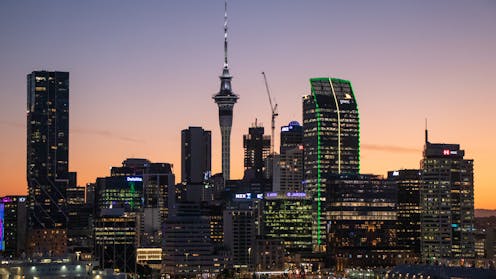
The recent report comparing Auckland to nine international peer cities delivered an uncomfortable truth: our largest city is falling behind, hampered by car dependency, low-density housing and “weak economic performance”.
The Deloitte State of the City analysis was no surprise to anyone who has watched successive governments treat the city as a problem to manage, rather than an engine to fuel.
The report’s findings were stark: Auckland rates 82nd out of 84 cities globally for pedestrian friendliness, and its car-dependent transport system is more carbon-intensive and slower to decarbonise than peer cities.
This is the direct result of decades of planning failures, including what urban researchers call the 1970s “great down-zoning” which halved central Auckland’s housing capacity.
This isn’t just Auckland’s problem. When we mismanage what geographers call a “primate city,” it reveals our fundamental misunderstanding of how modern economies work.
The concept of the primate city was formalised by geographer Mark Jefferson in 1939. Such cities are defined as being “at least twice as large as the next largest city and more than twice as significant”.
Auckland fits this definition perfectly. With more than 1.7 million people, it is over four times larger than Christchurch or the greater Wellington region. The city accounts for 34% of New Zealand’s population and is projected to hit 40% of the working-age population by 2048.
Auckland contributes 38% of New Zealand’s gross domestic product and its per-capita GDP is 15% higher than the rest of the country’s. Its most productive area, the central business district, enjoys a 40% productivity premium over the national average.
To economists, these numbers represent the “agglomeration benefits” research shows primate cities generate. It is the economic effect of combining businesses, talent and infrastructure.
Yet New Zealand systematically underinvests in the very place generating this outsized economic contribution.
A pattern of infrastructure failure
Auckland’s infrastructure deficit follows a predictable pattern. The City Rail Link, while progressing, has grown from an initial budget of NZ$2-3 billion to $5.5 billion, with opening delayed until 2026.
Light rail was cancelled entirely after years of planning. A second harbour crossing has been studied for decades without a shovel hitting dirt. Each represents billions in opportunity costs while congestion worsens.
This goes well beyond project mismanagement. It is a deep structural problem.
The Infrastructure Commission-Te Waihanga identifies a $210 billion national infrastructure shortfall, with Auckland bearing a disproportionate burden despite generating a disproportionately high level of revenue.
International research by the OECD shows successful countries treat metropolitan regions as engines of national growth, not a burden.
The ‘Wellington problem’
Public policy expert Ian Shirley called it the “Wellington Problem”: the way Auckland’s governance became an obsession for politicians and bureaucrats based in Wellington.
The tension dates to 1865 when the capital was moved from Auckland to Wellington, establishing a pattern where political power was deliberately separated from economic power.
Auckland loses an estimated $415.35 million annually in GST collected on rates. This goes to Wellington and into government revenue rather than being reinvested locally. Central government properties in Auckland, worth $36.3 million in rates, are exempt from payment while still using Auckland’s infrastructure.
When Auckland speaks with “one voice” through its unified council, Wellington responds with legislative overrides.
The recent National Land Transport Programme, for example, cut Auckland’s transport funding by $564 million. Mayor Wayne Brown said the government’s transport policy “makes zero sense for Auckland”.
Learning from others
The contrast with international approaches reveals just how counterproductive New Zealand’s approach has been.
London has an integrated Transport for London authority with congestion charging powers, generating £136 million annually for reinvestment. Paris is investing more than €35 billion in the Grand Paris Express transit project.
Japan’s “Quality Infrastructure Investment” principles include ¥13.2 trillion in regional infrastructure investment. Australia’s A$120 billion infrastructure programme explicitly recognises its largest cities contribute over 50% of GDP and require proportional investment.
Research has shown excessive urban concentration in one country can create problems. But denying the primate city resources only leads to a “deterioration in the quality of life” that drags down the entire national economy.
The solution lies in making strategic investments that maximise the benefits of agglomeration while managing any negative costs to the national economy.
Growing pains
Auckland isn’t a problem to be managed, it is an asset to be leveraged. Every successful developed economy has learned this lesson. Paris generates 31% of France’s GDP and gets treated accordingly.
Seoul produces 23% of South Korea’s output and receives massive infrastructure investment. Tokyo drives Japan’s economy.
The international evidence is unambiguous: countries that strategically invest in their primate cities achieve higher productivity growth and maintain competitive advantages.
Auckland doesn’t need sympathy or special treatment. It needs what every primate city in every successful economy gets: infrastructure investment proportional to its economic contribution, governance structures that reflect its scale, and political leadership that understands agglomeration economics.
The question isn’t whether Auckland is too big. The question is whether New Zealand is big enough to nurture its primate city.
Authors: Timothy Welch, Senior Lecturer in Urban Planning, University of Auckland, Waipapa Taumata Rau


 Daily Bulletin


