

Was the Air India crash caused by pilot error or technical fault? None of the theories holds up – yet
- Written by: Guido Carim Junior, Senior Lecturer in Aviation, Griffith University
Over the weekend, the Indian Aircraft Accident Investigation Bureau released a preliminary report on last month’s crash of Air India flight 171, which killed 260 people, 19 of them on the ground.
The aim of a preliminary report is to present factual information gathered so far and to inform further lines of inquiry. However, the 15-page document has also led to unfounded speculation and theories that are currently not supported by the evidence.
Here’s what the report actually says, why we don’t yet know what caused the crash, and why it’s important not to speculate.
What the preliminary report does say
What we know for certain is that the aircraft lost power in both engines just after takeoff.
According to the report, this is supported by video footage showing the deployment of the ram air turbine (RAT), and the examination of the air inlet door of the auxiliary power unit (APU).
The RAT is deployed when both engines fail, all hydraulic systems are lost, or there is a total electrical power loss. The APU air inlet door opens when the system attempts to start automatically due to dual engine failure.
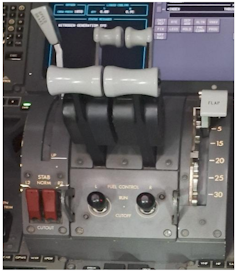
The preliminary investigation suggests both engines shut down because the fuel flow stopped. Attention has now shifted to the fuel control switches, located on the throttle lever panel between the pilots.

Data from the enhanced airborne flight recorder suggests these switches may have been moved from “run” to “cutoff” three seconds after liftoff. Ten seconds later, the switches were moved back to “run”.
The report also suggests the pilots were aware the engines had shut down and attempted to restart them. Despite their effort, the engines couldn’t restart in time.
We don’t know what the pilots did
Flight data recorders don’t capture pilot actions. They record system responses and sensor data, which can sometimes lead to the belief they’re an accurate representation of the pilot’s actions in the cockpit.
While this is true most of the time, this is not always the case.
In my own work investigating safety incidents, I’ve seen cases in which automated systems misinterpreted inputs. In one case, a system recorded a pilot pressing the same button six times in two seconds, something humanly impossible. On further investigation, it turned out to be a faulty system, not a real action.
We cannot yet rule out the possibility that system damage or sensor error led to false data being recorded. We also don’t know whether the pilots unintentionally flicked the switches to “cutoff”. And we may never know.
As we also don’t have a camera in the cockpit, any interpretation of pilots’ actions will be made indirectly, usually through the data sensed by the aircraft and the conversation, sound and noise captured by the environmental microphone available in the cockpit.
We don’t have the full conversation between the pilots
Perhaps the most confusing clue in the report was an excerpt of a conversation between the pilots. It says:
In the cockpit voice recording, one of the pilots is heard asking the other why did he cutoff. The other pilot responded that he did not do so.
This short exchange is entirely without context. First, we don’t know who says what. Second, we don’t know when the question was asked – after takeoff, or after the engine started to lose power? Third, we don’t know the exact words used, because the excerpt in the report is paraphrased.
Finally, we don’t know whether the exchange referred to the engine status or the switch position. Again, we may never know.
What’s crucial here is that the current available evidence doesn’t support any theory about intentional fuel cutoff by either of the pilots. To say otherwise is unfounded speculation.
We don’t know if there was a mechanical failure
The preliminary report indicates that, for now, there are no actions required by Boeing, General Electric or any company that operates the Boeing 787-8 and/or GEnx-1B engine.
This has led some to speculate that a mechanical failure has been ruled out. Again, it is far too early to conclude that.
What the preliminary report shows is that the investigation team has not found any evidence to suggest the aircraft suffered a catastrophic failure that requires immediate attention or suspension of operations around the world.
This could be because there was no catastrophic failure. It could also be because the physical evidence has been so badly damaged that investigators will need more time and other sources of evidence to learn what happened.
Why we must resist premature conclusions
In the aftermath of an accident, there is much at stake for many people: the manufacturer of the aircraft, the airline, the airport, civil aviation authority and others. The families of the victims understandably demand answers.
It’s also tempting to latch onto a convenient explanation. But the preliminary report is not the full story. It’s based on very limited data, analysed under immense pressure, and without access to every subsystem or mechanical trace.
The final report is still to come. Until then, the responsible position for regulators, experts and the public is to withhold judgement.
This tragedy reminds us that aviation safety depends on patient and thorough investigation – not media soundbites or unqualified expert commentary. We owe it to the victims and their families to get the facts right, not just fast.
Authors: Guido Carim Junior, Senior Lecturer in Aviation, Griffith University


 Daily Bulletin


