

I’ve seen the brain damage contact sports can cause – we all need to take concussion and CTE more seriously
- Written by: Alan Pearce, Professor, Adjunct Research Fellow, School of Health Science, Swinburne University of Technology
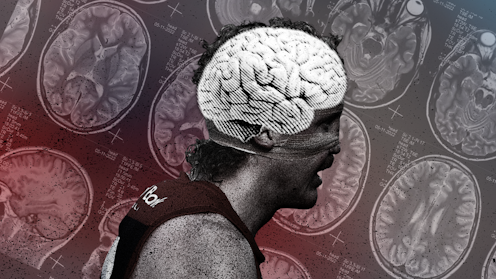
Concussion in sport continues to make headlines, whether it be class actions, young men flocking to the highly violent “RunIt” activity or debate about whether Australian rules football should remove the “bump” once and for all.
Bringing this weighty issue to greater prominence are the former athletes who bravely share their long-term health struggles after careers in sport – cognitive impairments, mental health issues or concerns about neurodegenerative disease, specifically chronic traumatic encephalopathy (CTE).
Yet for all the progress made by many sports in recent years, it feels like we still have not fully grasped the understanding of CTE – or maybe we don’t want to.
Remind me again, what is CTE?
CTE is a neurodegenerative brain disease, just like dementia, motor neurone disease (MND) and Parkinson’s disease.
Expert groups agree on the links between traumatic brain injury and increased risk of Alzheimer’s disease (and other dementias), and the growing evidence of links to MND and Parkinson’s.
People who have never had a traumatic brain injury can still regrettably suffer from these diseases. However, while CTE is rare in the general population, those with a history of repetitive impacts to the brain are more at risk.
These impacts may not be diagnosed brain injuries or concussions, but rather non-concussive impacts (smaller hits that do not produce signs or symptoms of concussion).
Contrary to anecdotal opinion, an athlete’s concussion history is not the crucial variable in risk and severity of CTE.
Emerging international evidence, including my own recently published studies, show the risk of developing CTE (and its severity) is linked to exposure: the age a person starts full contact sport and the length of a playing career.
The grey area of concussion, CTE and mental health
Currently, CTE cannot be diagnosed in living people.
However in understanding the progression of the disease in those who have passed away with CTE, families have described signs and symptoms including cognitive impairments such as:
- Parkinsonism
- memory loss
- trouble with planning and organising tasks
- impulsive behaviours
- anger and irritability
- emotional instability
- substance misuse
- suicidal thoughts/behaviour.
While these signs and symptoms can overlap with those we associate with mental health, this does not necessarily mean the affected person had “mental health concerns”.
The continued awareness in men’s mental health is a good thing broadly but it has sometimes misappropriated CTE as a mental health issue. For example, some fundraising games in the names of athletes who have died with CTE are being channelled to mental health charities and institutes, confusing the wider community.
Consequently two recent tragic stories, one from the family of deceased former AFL player Shane Tuck and the other from Amanda Green, the widow of the late NRL player and coach Paul Green, needed to be told.
Their stories contradicted widely held beliefs in the media and among fans that Tuck or Green were suffering with a psychiatric disease prior to their untimely deaths. In fact, they had CTE.
An uncomfortable conversation
So, why aren’t we talking about CTE more?
The answer is, unfortunately it is an inconvenient truth.
Considering CTE is entirely preventable if we remove exposure risk of repetitive hits to the head, the solution is to further modify many of our most popular sports to make head impacts much rarer.
There is sizeable opposition to this idea.
“Now is not the time to discuss such ‘political’ issues,” is the response I usually get from academics and colleagues involved in these sports, and even football loving friends, when I try to raise awareness.
This continued hesitation only slows the science of CTE further.
If an athlete’s family has been courageous in donating their brain to the Australian Sports Brain Bank and CTE has been found, the standard response from sports organisations is:
the (insert sport here) takes athlete health and wellbeing as its greatest priority […] the (insert sport here) has implemented strict concussion protocols and continues research into athletes’ brain health.
Even a Senate parliamentary inquiry has done little to change the situation.
In fact, while most sports have tried to become safer through rule changes, progress more broadly has plateaued or even regressed in recent years.
Take one recent example in the NRL, when some in the rugby league community made light of the multiple concussions suffered by Victor Radley. After playing his 150th game, he posed smiling with a t-shirt detailing the number of concussions he had suffered during his career. His club, the Sydney Roosters, posted the photo on Instagram before it was later removed.
Even more worrying is a new controversial activity called “RunIt”, which involves two men running full speed at each other with the intention of knocking over (or more aptly knocking out) the opponent.
A recent death of a New Zealand teenager playing RunIt has highlighted the dangers.
What more can be done?
With the help of the Concussion Legacy Foundation, experts around the world, including myself, have produced a CTE prevention protocol. This does not mean banning any sports but rather modifying components that will reduce exposure risk.
Here are five ideas I believe would make a difference.
1. Reducing contact loads in training, particularly in pre-season training.
2. Modify contact sports for children until the age of 14. This potentially removes six to eight years of incidental and unnecessary hits to kids’ heads. They can still play and learn all the fundamental motor skills and enjoy the psychological benefits of sport before graduating to the full version of the game at 14.
3. Influential media commentators need to upskill themselves around CTE and to not be afraid to mention CTE rather than deferring to “concussion protocols”.
4. Medical and allied health practitioners do not regularly screen for concussion or contact sport playing history when assessing a patient who is struggling with movement disorders, chronic headaches/fatigue or cognitive/behavioural impairments. Repetitive head impact history should be screened just like alcohol and drug use history.
5. When an athlete suddenly and tragically dies, we need to include, along with emergency help lines, information for help and support for those unsure about CTE.
Unfortunately, if we don’t have the political will to acknowledge CTE and act, more families will be grieving tragic deaths of athletes. These families may not even be aware of CTE.
This does not make me anti-sport, but pro-athlete. Let’s all become pro-athlete for the sake of our sports and the people who play them.
Authors: Alan Pearce, Professor, Adjunct Research Fellow, School of Health Science, Swinburne University of Technology


 Daily Bulletin


