

Read The Times Australia

Daily Bulletin

What’s a ‘Strombolian eruption’? A volcanologist explains what happened at Mount Etna

  • Written by: Teresa Ubide, ARC Future Fellow and Associate Professor in Igneous Petrology/Volcanology, The University of Queensland
What’s a ‘Strombolian eruption’? A volcanologist explains what happened at Mount Etna

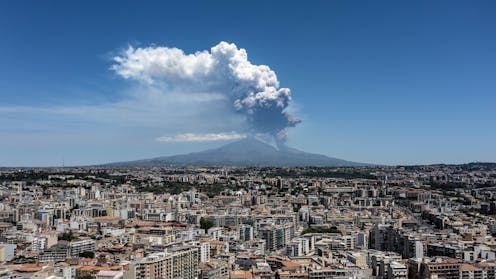
On Monday morning local time, a huge cloud of ash, hot gas and rock fragments began spewing from Italy’s Mount Etna.

An enormous plume was seen stretching several kilometres into the sky from the mountain on the island of Sicily, which is the largest active volcano in Europe.

While the blast created an impressive sight, the eruption resulted in no reported injuries or damage and barely even disrupted flights on or off the island. Mount Etna eruptions are commonly described as “Strombolian eruptions” – though as we will see, that may not apply to this event.

What happened at Etna?

The eruption began with an increase of pressure in the hot gases inside the volcano. This led to the partial collapse of part of one of the craters atop Etna.

The collapse allowed what is called a pyroclastic flow: a fast-moving cloud of ash, hot gas and fragments of rock bursting out from inside the volcano.

Two thermal images of a mountain.
Thermal camera images show the eruption and flows of lava down the side of Mount Etna. National Institute of Geophysics and Volcanology, CC BY

Next, lava began to flow in three different directions down the mountainside. These flows are now cooling down. On Monday evening, Italy’s National Institute of Geophysics and Volcanology announced the volcanic activity had ended.

Etna is one of the most active volcanoes in the world, so this eruption is reasonably normal.

What is a Strombolian eruption?

Volcanologists classify eruptions by how explosive they are. More explosive eruptions tend to be more dangerous, because they move faster and cover a larger area.

At the mildest end are Hawaiian eruptions. You have probably seen pictures of these: lava flowing sedately down the slope of the volcano. The lava damages whatever it runs into, but it’s a relatively local effect.

As eruptions grow more explosive, they send ash and rock fragments flying further afield.

At the more explosive end of the scale are Plinian eruptions. These include the famous eruption of Mount Vesuvius in 79AD, described by the Roman writer Pliny the Younger, which buried the Roman towns of Pompeii and Herculaneum under metres of ash.

Photo of glowing red lava against a black background.
In a Hawaiian eruption, like this one at Mauna Loa, lava flows along the ground and not a lot gets shot into the air. Bruce Omori / Paradise Helicopters / EPA

In a Plinian eruption, hot gas, ash, and rock can explode high enough to reach the stratosphere – and when the eruption column collapses, the debris falls to Earth and can wreak terrifying destruction over a huge area.

What about Strombolian eruptions? These relatively mild eruptions are named after Stromboli, another Italian volcano which belches out a minor eruption every 10 to 20 minutes.

In a Strombolian eruption, chunks of rock and cinders may travel tens or hundreds of metres through the air, but rarely further. The pyroclastic flow from yesterday’s eruption at Etna was rather more explosive than this – so it wasn’t strictly Strombolian.

Can we forecast volcano eruptions?

Volcanic eruptions are a bit like weather. They are very hard to predict in detail, but we are a lot better than we used to be at forecasting them.

To understand what a volcano will do in the future, we first need to know what is happening inside it right now. We can’t look inside directly, but we do have indirect measurements.

Photo of a cloud of ash rising from a volcano with fields in the foreground.
Highly explosive Plinian eruptions like that of Mount Pinatubo in 1991 can cause enormous destruction. Bullitt Marquez / AP

For example, before an eruption magma travels from deep inside the Earth up to the surface. On the way, it pushes rocks apart and can generate earthquakes. If we record the vibrations of these quakes, we can track the magma’s journey from the depths.

Rising magma can also make the ground near a volcano bulge upwards very slightly, by a few millimetres or centimetres. We can monitor this bulging, for example with satellites, to gather clues about an upcoming eruption.

Some volcanoes release gas even when they are not strictly erupting. We can measure the chemicals in this gas – and if they change, it can tell us that new magma is on its way to the surface.

When we have this information about what’s happening inside the volcano, we also need to understand its “personality” to know what the information means for future eruptions.

Are volcanic eruptions more common than in the past?

As a volcanologist, I often hear from people that it seems there are more volcanic eruptions now than in the past. This is not the case.

What is happening, I tell them, is that we have better monitoring systems now, and a very active global media system. So we know about more eruptions – and even see photos of them.

Monitoring is extremely important. We are fortunate that many volcanoes in places such as Italy, the United States, Indonesia and New Zealand have excellent monitoring in place.

This monitoring allows local authorities to issue warnings when an eruption is imminent. For a visitor or tourist out to see the spectacular natural wonder of a volcano, listening to these warnings is all-important.

Authors: Teresa Ubide, ARC Future Fellow and Associate Professor in Igneous Petrology/Volcanology, The University of Queensland

Read more https://theconversation.com/whats-a-strombolian-eruption-a-volcanologist-explains-what-happened-at-mount-etna-258060

Business News

Inside the Icon: The BridgeMuseum Officially Opens at the Sydney Harbour Bridge

A bold new way to experience one of Australia’s most recognisable landmarks has arrived, with BridgeClimb Sydney officially opening the all-new BridgeMuseum.  Located inside the Sydney Harbour Brid...

Daily Bulletin - avatar Daily Bulletin

Is Your Brand Showing Up in AI Search? Most Melbourne Brands Aren't.

The New Front Door Nobody Told You About Something changed. Quietly. Without a press release. The way buyers find businesses in Australia has been rewired. Not replaced, rewired. Google isn't dead...

Daily Bulletin - avatar Daily Bulletin

How Australian Businesses Can Measure SEO ROI

SEO can feel vague when you are staring at a dashboard full of numbers that do not clearly connect to revenue. The key is to measure the right signals in the right order, then tie them back to outcome...

Daily Bulletin - avatar Daily Bulletin

How Commercial Roller Shutters Improve Site Security Without Slowing Operations

Security upgrades can be frustrating when they make everyday work harder. A door that takes too long to open, creates bottlenecks at shift change, or fails at the worst time can turn “better protectio...

Daily Bulletin - avatar Daily Bulletin

Why a Document Destruction Service Still Matters for Modern Businesses

Businesses generate large volumes of information every day, from staff records and contracts to invoices, reports and customer files. While attention often focuses on how documents are stored, the way...

Daily Bulletin - avatar Daily Bulletin

Bicycle Rack Safety and Space-Smart Storage

Bike storage problems usually show up as small annoyances first: tangled handlebars, scratched frames, and bikes that topple when you pull one out. Over time, those issues become safety risks, especia...

Daily Bulletin - avatar Daily Bulletin

How to Tell if a Childcare Centre Is a Good Fit for Your Child

Choosing childcare can feel like you’re making a huge decision with limited information. Tours are short, centres are often on their best behaviour, and your child might act differently in a new space...

Daily Bulletin - avatar Daily Bulletin

Car Import Timeline: What Usually Happens at Each Stage

Importing a car into Australia can feel confusing because multiple agencies and checkpoints are involved, and the timeline is shaped as much by paperwork quality as it is by shipping speed. The most u...

Daily Bulletin - avatar Daily Bulletin

Portable Toilet Hygiene Standards Explained: Clean vs Sanitised vs Disinfected

In portable toilet servicing, the words clean, sanitised, and disinfected often get used as if they mean the same thing. They don’t. And that difference matters because a unit can look tidy and still ...

Daily Bulletin - avatar Daily Bulletin

The Daily Magazine

What Actually Makes a Good Criminal Lawyer in Melbourne

Most people only think about this question once. That is usually too late. Most people charged wi...

Why Working With A Chatswood Tutor Can Improve Academic Performance

Academic expectations continue increasing for students across primary school, high school, and senio...

Is It Worth Getting Solar Panels in Melbourne?

The real question is not whether solar works in Melbourne. It works. The question is what it is co...

How A Diploma Of Project Management Builds Practical Skills For Modern Work Environments

Developing the ability to plan, execute, and deliver outcomes efficiently is a key requirement in to...

How to Choose the Right Football for Every Level

Choosing a football may seem straightforward, but the right option depends on who will be using it a...

What to Ask a Wedding Photographer Before You Book

Booking a wedding photographer can feel deceptively simple: you like the photos, you like the vibe...

Why Stress Relief For Dogs Is Essential For Emotional Balance And Long-Term Wellbeing

Managing emotional health is just as important as physical care when it comes to pets, which is why ...

Australia’s Best Walking Trails and the Shoes You Need to Tackle Them

Australia is not short on spectacular walks. You can follow ocean cliffs in Victoria, cross ancien...

Why Pre-Purchase Building Inspections Are Essential Before Buying a Home in Australia

source Have you ever walked through an open home and started picturing your furniture, family d...