

It’s almost winter. Why is Australia still so hot?
- Written by: Andrew King, Associate Professor in Climate Science, ARC Centre of Excellence for 21st Century Weather, The University of Melbourne
This year, for many Australians, it feels like summer never left. The sunny days and warm nights have continued well into autumn. Even now, in May, it’s still unusually warm.
Much of the southern half of the continent is experiencing both unseasonable warmth and dry conditions. This is linked to persistent high atmospheric pressure (called “blocking”) to the south and southeast of Australia.
While temperatures will fall across southern Australia as we approach the winter solstice, early indications are that this winter will be a warm one. Rainfall predictions are less certain.
The extra warmth we’ve experienced raises obvious questions about the influence of human-caused climate change. The warming signal is clear and it’s a sign of things to come.
A warm and dry autumn for many
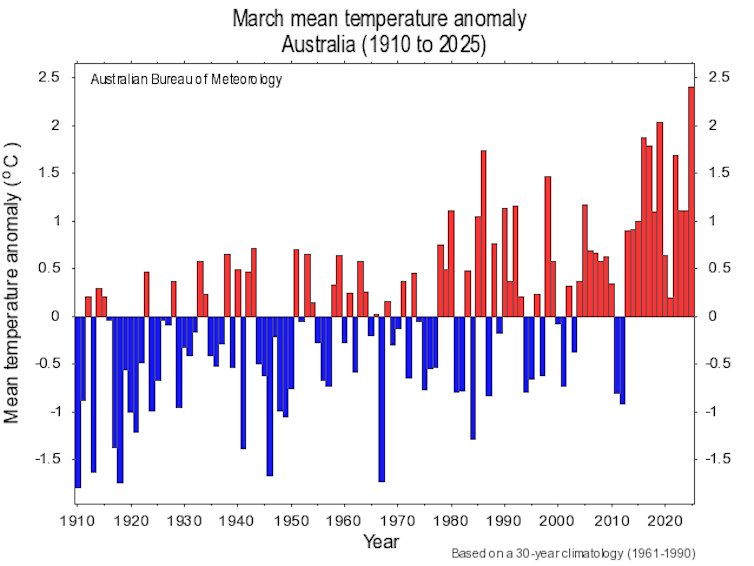
March and April brought unseasonal heat to much of Australia.
March was widely hot, with temperatures several degrees above normal across much of the country. But April’s heat was largely restricted to the southeast.

Victoria had its warmest April on record, and parts of the state experienced temperatures more than 3°C above normal across both March and April.
Temperatures normally fall quite quickly over the southeast of Australia during April and May as the days shorten and the continent’s interior cools. But this year, southern Australia was unusually warm at the start of May. Some locations experienced days with maximum temperatures more than 10°C above normal for the time of year.
Records were broken in Hobart and parts of Melbourne, which had their warmest May nights since observations began.

While Queensland and the New South Wales coast have had very wet spells, including downpours from Tropical Cyclone Alfred at the start of March, other parts of Australia have been quite dry.
The area between Adelaide and Melbourne has been exceptionally dry. A drought is unfolding in the region after a severe lack of rainfall, with deficits stretching back over the past year or so. Western Tasmania is also suffering from a severe lack of rainfall since the start of autumn, although welcome rain fell in the past week.
And it’s not just on land that unusual heat has been observed. The seas around Australia have been warmer than normal, causing severe coral bleaching to the west and east of the continent, harmful algal blooms and other ecosystem disruptions.
 Warm seas likely triggered the microalgal bloom in coastal waters of South Australia.
Anthony Rowland
Warm seas likely triggered the microalgal bloom in coastal waters of South Australia.
Anthony Rowland
Blocking highs largely to blame
A high pressure system has dominated over the south and southeast of Australia over the past few months.
High pressure in the Tasman Sea can sometimes get stuck there for a few days. This leads to what’s known as “blocking”, when the usual passage of weather systems moving from west to east is obstructed. This can lock in weather patterns for several days or even a week.
Repeated blocking occurred this autumn. As winds move anticlockwise around high pressure systems in the Southern Hemisphere, blocking highs in the Tasman Sea can bring moist, onshore winds to the New South Wales and Queensland coasts, increasing rainfall. But such high pressure systems also bring drier conditions for the interior of the southeast and much of Victoria and South Australia.
Often, these high pressure systems also bring northerly winds to Victoria, and this can cause warmer conditions across much of the state.
High pressure systems also tend to bring more clear and sunny conditions, which increases daytime temperatures in particular. Air in high pressure systems moves down towards the surface and this process causes warming, too.
Australia sits between the Pacific and Indian Oceans and is subject to their variability, so we often look there to help explain what’s happening with Australia’s climate. In autumn though, our climate influences, such as the El Niño-Southern Oscillation and the Indian Ocean Dipole, are less active and have weaker relationships with Australian climate than at other times of year. Neither of these climate influences is in a strong phase at the moment.
A warm winter on the cards
One big question is how long the heat will last. In parts of southeast Australia, including Melbourne, average temperatures drop quickly at this time of year as we approach the winter solstice.
However, the seasonal outlook from the Bureau of Meteorology points to a high likelihood of a relatively warm winter.
Australians rarely escape having a winter without any significant cold spells, but the long-range forecast suggests we should anticipate above-normal temperatures on average. Both daytime maximum temperatures and nighttime minimum temperatures are expected to be above average generally this winter.
Climate and water long-range forecast, issued 1 May 2025 (Bureau of Meteorology)Global warming is here
The elephant in the room is climate change. Human-caused climate change is increasing autumn temperatures and the frequency of late season heat events. As greenhouse gas emissions continue at a record pace, expect continued warming and a greater chance of autumn heatwaves in future.
The effect of climate change on rainfall is less clear though. For the vast majority of Australia, there is high uncertainty as to whether autumn will become wetter or drier as the world warms.
Authors: Andrew King, Associate Professor in Climate Science, ARC Centre of Excellence for 21st Century Weather, The University of Melbourne
Read more https://theconversation.com/its-almost-winter-why-is-australia-still-so-hot-256071


 Daily Bulletin


