

Willis warns of a ‘tight’ budget to come, but NZ should be going for productivity, not austerity
- Written by: Dennis Wesselbaum, Associate Professor, Department of Economics, University of Otago
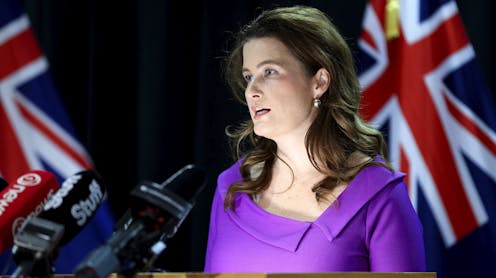
Finance Minister Nicola Willis has warned her 2025 “Growth Budget” will be “one of the tightest budgets in a decade”, with plans to reduce spending by billions.
It’s clear New Zealand is following a global trend towards austerity by focusing on reducing government spending and lowering government debt.
Complicating the economic picture for the government are Donald Trump’s tariffs and his trade war with China. In early April, financial services company J.P. Morgan Research said there was a 60% probability of the United States experiencing a recession in 2025 — with a 40% chance of a global recession.
Despite this uncertain economic future, the idea that New Zealand’s debt-to-GDP ratio requires immediate and drastic austerity-like measures is not supported by the evidence.
The ratio measures the government’s debt compared to its gross domestic product (GDP). Currently, New Zealand’s ratio is about 47%. This is substantially higher than before the pandemic (32% in 2019) and higher than Australia (35%).
But it is at the lower end compared with other advanced economies. The 2023 debt-to-GDP ratio in the US was 112%, 101% in the United Kingdom, and about 50% in Canada, Ireland and South Korea.
Rather than tightening the belt to reduce debt and increase fiscal balance, New Zealand needs to focus on boosting productivity, investing in education, building strong and resilient infrastructure and supporting health and wellbeing.
Lowering debt and creating fiscal space are legitimate goals. But they should be viewed as a means to an end, not an end in itself.
A necessary medicine
Austerity is often presented as necessary medicine during an economic crisis. The logic is seemingly straightforward: reduce government spending and debt to not overstimulate the economy, create fiscal resilience for future shocks, support low and stable inflation, and signal fiscal responsibility to international markets.
Several countries adopted austerity measures in response to high deficits following the global financial crisis.
Greece implemented deep spending cuts, tax hikes and pension reforms under the terms of a bailout from the European Union and International Monetary Fund (IMF). This reduced its deficit but caused a severe economic contraction and social unrest.
Spain similarly cut public wages, raised taxes and reformed pensions, stabilising its finances but causing persistently high unemployment.
Italy’s austerity measures involved pension reforms and tax hikes, achieving modest fiscal improvement but sparking political instability.
The UK focused on reducing public spending and welfare support, significantly lowering its deficit while putting pressure on public services and increasing inequality. Research found UK’s austerity measures led to hundreds of thousands of avoidable deaths.
While in many cases austerity helped restore fiscal balance, it often came with heavy economic and social costs, particularly in terms of unemployment, growth and public welfare.
Productivity is the key
Research indicates that debt-to-GDP ratios above about 80% tend to be associated with lower growth. But below this threshold, the ratio tends to be associated with increases in growth.
It is clear that deficits are neither always bad for economic growth, nor that they always lead to inflation, when combined with a credible fiscal strategy to return to surpluses in the future.
To raise the future wellbeing of all New Zealanders we need to avoid the heavy costs of austerity and rather focus on stimulating economic growth. And this comes with a price tag.
Using debt to finance investments into capital, which in turn increases our productivity, is key to fostering economic growth. This goes hand-in-hand with targeted industrial policies, reduction in regulation, increases in government efficiency and trade liberalisation
Importantly, public investment boosts economic growth mainly through two channels: efficiency (how much infrastructure is actually delivered for the money spent) and productivity (how well that infrastructure supports economic activity).
Research from the IMF suggests an increase in public investment of one percentage point of GDP is associated with an increase in output of about 0.2% in the same year and 1.2% four years later.
All-of-government focus
What New Zealand needs is a long-term growth strategy and an all-of-government focus on lifting productivity. This must be grounded in fiscal responsibility – one that boosts government efficiency. But not at the cost of delaying high-impact investments or leaving growth opportunities on the table.
Maintaining discipline while strategically investing in the drivers of long-term prosperity is essential for securing New Zealand’s economic future.
The path ahead requires careful navigation, not a rush towards austerity.
By thoughtfully balancing the need for fiscal prudence with the importance of investing in our productivity, human capital and infrastructure, we can ensure a more resilient and prosperous future for all New Zealanders.
Authors: Dennis Wesselbaum, Associate Professor, Department of Economics, University of Otago


 Daily Bulletin


