

Why build nuclear power in place of old coal, when you could have pumped hydropower instead?
- Written by: Timothy Weber, Research Officer for School of Engineering, Australian National University
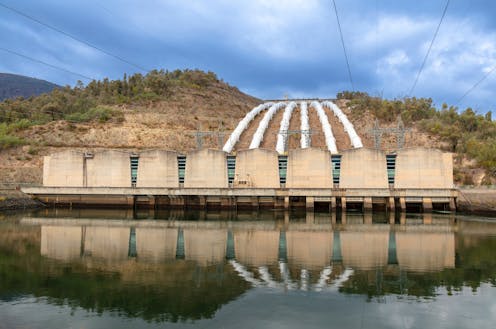
Australia’s energy policy would take a sharp turn if the Coalition wins the upcoming federal election. A Dutton government would seek to build seven nuclear power plants at the sites of old coal-fired power stations.
The Coalition says its plan makes smart use of the existing transmission network and other infrastructure. But solar and wind power would need to be curtailed to make room in the grid for nuclear energy. This means polluting coal and gas power stations would remain active for longer, releasing an extra 1 billion to 2 billion tonnes of carbon dioxide.
So is there another option? Yes: pumped hydro storage plants. This technology is quicker and cheaper to develop than nuclear power, and can store solar and wind rather than curtail it. It’s better suited to Australia’s electricity grid and would ultimately lead to fewer emissions. Drawing on our recent global analysis, we found the technology could be deployed near all but one of the seven sites the Coalition has earmarked for nuclear power.
The Coalition is likely to spend anywhere from A$116 billion to $600 billion of taxpayers’ money to deliver up to 14 gigawatts of nuclear energy. Experts say the plan will not lower power prices and will take too long to build. Our findings suggest cheap storage of solar and wind, in the form of pumped hydro, is a better way forward.
This way, we can continue to build renewable energy capacity while stabilising the grid. More than 45GW of solar and wind is already up and running, with a further 23GW being supported by the Capacity Investment Scheme until 2027. Only a handful of the pumped hydro sites we found would be needed to decarbonise the energy system, reaching the 1,046 gigawatt-hours of storage CSIRO estimates Australia needs.
Building pumped hydro storage systems near old coal-fired power generators has some advantages, such as access to transmission lines – although more will be needed as electricity demand increases. But plenty of other suitable sites exist, too.

Filling the gaps
Pumped hydro is a cheap, mature technology that currently provides more than 90% of the world’s electrical energy storage.
It involves pumping water uphill from one reservoir to another at a higher elevation for storage. Then, when power is needed, water is released to flow downhill through turbines, generating electricity on its way to the lower reservoir.
Together with battery storage, pumped hydro solves the very real problem of keeping the grid stable and reliable when it is dominated by solar and wind power.
By 2030, 82% of Australia’s electricity supply is expected to come from renewables, up from about 40% today.
But solar panels only work during the day and don’t produce as much power when it’s cloudy. And wind turbines don’t generate power when it’s calm. That’s where storage systems come in. They can charge up when electricity is plentiful and then release electricity when it’s needed.
Grid-connected batteries can fill short-term gaps (from seconds to a few hours). Pumped hydro can store electricity overnight, and longer still. These two technologies can be used together to supply electricity through winter, and other periods of calm or cloudy weather.

Finding pumped hydro near the Coalitions’s proposed nuclear sites
Australia has three operating pumped hydro systems: Tumut 3 in the Snowy Mountains, Wivenhoe in Queensland, and Shoalhaven in the Kangaroo Valley of New South Wales.
Two more are under construction, including Snowy 2.0. Even after all the cost blowouts, Snowy 2.0 comes at a modest construction cost of A$34 per kilowatt-hour of energy storage, which is ten times cheaper than the cost CSIRO estimates for large, new batteries.
We previously developed a “global atlas” to identify potential locations for pumped hydro facilities around the world.
More recently, we created a publicly available tool to filter results based on construction cost, system size, distance from transmission lines or roads, and away from environmentally sensitive locations.
In this new analysis, we used the tool to find pumped hydro options near the sites the Coalition has chosen for nuclear power plants.
Mapping 300 potential pumped hydro sites
The proposed nuclear sites are:
- Liddell Power Station, New South Wales
- Mount Piper Power Station, New South Wales
- Loy Yang Power Stations, Victoria
- Tarong Power Station, Queensland
- Callide Power Station, Queensland
- Northern Power Station, South Australia (small modular reactor only)
- Muja Power Station, Western Australia (small modular reactor only).
We used our tool to identify which of these seven sites would instead be suitable for a pumped hydro project, using the following criteria:
We included various reservoir types in our search:
Exactly 300 sites matched our search criteria. No options emerged near the proposed nuclear site in Western Australia, but suitable sites lie further north in the mining region of the Pilbara.
One option east of Melbourne, depicted in the image below, has a storage capacity of 500 gigawatt-hours. Compared with Snowy 2.0, this option has a much shorter tunnel, larger energy capacity, and larger height difference between the two reservoirs (increasing the potential energy stored in the water). And unlike Snowy 2.0, it is not located in a national park.
Of course, shortlisted sites would require detailed assessment to confirm the local geology is suitable for pumped hydro, and to evaluate potential environmental and social impacts.
More where that came from
We restricted our search to sites near the Coalition’s proposed nuclear plants. But there are hundreds of potential pumped hydro sites along Australia’s east coast.
Developers can use our free tool to identify the best sites.
So far, the Australian electricity transition has mainly been driven by private investment in solar and wind power. With all this renewable energy entering the grid, there’s money to be made in storage, too.
Large, centralised, baseload electricity generators, such as coal and nuclear plants, are becoming a thing of the past. A smarter energy policy would balance solar and wind with technologies such as pumped hydro, to secure a reliable electricity supply.
Authors: Timothy Weber, Research Officer for School of Engineering, Australian National University


 Daily Bulletin


