

Read The Times Australia

Daily Bulletin

Australia’s superb lyrebirds ‘farm’ the forest floor to increase their prey – a behaviour rarely seen in nature

  • Written by: Alex Maisey, Postdoctoral research fellow, Research Centre for Future Landscapes, La Trobe University
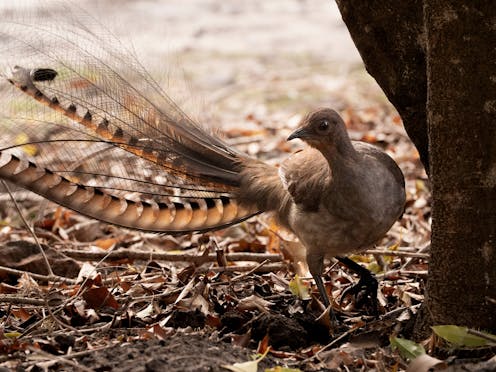
Australia’s superb lyrebirds ‘farm’ the forest floor to increase their prey – a behaviour rarely seen in nature

In wet forests of southeastern Australia, superb lyrebirds engage in extraordinary behaviour – tilling the soil to create habitats for their prey to flourish.

The superb lyrebird scratches through the leaf litter and topsoil while foraging, using its powerful claws to search for invertebrates such as worms, centipedes, spiders, crustaceans and insects.

This loosens the soil, allowing more air and water to infiltrate, and speeding up the decomposition of organic material. Our new study shows this creates an ideal habitat for the invertebrates on which it feeds – ensuring they grow large and ensuring the lyrebirds’ future buffet.

So, lyrebirds essentially “farm” their food resource by cultivating the forest floor. This behaviour is rarely seen in the non-human world. It extends across millions of hectares, potentially delivering far-reaching benefits to forest ecosystems.

A remarkable species

The superb lyrebird is mainly found in moist eucalypt forests in southeastern Australia. It is known for its mimicking song and, in the case of the males, ornate, lyre-shaped tail feathers.

Lyrebirds are considered “ecosystem engineers”. This means their foraging changes the environment in ways that affect other species.

Our previous research has shown superb lyrebirds can move an astounding 155 tonnes of litter and soil per hectare of forest floor each year.

The scale of this disturbance suggests it must affect the invertebrates that live in the soil, including those on which lyrebirds rely for their food. Did this in turn benefit the lyrebirds themselves? Our research set out to test this.

What our research involved

Our two-year project involved three sites in the tall forests of Victoria’s Central Highlands.

At each site, we established three experimental plots (3m × 3m), each involving a different “treatment”.

The first treatment involved fencing off the plot to create a lyrebird-free environment. We left these areas alone for two years.

The second treatment also fenced out lyrebirds. But at these, we visited monthly to rake the litter and soil, mimicking lyrebird foraging and scratching. We used a three-pronged, claw-like rake the same width as a lyrebird’s foot. But unlike the lyrebird, we didn’t eat the bugs we encountered!

In the third treatment, we marked the plots with metal stakes, but no fence. This allowed lyrebirds to forage as they pleased.

We collected a sample of soil and leaf litter from each plot at the start of the study, and then again in each spring season.

Then, with help from a specialist insect scientist, known as an entomologist, we counted and classified the invertebrates in the samples – a whopping 197,880 creatures in all.

three research plots in bush
The research involved three types of ‘treatments’, pictured above from left to right: fenced and left alone, fenced and raked, and unfenced. Author provided, Author provided (no reuse)

What we found

We compared samples from the fenced plots – both those that excluded lyrebirds and prevented them feeding, and those where we raked to mimic lyrebird foraging.

We found the raked plots had more types and a larger amount of invertebrates than the undisturbed plots. This suggests turning over the litter and soil creates conditions for invertebrates to thrive and grow bigger.

Then we compared samples from the raked plots and plots where lyrebirds had been free to forage. Again, invertebrates in the raked areas were bigger and more diverse. This was because in both treatments invertebrates had increased, but some had been eaten by lyrebirds in the unfenced plots.

These results provide evidence – albeit unsurprising – that lyrebird feeding affects the invertebrate community on the forest floor. But it also shows that lyrebird cultivation of the litter and soil allow invertebrates to rapidly increase in number and type, replacing what lyrebirds harvest.

lyrebird foraging
Lyrebird cultivation of the litter and soil allow invertebrates to rapidly increase. Jason Benz Bennee/Shutterstock

Big benefits for forests

Our research shows lyrebirds scratch and modify the forest floor in ways that promote bigger and more diverse food sources. This makes it one of only a few non-human animals known to farm their prey.

Other well-known examples include leaf cutter ants in South America, which grow elaborate fungus “farms” in their nest chambers. The ants weed out unpalatable fungi and select premium leaf matter to feed their crop.

And in West Africa, foraging by both the greater flamingo and the fiddler crab changes mudflats in ways that increase algal biofilms, their shared food resource.

The interaction between lyrebirds and invertebrates has wide benefits for forests. Invertebrates help cycle nutrients and disperse seeds. They also provide food for many birds, small mammals and reptiles.

In this way, the superb lyrebirds’ farming-type behaviour plays an important role in maintaining forest biodiversity. This fascinating behaviour also provides yet another reason to celebrate the complexity of nature.

Authors: Alex Maisey, Postdoctoral research fellow, Research Centre for Future Landscapes, La Trobe University

Read more https://theconversation.com/australias-superb-lyrebirds-farm-the-forest-floor-to-increase-their-prey-a-behaviour-rarely-seen-in-nature-247908

Business News

How Chatswood Tutoring Can Fit Into a Student’s Weekly Routine

Create a Predictable Weekly Structure A consistent weekly routine can make study easier to manage when students are balancing several subjects. Chatswood tutoring can provide a fixed learning point a...

Daily Bulletin - avatar Daily Bulletin

The Rise of Digital Marketplaces in the Australian Trade Sector

For decades, the Australian trade and construction sector operated almost entirely on word-of-mouth recommendations and local community networks. Small business owners typically relied on local newspa...

Daily Bulletin - avatar Daily Bulletin

How Immigration Lawyers Can Help

Introduction Visa decisions can shape employment, family life, study plans, travel, and future residence. A small omission can lead to delay, added expense, or refusal. Immigration lawyers assess l...

Daily Bulletin - avatar Daily Bulletin

How Industrial Drying Equipment Supports Efficient Processing

Many industrial processes require moisture to be removed from compressed air, products or process materials before they move to the next stage. Excess moisture can affect equipment performance, produc...

Daily Bulletin - avatar Daily Bulletin

Practical Ways a Whiteboard Can Improve Workplace Communication

Effective communication helps teams stay organised, share ideas and keep track of important information. While digital tools are now common in many workplaces, a whiteboard continues to provide a simp...

Daily Bulletin - avatar Daily Bulletin

Designing Eco-Friendly Custom Water Bottles for Your Next Event

The Evolution of Sustainable Event Merchandise Event planning has undergone a massive transformation over the last decade. Gone are the days when organizers could hand out cheap, single use plastic...

Daily Bulletin - avatar Daily Bulletin

Why Choosing a Professional Florist Melbourne Makes Flower Delivery Impactful

Flowers have a great power to speak when humans cannot express their feelings with right words. Flowers are the best gifts when you are celebrating a birthday or welcoming a newborn child into your fa...

Daily Bulletin - avatar Daily Bulletin

The Business Case for Choosing Australian Fabricators Over Imported Alternatives

For a long time, you might have defaulted to overseas suppliers when sourcing fabricated metal components for a project. The unit price was lower on paper, and the maths seemed straightforward. That...

Daily Bulletin - avatar Daily Bulletin

Australian organisations are relying on business continuity plans built for a far more predictable world

Tariff escalations, supply chain fragility, geopolitical events, and the ongoing threat of cyber disruption have reshaped the risk environment facing Australian organisations. The problem is that ma...

Daily Bulletin - avatar Daily Bulletin

The Daily Magazine

Choosing Waste Management Solutions for Everyday Business Operations

Considering Different Waste Streams Different materials can require different handling arrangements...

Buying Property with Someone else? Settle these Questions First

Buying a home with a partner, a sibling or a friend can make a purchase possible that neither of you...

How to Handle a Blocked Drain in Bribie Island Before Starting Deck Repairs

Planning an outdoor upgrade brings excitement, but building a beautiful timber deck requires caref...

What to Look For When Selecting an Installation Specialist for Gas Stoves and Water Filters in Brisbane

Upgrading your kitchen or improving your home's water quality requires specialised skills. When mana...

What to Consider Before Cleaning Your Exterior: Deck Pressure Cleaning, Pressure Cleaning, and How Much Does It Cost to Pressure Wash a House?

Maintaining a home's exterior in coastal Sydney requires regular attention to combat salt spray, mou...

Signs Your Trailer Needs Professional Repair Before Its Next Long Haul

A long road trip can put considerable strain on a trailer, particularly when it is carrying heavy ...

Automatic, Manual, CVT or DCT: Which Transmission Suits Australian Drivers?

Australia’s enthusiasm for cars is nothing new. From family SUVs and work utes to compact city cars ...

Cape Town: Full Day Private Cape Peninsula & Cape Point Tour

Embark on an unforgettable adventure with a full day private Cape Peninsula & Cape Point tour...

SMSF Audit Services in Brisbane: What Trustees Should Know Before Hiring One

Every self-managed super fund (SMSF) needs an independent audit each year before its annual return...