

Read The Times Australia

Daily Bulletin

Households are burning plastic waste as fuel for cooking and heating in slums the world over

  • Written by: Bishal Bharadwaj, Adjunct Research Fellow, Curtin Institute for Energy Transition, Curtin University
Households are burning plastic waste as fuel for cooking and heating in slums the world over

Poor people in vast city slums across the Global South are burning plastic to cook their food, warm their homes and boil water for hot showers.

Waste plastic is plentiful and highly flammable. So it’s not surprising people in developing countries, mainly in Africa, Asia and Latin America, are putting it to use – especially as wood is increasingly scarce.

But burning plastic is hazardous, as it releases toxins into the surrounding air – and possibly into the food on the stove.

We wanted to draw attention to this growing problem, which has received little attention to date despite the many potential harms.

In our new “perspective” paper, published in Nature Cities, we explain why so many communities are using plastic as an energy source.

We then explore further research needed and recommend ways for policymakers to tackle the issue.

Mountains of plastic waste

The world has produced more plastic in the past 20 years than the total previously produced since commercial production began in 1950. Roughly half a billion tonnes of plastic is now produced every year.

Plastic production is still accelerating. Global plastic use is predicted to almost triple by 2060 due to soaring demand from a growing population with rising incomes.

Unfortunately, most plastic is not recycled. Instead, it is discarded and ultimately ends up polluting marginal land such as flooded areas and open dumping grounds before making its way into the ocean.

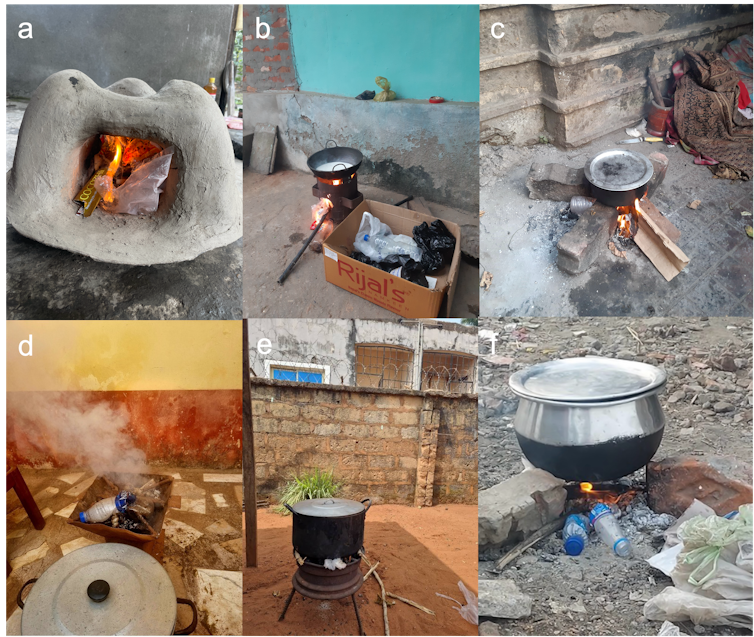
A composite image showing examples of how people are using plastic to cook and heat their homes.
Burning plastic waste for cooking and heating is becoming increasingly common in city slums. a–f, Photographs showing the use of plastic to start a fire in Koshi Province in Nepal (a), a household heating milk by burning plastic in Madhesh province of Nepal (b) and the burning of plastic in Guwahati, India (c), in Enugu, Nigeria (d,e) and in the slums of Lahore, Pakistan (f). Credits for photographs: a, Srijana Baniya; b, Pramesh Dhungana; c, Monjit Borthakur; d,e, Chizoba Obianuju Oranu; f, Sobia Rose. Bharadwaj, B., Gates, T., Borthakur, M. et al. The use of plastic as a household fuel among the urban poor in the Global South. Nat Cities (2025).

A product of energy poverty in city slums

Increasing urbanisation is reducing access to traditional fuels such as wood and crop residue from farmland.

But plastic is readily available. Low-income households with little or no access to gas or electricity often find themselves living alongside mountains of rubbish.

This plastic, made from fossil fuels, represents a cheap and convenient fuel. It’s lightweight, easy to transport, and a nuisance material that people want to be rid of. Plastic is also relatively easy to dry and store, but can burn even when wet. It’s also flexible and pliable, so it can be used easily in traditional cooking arrangements such as basic stoves.

Burning plastic releases toxins such as dioxins, furans and heavy metals into the air. These chemicals are known to cause cancer, heart disease and lung diseases.

The more vulnerable people in the household – including women and children and those who spend more time indoors – tend to be most exposed to the fumes. But the problem also affects people in the neighbourhood and the wider community.

Burning plastic is likely to also contaminate food. For example, eggs from farms near plastic waste incinerators in Indonesia contained hazardous chemicals from burned plastic. However, more evidence is needed around food contamination.

Furthermore, when households burn plastic bottles and other containers, some of the original contents also burn. Given chemicals are poorly regulated, the consequences of burning plastic could be greater still.

Overcoming the problem

A first step to overcoming the problem is understanding the reality of those living in slums. Policy-makers need to recognise these people’s needs and the challenges they face.

Extensive research is needed to design the most effective and inclusive policy interventions. This needs to be addressed if we are to reduce the associated health and environmental impacts on such large populations across the world.

We have gathered a collaborative, multidisciplinary team of researchers from around 35 countries – mostly in the Global South – to better understand the problem. We recently completed a survey of people exposed to the issue such as local government employees, teachers and community workers in more than 100 cities in 26 countries.

We are also examining the emissions from waste plastic during food preparation to determine the extent of contamination in variety of stoves.

Nobody wants to burn plastic waste to cook food, so policies like ban on burning plastic with out contextual intervention will not work. There is a need to design inclusive policy interventions that provide equitable benefits to the wider community. For example, encouraging people to:

  • wash any plastic before it is burned, to remove chemical residues
  • use improved cookstoves that vent the fumes outside
  • expand basic urban amenities like waste management to low income settlements
  • provide support to help lift households out of poverty.

Each approach will depend on the specific requirements of the slum settlement. But by implementing multiple approaches in parallel, we can tackle the problem more effectively.

Authors: Bishal Bharadwaj, Adjunct Research Fellow, Curtin Institute for Energy Transition, Curtin University

Read more https://theconversation.com/households-are-burning-plastic-waste-as-fuel-for-cooking-and-heating-in-slums-the-world-over-250265

Business News

Is Your Brand Showing Up in AI Search? Most Melbourne Brands Aren't.

The New Front Door Nobody Told You About Something changed. Quietly. Without a press release. The way buyers find businesses in Australia has been rewired. Not replaced, rewired. Google isn't dead...

Daily Bulletin - avatar Daily Bulletin

How Australian Businesses Can Measure SEO ROI

SEO can feel vague when you are staring at a dashboard full of numbers that do not clearly connect to revenue. The key is to measure the right signals in the right order, then tie them back to outcome...

Daily Bulletin - avatar Daily Bulletin

How Commercial Roller Shutters Improve Site Security Without Slowing Operations

Security upgrades can be frustrating when they make everyday work harder. A door that takes too long to open, creates bottlenecks at shift change, or fails at the worst time can turn “better protectio...

Daily Bulletin - avatar Daily Bulletin

Why a Document Destruction Service Still Matters for Modern Businesses

Businesses generate large volumes of information every day, from staff records and contracts to invoices, reports and customer files. While attention often focuses on how documents are stored, the way...

Daily Bulletin - avatar Daily Bulletin

Bicycle Rack Safety and Space-Smart Storage

Bike storage problems usually show up as small annoyances first: tangled handlebars, scratched frames, and bikes that topple when you pull one out. Over time, those issues become safety risks, especia...

Daily Bulletin - avatar Daily Bulletin

How to Tell if a Childcare Centre Is a Good Fit for Your Child

Choosing childcare can feel like you’re making a huge decision with limited information. Tours are short, centres are often on their best behaviour, and your child might act differently in a new space...

Daily Bulletin - avatar Daily Bulletin

Car Import Timeline: What Usually Happens at Each Stage

Importing a car into Australia can feel confusing because multiple agencies and checkpoints are involved, and the timeline is shaped as much by paperwork quality as it is by shipping speed. The most u...

Daily Bulletin - avatar Daily Bulletin

Portable Toilet Hygiene Standards Explained: Clean vs Sanitised vs Disinfected

In portable toilet servicing, the words clean, sanitised, and disinfected often get used as if they mean the same thing. They don’t. And that difference matters because a unit can look tidy and still ...

Daily Bulletin - avatar Daily Bulletin

Options Available When a Company Faces Financial Distress

Financial distress can develop gradually or arrive suddenly, and when it does, the decisions made in the early stages often determine what options remain available later. Directors who act promptly ...

Daily Bulletin - avatar Daily Bulletin

The Daily Magazine

What Actually Makes a Good Criminal Lawyer in Melbourne

Most people only think about this question once. That is usually too late. Most people charged wi...

Why Working With A Chatswood Tutor Can Improve Academic Performance

Academic expectations continue increasing for students across primary school, high school, and senio...

Is It Worth Getting Solar Panels in Melbourne?

The real question is not whether solar works in Melbourne. It works. The question is what it is co...

How A Diploma Of Project Management Builds Practical Skills For Modern Work Environments

Developing the ability to plan, execute, and deliver outcomes efficiently is a key requirement in to...

How to Choose the Right Football for Every Level

Choosing a football may seem straightforward, but the right option depends on who will be using it a...

What to Ask a Wedding Photographer Before You Book

Booking a wedding photographer can feel deceptively simple: you like the photos, you like the vibe...

Why Stress Relief For Dogs Is Essential For Emotional Balance And Long-Term Wellbeing

Managing emotional health is just as important as physical care when it comes to pets, which is why ...

Australia’s Best Walking Trails and the Shoes You Need to Tackle Them

Australia is not short on spectacular walks. You can follow ocean cliffs in Victoria, cross ancien...

Why Pre-Purchase Building Inspections Are Essential Before Buying a Home in Australia

source Have you ever walked through an open home and started picturing your furniture, family d...