

Fermented clothing? Here’s how the biofilm on kombucha can be turned into green textiles
- Written by: Rajkishore Nayak, Associate Professor , RMIT University Vietnam
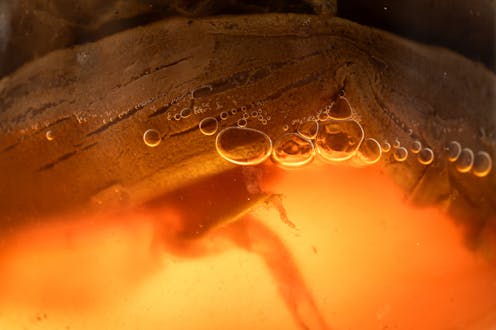
If you’ve ever made kombucha, you will be familiar with the term SCOBY – a symbiotic culture of bacteria and yeast. It’s impossible to miss – it’s the floating biofilm on top of your delicious drink.
While a SCOBY looks gross, it is remarkably versatile. If you feed it on sugar and tea or coffee in large vats, it grows rapidly. The reason you need tea or coffee is because caffeine contains nitrogen, which stimulates microorganism growth. Species of bacteria in the SCOBY such as komagataeibacter xylinus have the curious ability to eat sugars and produce bacterial cellulose.
The reason we and other researchers are focused on this unusual substance is because cellulose is extremely useful. Cotton is largely cellulose, as is flax, which we use to produce linen. Cellulose from bacteria has the advantage of being about ten times stronger than cotton.
Traditional methods of making the world’s clothes comes at a large environmental cost. If we can scale up production of bacterial cellulose using common materials such as sugar and tea, we might produce a new kind of versatile, sustainable textile. In our new research, we use this cellulose to make wallets and canvases for painting.
What’s so good about bacterial cellulose?
Deriving cellulose from bacteria isn’t new. It was first discovered back in 1886. Since then, the main use we’ve found for it has been in food and drink.
Kombucha – sometimes known as tea-mushroom – is thought to have been invented in China. In the Philippines, people have long fermented pineapple juice or coconut water to produce enough SCOBY to make chewy, gelatinous desserts. But this source of cellulose could be used for much more.
In recent years, researchers have looked into using food waste to make this cellulose.
Bacterial cellulose is made by cultivating a SCOBY in sugared tea, just like kombucha. But instead of the drink, what we are after is the SCOBY itself. As the microbes feed on the sugar, they spin out cellulose fibre and form a dense mat able to be harvested and processed.

Despite not being from plants, the bacterial cellulose is remarkably similar to cellulose from cotton. In some ways, it might be better – it is incredibly pure, highly absorbent and boasts impressive tensile strength. It’s natural, nontoxic, has a low environmental footprint and is biodegradable.
These traits make it potentially suitable for a range of uses, from clothing through to biomedical use in gauze bandages due to natural antibacterial properties. It can be dyed, sewed and treated to make different textures. It can be used to replace leather in clothing, footwear and accessories.

But clothing is the main game. Researchers have found ways of growing this cellulose in moulds shaped like pieces of clothing to avoid the 15-20% of material wasted by cutting fabric.
Bacterial cellulose might offer a way to reduce our reliance on the fibres we use to make clothes, which come with substantial environmental costs regardless of whether they are natural or synthetic.
Farming cotton requires huge volumes of water and plentiful pesticides and insecticides. To make one kilo of cotton fibre requires between 8,000 and 22,000 litres of fresh water. Synthetic fabrics such as polyester and nylon are made from oil, a fossil fuel.
The textile industry is highly polluting, consuming vast amounts of water and energy. As fashion gets ever faster, many of these clothes have a short lifespan before becoming waste. Synthetic fibres shed huge volumes of microplastics at every step of their lifespans.
The challenge of fermentation
In recent years, there’s been great interest in precision fermentation – using the rapid growth rate of microbes to produce foods and materials we want, such as milk grown without cows.
One of the big challenges with these approaches is scale. Bacterial cellulose is a similar form of fermentation. As a result, it faces similar challenges around scalability and efficiency. While the material has promise, the question is whether it can be produced cheaply and at scale.
To date, we haven’t yet found how to scale bacterial cellulose up to the level needed to meet the demand of large clothing manufacturers. And at present, the fermentation process is water intensive. Fermentation makes the water acidic, meaning it can’t be easily reused.
This fibre could readily replace cotton, but doesn’t have the same extreme durability and elasticity as some synthetic fibres.
Which way forward?
The way we currently make clothes comes at a huge environmental cost. Bacterial cellulose could offer one way to make clothes at vastly lower cost to the planet.
While there are still questions over whether it’s possible to make it competitive, researchers in several countries – including our research group – are coming at the problem from different angles. If they succeed, we might one day see a future where clothes and shoes come from sugar and tea.
Authors: Rajkishore Nayak, Associate Professor , RMIT University Vietnam


 Daily Bulletin


