

Interactive: What Earth’s 4.54 billion-year history would look like in a single year
- Written by: Francisco Jose Testa, Lecturer in Earth Sciences (Mineralogy, Petrology & Geochemistry), University of Tasmania
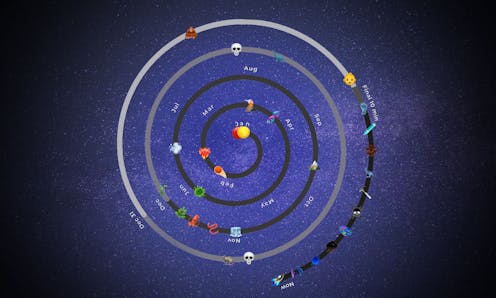
As a kid, it was tough for me to grasp the massive time scale of Earth’s history. Now, with nearly two decades of experience as a geologist, I think one of the best ways to understand our planet’s history and evolution is by condensing the entire timeline into a single calendar year.
It’s not a new concept, but it’s a powerful one.
So, how do we go about this? If we consider Earth’s age as 4.54 billion years and divide it by 365 days, each day of the Gregorian calendar represents about 12.438 million years.
Let’s say we want to calculate what “day” the Paleozoic started in our new Earth calendar. We just need to subtract 541 million years from the age of the planet and divide it by 12.438 million years. Simple, right?
As I ran these equations, I noticed something amusing. Some of the most significant events in Earth’s history coincide with major holidays in the Western world. By this reckoning, the dinosaurs went extinct on Christmas Day.
The Earth calendar
View the events in the infographic above, or scroll down to read about the entire year in order.
January 1
4.54 billion years ago: Formation of proto-Earth as part of the Solar System
Dust and gas in the early Solar System collide and combine under gravity. This process eventually leads to the formation of a molten planet, our proto-Earth.
January 3
4.5 billion years ago: Theia’s impact and the formation of the Moon
A Mars-sized planet, Theia, collides with the proto-Earth, changing the composition of our planet forever. This massive impact ejects a significant amount of material into orbit around Earth, which eventually coalesces to form the Moon.
February 4
4.1 billion years ago: Beginning of the Late Heavy Bombardment
Earth, the Moon and other inner bodies of our Solar System experience intense asteroid and comet impacts, which shape their surfaces. Unlike Earth, the Moon still retains these craters today because it lacks an atmosphere, water and tectonic activity. The bombardment continues until the very end of February – 3.8 billion years ago.
February 14
3.97 billion years ago: Beginning of the Archean Eon
By Valentine’s Day, the hottest period in Earth’s history – the Hadean Eon – has finally come to an end. With these hostile conditions in the past, the stage is lovingly set for life to emerge as the Archean Eon begins.
March 16
3.6 billion years ago: Formation of the first supercontinent, maybe
For a couple of weeks now, Earth has been cool enough to form stable continental crusts. Vaalbara is a theorised supercontinent consisting of two cratons (ancient, stable and thick blocks that form the cores of continents): Kaapvaal in eastern South Africa, and Pilbara in north-western Western Australia. While still under debate, this would make Vaalbara 3.6 to 2.7 billion years old, one of the oldest supercontinents we know of.
March 26
3.48 billion years ago: Earliest direct evidence of life
Right before the end of the first quarter of the year, simple prokaryotic organisms appear during the Paleoarchean. These are the earliest direct evidence of life recorded as microfossils (stromatolites).
May 27
2.7 billion years ago: Cyanobacteria become the first oxygen producers
Blue-green algae called cyanobacteria develop oxygenic photosynthesis. They use sunlight to convert carbon dioxide and water into organic compounds, releasing oxygen as a byproduct. It’s a milestone for the development of our current atmosphere.
June 16
2.46 billion years ago: The Great Oxygenation Event
A dramatic rise in oxygen levels occurs in shallow seas and in Earth’s atmosphere, driven by oxygenic photosynthesis from cyanobacteria. This event lasts approximately 400 million years, transforming Earth’s environment and paving the way for more complex life forms to thrive on a radically changed planet.
September 17
1.3 billion years ago: Formation of the supercontinent Rodinia
One of the first supercontinents to form on Earth, Rodinia brings together most of the planet’s landmasses. During its 550 million years of existence, Earth is predominantly inhabited by simple life forms, including prokaryotes and early eukaryotes.
October 31
750 million years ago: Breakdown of Rodinia and Snowball Earth events
By Halloween, Rodinia begins to crack apart just like candies in a kid’s trick-or-treat bag. The breakup of Rodinia dramatically influences the planet’s climate and ocean circulation, potentially triggering Snowball Earth events. These two major global glaciations, lasting approximately 70 million years, play a significant role in shaping Earth’s history.
November 9
635 million years ago: The Ediacaran Period begins
Right before the start of the Paleozoic, the first large, complex, multi-cellular marine life forms appear. The Ediacaran biota includes diverse, soft-bodied organisms – early animals, algae and other complex life. Today, curious visitors to the Flinders Ranges in South Australia might be lucky enough to spot some Ediacaran fossils.
November 17
538.8 million years ago: The Cambrian Explosion
The Cambrian Explosion lasts no more than two days (25 million years). During this time, sudden development of complex life occurs in the oceans. Almost all present-day animal phyla appear, and other groups diversify in major ways. Undoubtedly, this is a critical period for life on our planet.
November 23
470 million years ago: Plants first colonise Gondwanaland during the Ordovician Period
Early land plants are simple, non-vascular organisms that colonise moist environments – much like moss today. Over time, plants evolve more complex structures, including vascular tissue specialised for transporting water, nutrients and food, allowing them to thrive in a wider range of terrestrial habitats.
December 1
370 million years ago: First vertebrates move onto land
On the very first day of December, four-limbed animals called tetrapods are the first animals with backbones (vertebrates) to transition to a life on land during the Late Devonian period. These are the ancestors of all land-dwelling vertebrates, living and extinct.
December 10
252 million years ago: Permian-Triassic mass extinction
Life is almost entirely obliterated after a series of massive Siberian volcanic eruptions trigger global warming and a lack of oxygen in the oceans. The Great Dying is the largest extinction in Earth’s history, wiping out more than 90% of marine species and about 70% of terrestrial species.
December 12
230 million years ago: The rise of dinosaurs
The very first dinosaurs are small, bipedal reptiles that eventually evolve into the diverse group of animals that dominate Earth during the Mesozoic Era. Dinosaurs reign over our planet for 13 days, meaning their kingdom endures for an epic 165 million years.
December 25
66 million years ago: Cretaceous-Paleogene mass extinction
Christmas Day is not a joyful day for dinosaurs: they go extinct. The current leading hypothesis for their demise is an asteroid impact in the Yucatán Peninsula of Mexico. A massive space lump of coal from Santa, if you will.
December 26
56 million years ago: The rise of mammals
Boxing Day is a good day for mammals. During the Palaeocene, right after the extinction event, mammals begin to grow in size and diversity. By noon, when the Eocene starts 56 million years ago, they have evolved into the first large herbivores and carnivores.
December 31: midday
~7 to 6 million years ago: The planet of the apes
The very first hominids, either Sahelanthropus or Orrorin, appear by noon on December 31. These species represent some of the earliest common ancestors of humans and other great apes, such as gorillas, orangutans and chimpanzees.
December 31: 11:25pm
300,000 years ago: Modern humans finally arrive
The very first Homo sapiens emerge in Africa, marking the beginning of anatomically modern humans.
The final ten minutes
We’re almost at midnight, and nearly all of humanity’s history can be condensed into the last ten minutes of the year.
11:50pm
~86,377 years ago: Homo sapiens migrate out of Africa into Eurasia. Thus begins a significant global colonisation by early modern humans.
11:51pm
~77,740 years ago: The first symbolic art. Engraved ochre in South Africa’s Blombos Cave is considered one of the earliest symbolic artworks created by humans, indicating the development of cognitive and cultural sophistication.
11:52pm
~69,102 years ago: The Last Glacial Period. An ongoing global cooling event intensifies, forcing humans to adapt to harsher climates.
11:53pm
~60,464 years ago: Humans reach Australia. This marks the earliest known migration across sea, and settlement on a new isolated continent.
11:54pm
~51,826 years ago: Upper Paleolithic Revolution. Humans arrive at a capacity for well-developed language, more complex social structures, and highly specialised tools.
11:55pm
~43,119 years ago: The Neanderthals go extinct. Multiple factors cause their demise, including violence, diseases, natural catastrophes and being outcompeted by Homo sapiens, the only remaining hominid species on Earth.
11:56pm
~34,551 years ago: Symbolic art flourishes and culture emerges globally among modern humans. This time is characterised by significant advancements in creativity and social organisation.
11:57pm
~25,913 years ago: The Last Glacial Maximum. Ice sheets reach their greatest extent, covering large parts of North America, Europe and Asia. This is the peak of the most recent ice age, affecting both ecosystems and human migration.
11:58pm
~17,275 years ago: Warming begins after the Last Glacial Maximum. Ice sheets gradually retreat, leading towards the end of the last ice age.
11:59pm
~8,638 years ago: Significant events take place globally. The Agricultural Revolution has started, with humans cultivating crops and domesticating animals, leading to the first permanent settlements and village life.
Midnight
8,638 years ago to today: A great deal happens in the last few seconds of the year. From the Bronze and Iron Age, to the rise and fall of major empires, the Renaissance, the Industrial Revolution, world wars, space exploration, the internet and artificial intelligence.
Authors: Francisco Jose Testa, Lecturer in Earth Sciences (Mineralogy, Petrology & Geochemistry), University of Tasmania


 Daily Bulletin


