

The Coalition reveals the cost of its nuclear power plan – but the devil is in the missing detail
- Written by: Thomas Longden, Senior Researcher, Urban Transformations Research Centre, Western Sydney University
The Coalition has released long-awaited detail on its nuclear energy policy, claiming its plan to build seven nuclear power stations would be A$263 billion cheaper than Labor’s renewables-only approach.
The figures are contained in an analysis prepared by Frontier Economics. I’ve conducted preliminary analysis of the document, and found key assumptions that differ from other similar analyses, including that from Australia’s premier science organisation, CSIRO.
What’s more, the analysis is lacking crucial information about how the figures were calculated. This prevents researchers and the public from understanding the full implications of the Coalition’s policy.
A successful transition to clean energy is vital if Australia is to tackle the climate crisis. It’s also central to addressing rising power bills and keeping the economy on track. There is more than one way to lower Australia’s emissions, but the Coalition has work to do before next year’s election to show voters it has a reliable plan.
The Coalition goes nuclear
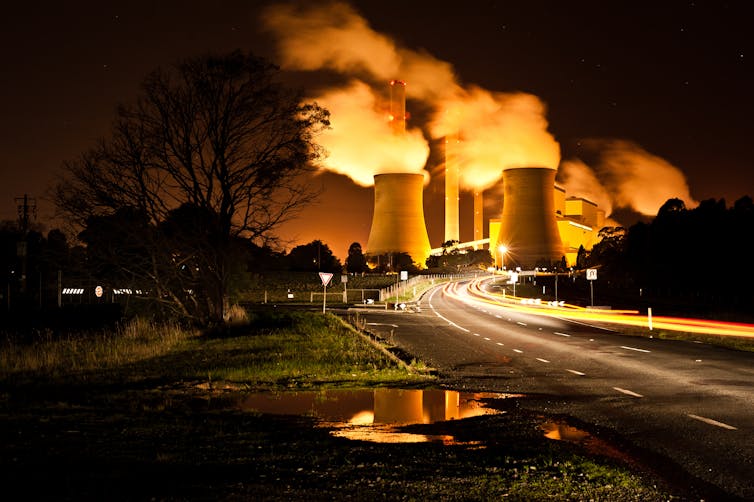
The Coalition’s nuclear plan involves building seven nuclear reactors at the sites of former or current coal plants.
It claims the first reactors could be operating by the mid-2030s. This conflicts with analysis showing the earliest they could be built is the 2040s.
The Coalition says under its plan, Australia’s energy mix in 2050 would comprise 54% renewables, 38% nuclear and the rest a mix of storage and gas. In contrast, Labor’s plan would have Australia running almost entirely on renewable energy by mid-century.
The Coalition’s plan could increase emissions and allow polluting coal-fired power stations to continue running for longer than currently forecast.
The thorny question of cost
The cost of the Coalition’s proposal is a key point in the debate. According to CSIRO analysis, “nuclear power does not currently provide the most cost-competitive solution for low-emission electricity in Australia”. This position is at odds with the Coalition’s claims.
Earlier this week, CSIRO released its draft GenCost report. It estimates the cost of building new electricity generation, storage, and hydrogen production in Australia out to 2050.
The analysis involves calculating average costs over the plant’s life, which takes into account the costs of both building and running it. This calculation is formally known as the “levelised cost”.
The levelised cost helps investors understand how much the plant’s electricity must sell for, if they are to get a return on their investment.
The Frontier Economics report does not contain a levelised-cost estimate or a “capacity factor”, which captures how often a plant is running at maximum power. This makes it difficult to probe the figures it provides. This oversight must be corrected to allow robust scrutiny of the Coalition’s costings.
The scenario presented by Frontier Economics also reportedly assumes the Coalition plan will not need notable additions of transmission infrastructure to transport electricity under its plan. This is because the proposed nuclear plants would be built at the sites of old coal-fired power stations, where transmission infrastructure already exists.
The Coalition has used this purported benefit when promoting its plan, and says the transmission infrastructure needed under Labor’s renewables policy would be prohibitively expensive.
However, as others have noted, the Coalition may need to build substantial new transmission infrastructure. This is because Australia’s electricity demand is forecast to surge in coming decades, and transmission infrastructure will have to be upgraded to cope.
Analysis also suggests the Coalition’s plan will not reduce consumers’ power bills. The Institute for Energy Economics and Financial Analysis found household electricity bills could rise by $665 a year, on average, if nuclear energy were introduced in Australia. For a four-person household, the bill rise would be $972 a year.
The institute also noted the tendency for huge cost overruns among nuclear power plants built overseas.

A time-critical issue
CSIRO’s GenCost analysis assumes nuclear power plants operate for 30 years. Frontier Economics assumes capital construction costs are averaged out over 50 years, which could partly explain its lower cost estimate.
Meanwhile, the Coalition claims the plants would operate for 80-100 years.
Long lifetimes are possible for nuclear reactors. For example, in the United States, 20 reactors are expected operate for up to 80 years. But many reactors have retired long before this age.
The time required to build the seven nuclear plants is also fiercely debated. CSIRO says the quickest possible time frame for developing and building a nuclear reactor in Australia is 15 years.
In the Frontier report, the first nuclear reactors would come online from 2036 and production would ramp up between 2040 and 2050.
Australian voters will decide
The Coalition says adding nuclear power to the energy mix will make electricity cheaper, cleaner and more reliable. But it has not yet provided solid evidence to support these claims.
What’s more, we don’t yet know how the Coalition plans to overcome community opposition to nuclear power, how it plans to store nuclear waste, and how it will get around state government bans on nuclear energy. Having reliable water sources will also be important, as France discovered during drought.
Clearly, the debate has a long way to run before voters make their choice at the ballot box next year. Let’s hope by that time, we have the information we need.
Authors: Thomas Longden, Senior Researcher, Urban Transformations Research Centre, Western Sydney University


 Daily Bulletin


