

Our analysis of wealth trends suggests Australia’s middle class may be ‘shrinking’
- Written by: Melek Cigdem-Bayram, Ronald Henderson Senior Research Fellow, The University of Melbourne
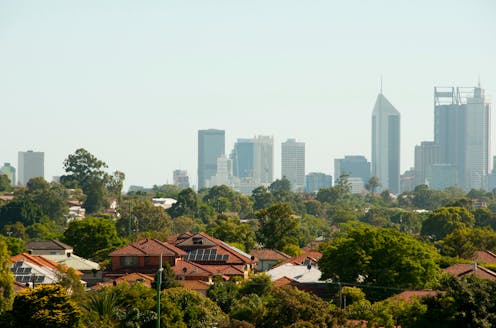
There are growing concerns about wealth inequality in Australia and what it means for people’s ability to get ahead.
For many, home ownership has become a pipe dream. Huge numbers of Australians now feel the cards are increasingly stacked against them.
Our recent working paper examined changes in absolute and relative wealth held by Australians, using data from the Household, Income and Labour Dynamics in Australia (HILDA) Survey.
We examined trends in holdings across different asset classes between 2002 and 2018, also breaking down this data by age.
In absolute terms, Australia’s wealth gaps are large and growing. Between 2002 and 2018, the absolute wealth gap between the top 10% and the bottom 10% of households increased – from A$1.33 million to $2.19 million.
But if we look beneath the surface at relative measures, some groups – including the poorest households – have actually improved their standing on certain metrics.
For young people and middle Australia, however, it’s a sobering picture – especially when it comes to property ownership.
Read more: How much do you need to retire? It's probably a lot less than you think
How do we measure inequality?
First, it’s important to note that wealth and income are different measures of a person or household’s financial position.
Net wealth refers to a household’s stock of assets – for example, real property, superannuation or shares – minus its debts and liabilities.
Income, on the other hand, is a cash flow measure that can include wages from employment, taxes and transfers, and returns on investments.
We can express levels of wealth or income inequality using a measure called the Gini coefficient.
A Gini of 0 means total equality – everything is divided exactly equally among a population.
A Gini of 1, on the other hand, means total inequality, where one person has everything.
As you’d expect, countries in the real world fall somewhere in the middle.
Inequality stable – but it’s not so simple
Looking at this measure, Australia’s wealth inequality remained fairly stable over this period.
Between 2002 and 2018, Australia’s net wealth Gini increased only marginally, from 0.602 to 0.606, indicating that wealth inequality grew only slightly over this period.
But this overall picture masks trends that are visible if we zoom in on different parts of the wealth distribution.
The relative wealth gap between the richest and the poorest households in Australia – the net wealth of the top 10% divided by the net wealth of the bottom 10% – has actually fallen.
Between 2002 and 2018, the bottom 10% increased their wealth by 83%, albeit from a very low level.
This rate surpassed that of the top 10% of households, whose wealth grew by 65%. As a result, the relative share in total wealth of the poorest has increased.
Middle Australia losing ground
Why, then, do so many perceive wealth inequality to be much worse? The answer probably lies in what’s happening to middle Australia, and to the young relative to older generations.
Our analysis compared households in the middle of the wealth distribution – those with more assets than exactly half the population – to those at the top and the bottom.
We found the wealth of those in the middle grew more slowly than that of those in the top 10%, increasing the relative gap between them.
But this group has also become poorer relative to the bottom 10%, reducing the gap between the bottom and the middle.
Combined, this suggests a “disappearing”, or at least, a “shrinking” middle.
More financial wealth
Our analysis unpacked wealth trends further by comparing changes in holdings of financial assets (cash, shares, superannuation and so on) to holdings of real property assets.
Looking solely at financial wealth, both young people and the bottom 10% of households actually saw their relative share increase between 2002 and 2018.
For the bottom 10% of households, average financial wealth increased by more than 200% over this period.
This improvement might seem impressive, but it’s important to note that it starts from a very low base.
The average financial wealth of the bottom 10% of households grew from about $2,800 to just over $9,000.
The main driver of this improvement is the Superannuation Guarantee - a mandated contribution made by employers to their employees’ superannuation funds for use in retirement.
Overall, the Gini coefficient for financial assets actually fell over this period, indicating greater equality in financial wealth.
Increasing polarisation in property ownership
Looking solely at property ownership, however, tells a story of increasing polarisation. The Gini coefficient for net property wealth worsened between 2002 and 2018, rising from 0.57 to 0.65.
At the bottom, more poor households owned no dwellings in 2018 than in 2002. In contrast, at the top, more property-rich households owned multiple properties.
The richest 10% enjoyed a 69% growth in their housing equity, while for the poorest households, housing wealth remained at zero.
The middle group increased their housing wealth by around 30% over this period. But middle households exhibited worse outcomes in housing wealth than the rich, in both absolute and relative terms.
Home ownership a fading dream
This trend is consistent with other data showing a decline in home ownership among Australians.
The decline in ownership of real property has been dramatic among those aged 25 to 34. Many of this cohort may go on to become homeowners in the next stage of their lives, but a growing number will never own a home.
A retirement time bomb?
Housing and financial wealth are deeply intertwined. The financial wealth of most households is tied up in their superannuation.
Owning a home, on the other hand, has traditionally provided vital financial and living security for retirees, especially if they rely on the publicly funded age pension
This is why home ownership is sometimes described as the “fourth pillar” of Australia’s retirement system. Falling rates of home ownership should sound alarm bells.
Australia’s declining levels of home ownership date back to the 1980s. They mean a growing number of Australians are likely to reach their retirement years either as renters or highly mortgaged.
This presents a growing challenge for policymakers. There’s likely to be increasing demand for public support for those who have retired without owning a home, while an ageing population puts a strain on tax revenue.
Authors: Melek Cigdem-Bayram, Ronald Henderson Senior Research Fellow, The University of Melbourne


 Daily Bulletin


