

‘They’re my babies’: what our attitudes to backyard chickens reveals about Australians
- Written by: Emily A. Buddle, Research Fellow in Humanities, University of Adelaide
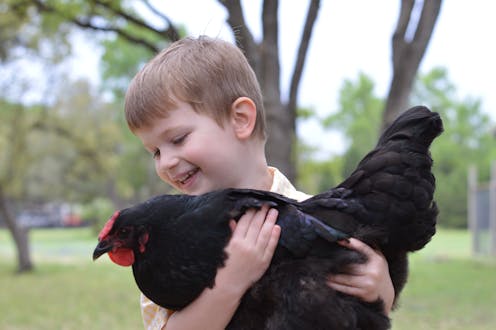
Chicken – or chooks, as they are affectionately known in Australia – have been a mainstay in backyards for generations.
More and more Australians now keep chickens, after the COVID pandemic triggered food shortages and prompted concern for egg supplies. At the same time, the welfare of egg-producing chickens is also in the spotlight, leading to an increase in the sale of free range eggs.
Globally, academic research into the trend has largely focused on public health and biosecurity risks. The human relationship to backyard chickens has not been deeply explored. Our recent research sought to change this.
We surveyed backyard-chicken owners in Adelaide, and found their relationships with the birds blur the lines between pet and livestock. The results throw up interesting questions about animal welfare, our trust in food systems, and how we relate to the non-human world.
What our research found
We interviewed 44 people who keep chickens at home. The in-depth discussions were conducted either over the phone or at suburban fodder stores, where chicken feed is sold.
We questioned participants on their motivations for keeping chickens in their backyards. Some saw their chickens as pets – in fact, one participant told us “they’re my babies”. Another respondent said:
Chickens as pets are a heap of fun and they’ve got such personalities and character and that’s one of the reasons why I like to have them out and about.
Backyard chickens provided an ongoing supply of fresh eggs from a trusted source. One person said:
I like fresh eggs. I don’t like buying eggs […] I get better quality […] And less stress to the chickens. I know that the chickens are happy. They’re not barn, they’re not cage, they’re definitely free range.
Others valued being able to recycle their food scraps by feeding them to chickens.
Some respondents said backyard chooks provided an educational experience for their children. One told us:
Hatching baby chicks has been an amazing experience for us and I think as our kids have grown up the whole thing has taught them a bit about life cycles and life and death.
Others said keeping chickens helped teach their children how to care for animals and educated them about where food comes from. Many recounted having chickens when they were children, and wanted the same experiences for their children or grandchildren.
Backyard chickens also provided some people with opportunities to connect with neighbours, by sharing food scraps and gifting eggs.
A few ethical quandaries
Interestingly, while some participants ate chicken, many emphasised that they would not kill or eat their own birds. Some had a preference for free-range chicken, but others said their keeping of backyard chickens had not influenced the type of meat they buy.
And while people valued their chickens for their ability to provide eggs and companionship, they were not likely to allow the animals inside the home. They were also unlikely to take them to the vet if they were unwell. As one person told us:
I personally just can’t justify the cost of the vet versus the monetary value of my chickens.
So while chickens are seen as pets, they are not considered as valuable as cats and dogs, which would usually be given vet care if needed.
This is worrying from a biosecurity perspective. Backyard chickens are capable of spreading highly pathogenic diseases such as avian influenza, and preventing this is difficult if chicken owners don’t take the animal to the vet.
What’s more, sick or injured chickens that don’t receive vet care may suffer unnecessarily, raising animal welfare concerns.
What all this means
Our results suggest backyard chickens are valued primarily because they provide eggs – but importantly, not meat. They are also valued for the human experiences they produce.
Owners consider their chooks to have distinct personalities and other attributes associated with pets. Yet the animals are not afforded the same care as cats and dogs.
This suggests backyard chickens occupy an in-between space on the human-animal relations spectrum – they are neither livestock nor companion animals.
As the trend of keeping backyard chickens grows, policymakers should consider the biosecurity risks and welfare of these and other animals that exist outside traditional categories.
This is especially important given the potential for a particularly virulent strain of avian influenza known as H5N1 to arrive in Australia and devastate wild and farmed bird populations.
Earlier this year, food security issues again came to the fore when Coles limited egg purchases in most of its supermarkets due to a bird flu outbreak in Victoria. It coincided with consumer concerns about and the rapidly increasing costs of food, including eggs.
Our results suggest more research is needed into consumers’ lack of trust in food supply systems, and the diverse ways Australians navigate the issues.
Authors: Emily A. Buddle, Research Fellow in Humanities, University of Adelaide


 Daily Bulletin


