

People believe lab animals have less mental capacity than other animals, research shows
- Written by: Kevin Vezirian, Maître de conférences, Université Savoie Mont Blanc
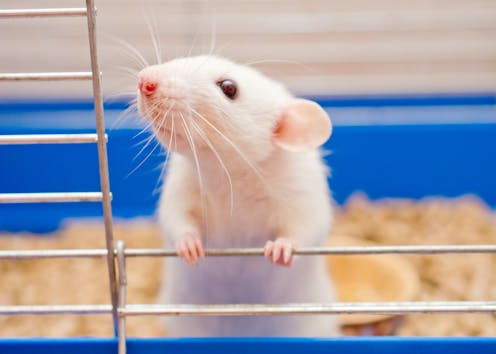
Many of us care for animals and feel empathy when they suffer. At the same time, many of us also accept their suffering and death when it happens in the name of science.
How do people manage this tension? Our latest research shows we do it by pretending lab animals have no inner lives or complex mental capacities.
Justified suffering?
More than 190 million animals are used in laboratory experiments around the world each year, according to one estimate. These animals undergo experiments we do not want to perform on humans, whose lives are more important to us.
Some experiments involve simple things such as eating various foods and taking blood samples. Others are more extreme, such as simulating drowning to test antidepressants, or inducing painful tumours to study cancer.
Despite efforts to encourage alternatives to animal experimentation, many still see it as necessary. This view is common not only among scientists, but also members of the public. Many perceive animal suffering as justified by hoped-for benefits to human health.
Mixed feelings
At the same time, numerous polls show the public is increasingly opposed to animal exploitation, particularly of animals most like us.
So people don’t want animals to suffer, but may perceive animal suffering as necessary to benefit humans. How do we resolve these mixed feelings?
Animal experimentation disturbs us because the animals used in laboratories have mental capacities. They can experience suffering. If you ask people to imagine the emotional activity of a lobster, they are more opposed to it being mistreated.
There are several ways of silencing our empathy for laboratory animals to legitimise animal experimentation. One common method is to understate animals’ mental capacities.
A dog or an ‘experimental animal’?
So if people see a creature as a lab animal, will they have a lower opinion of its cognitive abilities? This is the question we examined in our latest study, published in the Journal of Experimental Social Psychology.
We showed pictures of different animals (rabbits, hamsters, dogs, macaques) to 3,455 participants, accompanied by descriptions. One group of participants read descriptions of characteristics such as size and fur colour, while the other group had the animal presented as a laboratory subject.
All participants were asked to rate the extent to which the animals presented possessed 15 mental abilities, such as hunger, joy, fear, pride, suffering or planning ability.

For example, the control group saw the image above left with the caption: “This animal is a dog and more specifically a beagle. It is a four-legged animal, and the colour of its coat can be composed of several colours such as white, brown or black. The beagle is a diurnal animal, which means that it is active during the day and rests at night.”
The experimental group saw the image above right with the caption: “This hamster lives in a laboratory to be used as an experimental animal for medical, personal care and household products. For scientific purposes, it will be subjected to tests and suffer organ failure, bleeding and irritation. At the end of the experiment, the hamster will be euthanised.”
Objectifying animals
We found participants systematically attributed fewer mental and cognitive abilities to animals described in a laboratory context than to animals presented through their physical characteristics. We found this effect was replicated through different studies and despite experimental variations.
The results were similar when presented with pictures of different animals (a hamster, a mouse or even a beagle), or in different situations (a laboratory animal in pain, or a laboratory animal not in pain).
Scientists often objectify lab animals, using euphemisms such as “sacrifice” instead of “kill” and avoiding giving animals names. Our new research shows we are also motivated to deny the cognitive abilities of animals as soon as they are labelled as test subjects.
The use of euphemisms, not naming the animals, and the reduction of their cognitive abilities, ultimately serve the same function: to reduce the animals to the status of test tubes.
Our study supports the idea that categorising laboratory animals as nothing more than “hairy test tubes” lacking cognitive capacity facilitates psychological detachment.
This makes it easier to justify their use in scientific experiments, and quell any inner moral conflict. If animal experimentation upsets us, it is psychologically more comfortable to objectify test animals and not to recognise their mental capacity.
Legitimising animal sacrifice
Our results are in keeping with earlier work showing people will perform a similar manoeuvre if they are told an animal is destined for the butcher. They will lower their estimate of the animal’s cognitive abilities to justify meat consumption.
Of course, people hold a range of views towards animal experimentation. These are influenced by many factors, such as gender and interest in science.
However, our research is the first to demonstrate that the simple fact of categorising an animal as a test subject will lead to the denigration of its mental capacities.
Beyond animal experiments
The benefits of experimenting on animals are much debated. A survey of 20 vast systematic reviews of various kinds of biomedical animal experiments found only two concluded that animal experimentation was useful.
One of the limitations of animal experiments is the poor reproducibility of research. This lack of stability in scientific results is extremely costly for society. The development of alternatives to animal testing is progressing.
Opponents of animal testing often focus on the three Rs: replace, reduce, refine. These are widely accepted in Europe, the United States and elsewhere.
However, moving away from animal experiments may prove difficult. As we have seen, the mere presence of animals in laboratories can be enough to make us believe that their sacrifice is no sacrifice at all.
Authors: Kevin Vezirian, Maître de conférences, Université Savoie Mont Blanc


 Daily Bulletin


