

Snakes are waking up. What should you do if you’re bitten? And what if you’re a long way from help?
- Written by Hamish Bradley, Adjunct Lecturer, Anaesthetist and Aeromedical Retrieval Specialist, The University of Western Australia
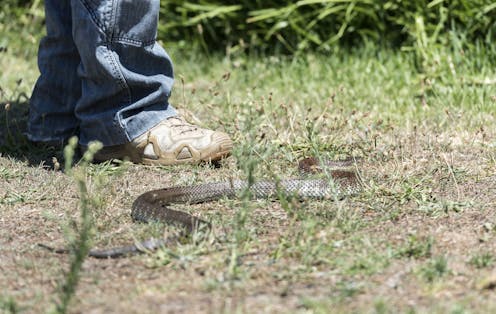
From the creeks that wind through inner city Melbourne to the far outback in Western Australia, snake season is beginning.
Over the cooler months snakes have been in state of brumation. This is very similar to hibernation and characterised by sluggishness and inactivity. As warmer conditions return both snakes and humans become more active in the outdoors, leading to an increased likelihood of interaction. This may happen when people are hiking, dog-walking or gardening.
The risk of being bitten by a snake is exceptionally small, but knowing basic first aid could potentially save your, or another person’s, life.
When a snake bites
Snake bite envenomation (when venom enters the blood stream) is a significant issue in Australia, with 3,000 cases annually and an average of two deaths.
Snake bite should always be treated as a life-threatening emergency, and if you are bitten in rural or remote Australia, you will often receive an air medical emergency pick up to a regional or metropolitan hospital for advanced care.
The effects of snake bites vary, depending on the species of snake and first aid measures undertaken.
Australian standard first aid guidelines include:
- calling for help (dialing 000 or activating an emergency beacon)
- applying a pressure immobilisation bandage
- resting.
Why pressure is important
Snake venom is carried within the lymphatic system. This is a collection of tiny tubes throughout the body that return fluid outside of blood vessels back to the blood stream.
Muscles act as a “pump” to help the fluid move through this system. That’s why being still, or immobilisation, is vital to slow the spread of venom.
A firm pressure immobilisation bandage, applied as tight as you would for a sprained ankle, will compress these tubes and help limit the venom’s spread.
Ideally bandage the entire limb on which the bite occurred and apply a splint to help further with immobilisation. It is very important that the blood supply to the limb is not limited by this bandage.
Never attempt to capture or kill the snake for identification. This risks further bites and is not required for specialist care. The decision about when to give antivenom (if any) is based on the geographical location, symptoms, the results of blood tests and discussion with a toxicologist.
The tyranny of distance
People living in rural and remote locations may also have limited access to health care, including access to ambulance services, snake bite first aid such as bandages and splints, and to antivenom.
Availability and the prompt use of antivenom have been identified as crucial factors in the effective treatment of snake envenomation – but not studied in detail.
Over one year (as a component of a larger three-year study) we collected information on the pre-hospital care and in-flight care with the Royal Flying Doctors Service Western Operations.
During this time, 85 people from regional, rural, remote and very remote Western Australia were flown by Royal Flying Doctor Service to hospital for suspected or confirmed snake bites. Reassuringly, only five of these patients (6%) ultimately received a toxicologist’s diagnosis of envenomation.
To move or not to move?
Troublingly, 38 (45%) of the 85 snake bite victims continued to move around and be active following their suspected snake bite. This raises questions about whether people lack knowledge of first-aid guidelines, or whether this is a consequence of being isolated, with limited access to health care.
Either way, our as-yet-unpublished research highlights the vulnerability of Australia’s rural and remote people. All patients eventually received a pressure immobilisation bandage, with an average time from bite to application of 38 minutes. Three quarters of the patients made their way to health-care site by foot, or private car, arriving on average 65 minutes after the bite.
Read more: Breakthroughs and setbacks on the hunt for a universal snakebite antivenom – podcast

What needs to change?
Our results indicate rural and remote Australians need innovative health-care solutions beyond the metropolitan guidelines, particularly when outside ambulance service areas.
Basic snake bite first aid education needs to be not only reiterated but also a pragmatic approach is required in these geographically isolated locations. This would involve being vigilant, staying safe and, when isolated, always carrying emergency technology to call for help.
The authors wish to acknowledge the efforts required through this research project as it continues, including by Fergus Gardiner, Kieran Hennelly, Rochelle Menzies, James Anderson, Alex McMillan and John Fisher. Hamish Bradley is an Aeromedical Retrieval Specialist and Principal Investigator in this project.
Authors: Hamish Bradley, Adjunct Lecturer, Anaesthetist and Aeromedical Retrieval Specialist, The University of Western Australia

 Daily Bulletin

