

Budget cuts to climate funding mean NZ may now struggle to meet its international obligations
- Written by: Nathan Cooper, Associate Professor of Law, University of Waikato
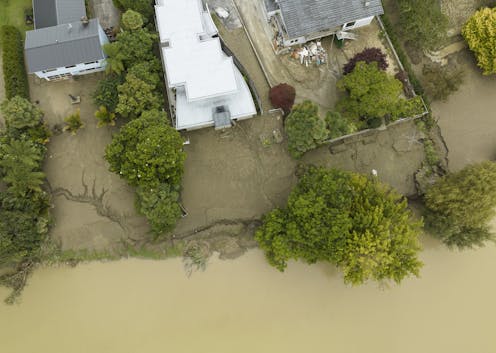
With no new investment to combat climate change in last month’s budget, and a long list of cuts to climate and environment-related areas, the government risks damaging its global reputation.
The Climate Resilience for Māori initiative has been scrapped, along with mātauranga Māori approaches to agricultural emissions reduction. There is reduced funding for the Climate Change Commission, which advises the government on policies to achieve legislated emissions targets.
Freshwater and native forest planting initiatives will be scaled back, along with reduced biosecurity monitoring.
Also cut are programmes to develop a national circular economy and bioeconomy strategy for waste reduction and the “Jobs for Nature” initiative, which was due to run until 2026.
More adaptation, less mitigation
Climate Change Minister Simon Watts affirmed the government’s commitment to “support New Zealand to reduce emissions and adapt to the future effects of climate change”, reflecting an established two-pronged approach through:
mitigation (reducing emissions and increasing sinks for greenhouse gases)
and adaptation (measures such as flood defences and managed retreat to protect communities and infrastructure from climate impacts).
Of course, responding to climate change effectively will require both. But a closer look at the government’s priorities, as indicated by this budget, suggests there’s more appetite for adaptation to ensure communities, jobs, industries and homes are prepared to withstand the impacts of climate change.
Mitigation seems a lesser priority, especially if it means further regulating industries and potentially affecting the jobs they currently support.
However, easing off on mitigation means more severe and costly adaptation in the future. This raises questions about how fiscally responsible this budget really is.
The Climate Change Commission reminds us that:
Investing in emissions reduction, which is needed across all sectors – energy, buildings, transport, food and industry – is an investment in our future.
The longer we wait to cut emissions, the more the costs of climate change will compound. Mitigation now, alongside adaption is likely to be the more fiscally responsible choice over the long term.
No surprise
The rolling back of environmental protections and climate action advanced by the previous Labour administration comes as no surprise. None of the coalition parties campaigned on so called green credentials.
Environment and climate change portfolios have been removed from Cabinet. The government last week announced it will repeal Labour’s ban on offshore oil and gas exploration. It also plans to double mineral exports by 2035 and the Fast-track Approvals Bill is currently going through the select committee process.
Resources Minister and NZ First MP Shane Jones argues the bill is necessary to counter “New Zealand’s excessive levels of environmental protection”.
Climate obligations
Despite this rollback, the government still has climate change responsibilities at home and internationally. These include administering the New Zealand Emissions Trading Scheme, setting emissions budgets and preparing emissions reduction and national adaptation plans.
Also, under the Paris Agreement and United Nations Framework Convention on Climate Change (UNFCCC), the climate change minister must set a pledge, known as a nationally determined contribution (NDC), to reduce greenhouse gas emissions. This is due in 2025.
So how is the coalition positioned to deliver on New Zealand’s climate change obligations?
Internationally, the next big test will come this November, at the UNFCCC’s next annual climate summit COP29. The focus will be on climate finance, investing to increase resilience to extreme weather and ensuring developing countries can afford to transition away from fossil fuels.
Despite its size, New Zealand’s position in international climate negotiations carries weight, not least as a regional leader in the Pacific. For many Pacific island countries, climate finance is hugely important. Attention will be on New Zealand to once again show bold leadership and increase contributions to global climate finance.
Next year’s NDC is required to be more ambitious than the previous one. Like many countries, New Zealand’s current NDC is widely acknowledged to be insufficient to limit global temperature rise to 2°C above pre-industrial levels.
That’s despite being set by a Labour government much keener to claim green credentials than the current coalition. It’s going to be difficult for this government to ratchet up the NDC, while also reducing environmental protections and removing economic roadblocks.
Perhaps there is a way forward by looking again at how some industry players are connecting emissions reduction with good business. Internationally, trade agreements such as the recently negotiated deal with the EU reflect that consumers and businesses have become more climate conscious. A genuinely ambitious NDC could be the smartest choice to keep New Zealand’s exports competitive.
Like so much in politics, it’s about balancing competing priorities and looking for the compromise. But the current mood music from this government doesn’t make for easy listening for anyone serious about doing our fair share on climate change and challenging the assumption that economy versus environment must be a zero-sum game.
Authors: Nathan Cooper, Associate Professor of Law, University of Waikato


 Daily Bulletin


