

Alice’s adventures in banking wonderland: how an ambitious finance start-up didn’t change the world
- Written by: John Hawkins, Senior Lecturer, Canberra School of Politics, Economics and Society, University of Canberra
Stuart Kells is in some senses an Antipodean version of American journalist and historian Michael Lewis. Kells has chronicled the antics of corporate players, such as publishers Penguin Random House, diamond miners Argyle, and financial market traders in the water of the Murray-Darling Basin. This new book is published by Melbourne University Publishing, whose corporate history he has also written.
In Alice: The Biggest Untold Story in the History of Money, he turns his attention to a financial innovator. But in his choice of protagonist, Kells differs from Lewis, whose most recent book told the story of the famous crypto wunderkind Sam Bankman-Fried. Kells’ book is the story of Australian banking consultant Ian Shepherd, whose ambitious plan to reinvent the financial system and mitigate some of its risks ended in failure.
Review: Alice: The Biggest Untold Story in the History of Money – Stuart Kells (Melbourne University Publishing)
The early part of Kells’ book revolves around its two key characters, both bright Australian expats in America.
Kate Jennings (1948-2021) was a radical feminist author and editor of Mother I’m Rooted: An Anthology of Australian Women Poets (1975). In an unlikely career progression, she ended up a speechwriter with the corporate financial-management firm Merrill Lynch.

Jennings wrote an acclaimed semi-autobiographical novel about her time in the US financial markets called Moral Hazard (2002). It was shortlisted for the Miles Franklin Award. Author Gideon Haigh described it as a novel that enunciates “disquieting truths”. Some of the best lines in Kells’ book (e.g. “the only perfect hedge is in a Japanese garden”) come from it.
Jennings’ essay collection Trouble: Evolution of a Radical, Selected Writings 1970-2010, also includes a critique of the inadequate regulation of the US financial system, delivered as a lecture in 2003 to the unlikely audience of Anne and Gerard Henderson’s Sydney Institute. In Kells’ words, Jennings “found the poetry in the world of money”.
The other key figure in Kells’ book is Shepherd, who was a few years ahead of me studying economics at the University of Sydney, and, like me, started his career at the Commonwealth Bank. After earning an MBA from Stanford, Shepherd became a consultant with global management firm McKinsey & Company, specialising in banking.
In the 1980s, the volume of trading in financial markets grew rapidly, as did the risks around it. Shepherd thought deeply about those risks.
Read more: 'Famously fed up’. How the work of feminist writer Kate Jennings changed Australia
The rise and fall of Alice
The name of the Alice Project itself does not appear until page 127 of Kells’ book. It refers to Shepherd’s electronic market start-up, which he founded in the early 1990s.
 Alice sought to disaggregate financial instruments, such as deposits, loans, insurance and options. Complicated financial transactions would be broken down into simple components, each of which had the form of a collateralised contract.
The idea was to develop a real-world version of the theoretical “Arrow-Debreu security”, which takes the form of a simple payout rule, such as “I pay you $1 if it rains tomorrow and nothing if it does not”.
The right combination of these contracts could duplicate the payoffs of existing financial instruments, but allow hedging of many more types of risk.
Much as Bitcoin inventor “Satoshi Nakamoto” and entrepreneur Elon Musk would later, Shepherd saw the large profits banks made from the payments system and wondered if a more efficient alternative could be devised – one that would avoid some of the risks of the current system.
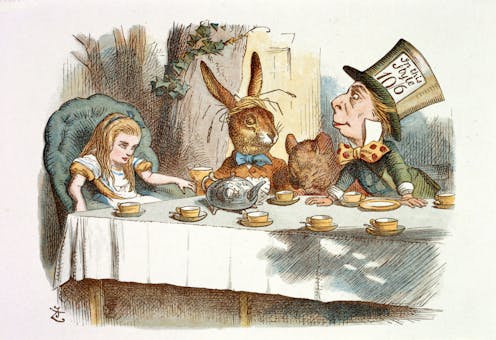
Alice was named after the Lewis Carroll novel in a deliberate contrast to the more macho names common in finance. It was argued that Alice was creating a market in which anything is possible. National Australia Bank took a hefty initial stake in the company, which it later raised to around half.
For the scheme to work, it would have needed a very large user base, betting on both sides of a huge range of propositions, in order to generate an attractive degree of liquidity.
In May 2007, Alice was sued by CLS, a bank named after its goal of continuous linked settlement: a system for settling international transactions. CLS was backed by a consortium, including global banks such as J.P. Morgan and Citigroup.
Both CLS and Alice believed the other had infringed on their copyright. National Australia Bank was somewhat conflicted, as it had a stake in both. The litigation was escalated to the US Supreme Court in 2013.
Alice lost the case. The Supreme Court ruled the Alice system was not patentable. NAB then withdrew its involvement with Alice.
The treatment of finance
In 2010, Shepherd heard an interview Jennings had with Phillip Adams. Impressed, he contacted her and they had a series of meetings.
Both were avid followers of the collapse of Enron, which they saw as akin to a bank run. Shepherd even visited the former Enron CEO and fellow McKinsey alumnus Jeffrey Skilling in prison. I was surprised by how sympathetically Kells treats Skilling.
Jennings had sat in on the court hearings and would have been the obvious choice to write a book on the adventures of Alice. But she was by this time in poor health. Instead Kells took up the project, helped by Shepherd, who emerges as the hero of the story.
In some ways, the book is unsatisfactory. The story of this stalled venture, effectively reduced to a one-man-band, does not seem to justify the claim on the book’s cover that it forms part of the “history of money”.
Alice sought to disaggregate financial instruments, such as deposits, loans, insurance and options. Complicated financial transactions would be broken down into simple components, each of which had the form of a collateralised contract.
The idea was to develop a real-world version of the theoretical “Arrow-Debreu security”, which takes the form of a simple payout rule, such as “I pay you $1 if it rains tomorrow and nothing if it does not”.
The right combination of these contracts could duplicate the payoffs of existing financial instruments, but allow hedging of many more types of risk.
Much as Bitcoin inventor “Satoshi Nakamoto” and entrepreneur Elon Musk would later, Shepherd saw the large profits banks made from the payments system and wondered if a more efficient alternative could be devised – one that would avoid some of the risks of the current system.
Alice was named after the Lewis Carroll novel in a deliberate contrast to the more macho names common in finance. It was argued that Alice was creating a market in which anything is possible. National Australia Bank took a hefty initial stake in the company, which it later raised to around half.
For the scheme to work, it would have needed a very large user base, betting on both sides of a huge range of propositions, in order to generate an attractive degree of liquidity.
In May 2007, Alice was sued by CLS, a bank named after its goal of continuous linked settlement: a system for settling international transactions. CLS was backed by a consortium, including global banks such as J.P. Morgan and Citigroup.
Both CLS and Alice believed the other had infringed on their copyright. National Australia Bank was somewhat conflicted, as it had a stake in both. The litigation was escalated to the US Supreme Court in 2013.
Alice lost the case. The Supreme Court ruled the Alice system was not patentable. NAB then withdrew its involvement with Alice.
The treatment of finance
In 2010, Shepherd heard an interview Jennings had with Phillip Adams. Impressed, he contacted her and they had a series of meetings.
Both were avid followers of the collapse of Enron, which they saw as akin to a bank run. Shepherd even visited the former Enron CEO and fellow McKinsey alumnus Jeffrey Skilling in prison. I was surprised by how sympathetically Kells treats Skilling.
Jennings had sat in on the court hearings and would have been the obvious choice to write a book on the adventures of Alice. But she was by this time in poor health. Instead Kells took up the project, helped by Shepherd, who emerges as the hero of the story.
In some ways, the book is unsatisfactory. The story of this stalled venture, effectively reduced to a one-man-band, does not seem to justify the claim on the book’s cover that it forms part of the “history of money”.
 Stuart Kells.
Melbourne University Publishing
Kells refers to Alice as “a new type of tradeable security and a new kind of market”. But even on a second reading, I never got a really clear idea from the book of the innovation Alice would have brought to financial markets.
I thought the description of derivative markets was not quite right. Buyers and sellers are not “exposed to unlimited profits and losses”. A holder of an option can just not exercise it and their loss is limited to what they paid for it. And it is definitely wrong to claim that “some countries are using cryptocurrencies to assemble an alternative financial system”. The only one that is trying is El Salvador, and it is not succeeding.
While I generally enjoyed reading the book, it could have been shorter. Do we need to read the correspondence on Jennings’s seating arrangements at the court? I found Kell’s earlier books The Library: A Catalogue of Wonders (2017) and Shakespeare’s Library (2018) excellent.
Correction: An earlier version of this article mis-stated Kells’ academic background. Kells has degrees in finance, economics and law, among others.
Authors: John Hawkins, Senior Lecturer, Canberra School of Politics, Economics and Society, University of Canberra
Stuart Kells.
Melbourne University Publishing
Kells refers to Alice as “a new type of tradeable security and a new kind of market”. But even on a second reading, I never got a really clear idea from the book of the innovation Alice would have brought to financial markets.
I thought the description of derivative markets was not quite right. Buyers and sellers are not “exposed to unlimited profits and losses”. A holder of an option can just not exercise it and their loss is limited to what they paid for it. And it is definitely wrong to claim that “some countries are using cryptocurrencies to assemble an alternative financial system”. The only one that is trying is El Salvador, and it is not succeeding.
While I generally enjoyed reading the book, it could have been shorter. Do we need to read the correspondence on Jennings’s seating arrangements at the court? I found Kell’s earlier books The Library: A Catalogue of Wonders (2017) and Shakespeare’s Library (2018) excellent.
Correction: An earlier version of this article mis-stated Kells’ academic background. Kells has degrees in finance, economics and law, among others.
Authors: John Hawkins, Senior Lecturer, Canberra School of Politics, Economics and Society, University of Canberra


 Daily Bulletin


