

‘Invisible’ consultants help companies write sustainability reports. Here’s why that’s a problem
- Written by: Hendri Yulius Wijaya, PhD Student in Political Science (Joint Supervision with Business School), The University of Melbourne
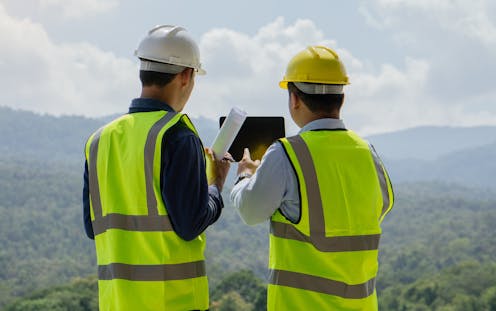
Around the world, more and more companies are publishing sustainability reports – public scorecards detailing their impacts on society and the environment.
Environmental, social and governance (ESG) reports outline the positive and negative effects of a company’s activities, and the steps they’re taking in response.
Companies publish these reports as their own documents. But often, externally hired consultants play an invisible role in gathering data and framing it in a positive narrative the public will find easy to digest.
And getting these reports independently evaluated – “external assurance” – is still not required by many regulators around the world. As a result, they can allow companies to “greenwash”.
This could be by only disclosing information that makes a company look “sustainable” to the public. Or by only reporting on categories that paint them in a good light, and excluding the less flattering ones.
Read more: How Australian companies can fudge their numbers to show social and environmental progress
The problems inherent in this process create a blind spot for society. We urgently need to shine a light on consultants’ unseen involvement in sustainability reporting.
The business of polishing ‘facts’
It’s increasingly becoming mandatory for large publicly traded companies to disclose their social and environmental performance, particularly across Europe and the Asia-Pacific region.
In Australia, such reporting is voluntary, but widespread. As many as 98% of top Australian companies published sustainability reports last year. Consulting firms have quickly expanded their existing lines of service to capture this growing market opportunity.
Consultancies legitimise their expertise by offering businesses a range of frameworks and discourses. These convey the benefits of implementing sustainability measures and show how they could boost profitability.
But use of the firms has attracted heavy criticism.
One argument is that consulting firms actually undermine their own sustainability services by continuing to do work for major companies in polluting industries, such as the oil and gas sector.
Another is that consulting firms’ contributions to sustainability are largely superficial. It’s too easy for companies to engage them just to tick boxes – perhaps to meet certain global standards or frameworks in bad faith, or create the impression they are responsible companies in other ways.
Problems with the process
Drawing on the lead author’s previous experience as a sustainability reporting professional in Indonesia, we wanted to take a closer look at these criticisms.
To examine the issue properly, we need to recognise that a power imbalance can arise between external consultants and the companies that hire them when sustainability reports are treated as an end in themselves or “time-bound projects”.
This attitude stands in stark contrast to the continuous strategy of measurement and disclosure that is required to create meaningful change at a company.
First, with such a narrow view of reporting, consultants are treated as simply a service provider – they are hired to complete a report within a given timeframe. But this limits their exposure to a company’s overall operations. Consultants have to rely on information passed on to them by employees, or they distribute oversimplified, generic forms for the organisation’s members to quickly fill in.
Who they get to speak with to gather this information is also completely at the whim of their client. Under these constraints and tight deadlines, it’s difficult for them to perform meaningful data analysis.
Second, in practice, “reporting” often actually means “selecting which information shall and shall not be presented to the public”.
Using external consultants to prepare a report might seem like it would offer an unbiased or independent perspective. But the reports are heavily scrutinised by company management, who ultimately make the final decision about what to include.
And third, pressure to comply with certain regulations and standards can make companies shortsighted. Consultants are tasked with ensuring a company “ticks the box” and fulfils its reporting requirements. But if this is the primary incentive, the information presented can be superficial and lack context.
A deeper contextual analysis is necessary to describe what lies behind the raw numbers, including a company’s challenges, improvement targets and the path forward.
Read more: Sustainability schemes deployed by business most often ineffective, research reveals
What needs to change?
Consultants can still play a key role in the global move to ESG reporting. But the industry’s approach needs to change.
For one, sustainability reports cover a wide range of ESG topics – from climate to social inclusion. It is impossible for a single consultant to tackle all of them simultaneously. Companies should ensure there is a diverse range of experts in the teams they hire.
More countries could also pass laws requiring “external assurance” – independent, standardised cross checking of companies’ sustainability reports.
Meanwhile, companies and consultants need to return to the underlying principle of sustainability reporting: it’s not just about producing marketing material. Faced with a very real global crisis, it’s a key way to measure the impacts, risks and challenges of doing business, and present a company’s action plan to address them.
It’s important to be sceptical when the information in a sustainability report only shows good performance. Nobody is perfect. Neither is any business.
Read more: Explainer: what is corporate social responsibility or CSR – and what do investors need to know?
Authors: Hendri Yulius Wijaya, PhD Student in Political Science (Joint Supervision with Business School), The University of Melbourne


 Daily Bulletin


