

Why do we make violent art – and what does it say about the artist?
- Written by: Jacqueline Millner, Professor in Visual Arts, La Trobe University
The sensationalised media coverage of the recent suspected mushroom poisonings in regional Victoria expanded last week, to include children’s scribblings on a wall.
The pictures, which comprised stick figures, rudimentary drawings and text that referenced death and dying, were removed last year from the former home of the woman who cooked the lunch. Drawn by her primary-school-aged children, and photographed long ago by the tradesman who cleaned the wall, they included tombstones, swords and the words “I am dead” and “You don’t long to live”.
The news story revealing the pictures quoted another tradesperson who saw the wall, saying the drawings were not what you’d “typically expect” from children of that age. “You’d think they’d be drawing flowers and unicorns, not gravestones and death.”
It was implied that these “eerie”, “scary” depictions of violence indicate something troubling. But art history doesn’t bear this out, whether we’re talking about children’s capacity for gruesome drawings, or indeed the tradition of modern artworks by fully fledged artists whose work deliberately explores troubling themes.
Read more: Violence is here to stay – we need to understand it
Ethical concerns and the human condition
In fact, the history of modern art suggests depictions of violence are often tied to deep ethical concerns and explorations of the human condition. The idea that violent art must be the expression of a violent individual is simply not true.
In the wake of Freudian theories about the monster lurking inside “civilised man”, early 20th-century modernist explorations of violence were often a means of accessing unconscious human desires and fears.
Much surrealist and expressionist art sought to reveal deeper truths, beyond what was sanctioned in bourgeois society.

Man Ray’s 1921 Gift (or, Cadeau), a sculpture of a domestic iron studded with tacks, acknowledges the violent drives that unconsciously propel much human behaviour. And Andre Masson’s delicate line-renderings of massacres (1930-34) confront the viewer with the violence of war.
Such work was often motivated by the desire to outrage polite society and compel it to confront its hypocrisy, particularly in the wake of the horrors unleashed by the ruling classes during the first world war.
A modernist impulse to shock and an attraction to the darker side of the human psyche are still common in art and popular culture. It’s partly about asserting freedom from social norms. But it’s also about highlighting the breadth of human experience – and the social and personal harm that can result when that complexity is denied.
The Young British Artists, who began to exhibit together after a 1988 exhibition organised by Damien Hirst (perhaps their most notorious member), made a very successful brand of it.
 Marcus Harvey’s Myra is rendered in children’s handprints.
Michael Stephens/PA Images/Getty Images
Marcus Harvey’s Myra is rendered in children’s handprints.
Michael Stephens/PA Images/Getty Images
Their work included Marcus Harvey’s Myra (1995), a portrait of a child serial killer, rendered in children’s handprints. Harvey’s work intends to shock us out of our assumptions about who serial killers are and their motivations, but also to force us to see that our society has produced people capable of such heinous acts.
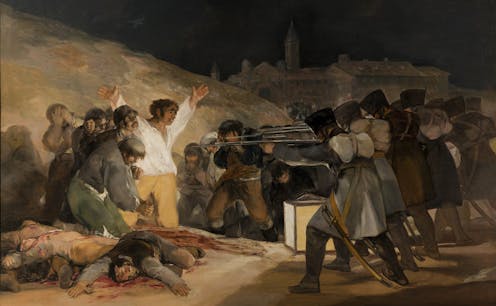
Another strain of modern art represents violence as a means of holding perpetrators to account. Proto-realist painters such as Francisco Goya depicted the atrocities of war in early 19th-century Spain in graphic detail as protest.
His contemporary Honoré Daumier was jailed for Gargantua (1831), a caricature of King Louis Phillipe. It was one of a series of engravings illustrating the brutality of the French administration’s class warfare.
 Honoré Daumier’s caricature of King Louis Phillipe, Gargantua, had him jailed.
Wikimedia Commons
Honoré Daumier’s caricature of King Louis Phillipe, Gargantua, had him jailed.
Wikimedia Commons
Documentary and protest
The legacy of such artists lives on in documentary photography and film. There, the violence of political and historical events is made widely visible, with the aim of influencing public opinion and forcing governments to act.
Nick Ut’s photograph of “napalm girl” (1972), since identified as nine-year-old Phan Thi Kim Phuc, photographed naked while fleeing a napalm attack, is an iconic example. It arguably helped end the war whose horrors it captured.
 Nick Ut’s 1972 photograph arguably helped end the war it captured.
Nick Ut/AP
Nick Ut’s 1972 photograph arguably helped end the war it captured.
Nick Ut/AP
And recent exposés about the horrors of factory farming – such as Hogwood (2020), a documentary focused on a UK pig farm that features undercover footage – compel us to confront the normalised violence embedded on our dinner plates.
Violence using the artist’s body
Violence enacted on the artist’s own body has been a powerful means to explore the limits of the human condition, but also to make literal the violence of social and political repression.
In her early performance work, Cut Piece (1964), Yoko Ono sits impassively onstage, a pair of scissors before her, awaiting the audience’s response to the invitation to cut off a little snippet of her clothing to take with them.
The audience’s latent gendered violence is gradually manifested, without a word being said by the artist: men take to her clothes with escalating bravado, until Ono is left in tatters.
Yoko Ono’s Cut Piece revealed the audience’s gendered violence.In her Rhythm series of performances (1973-74), Marina Abramovic variously stabbed a knife between her splayed fingers, lay at the centre of a burning five-point star, and offered her prone body as an object for the audience to interact with, using a selection of objects that included a gun, a scalpel and a saw.
By subjecting herself to violence, Abramovic tests her physical and psychological limits – and by extension, our own. And she demonstrates the violent tendencies that are normalised and affirmed in patriarchal systems when, during Rhythm 0, her body is repeatedly assaulted by members of the public.
Select footage from Marina Abramovic’s Rhythm performances.In 2002, Australian artist Mike Parr sewed his lips shut and nailed his arm to a wall in his endurance performance Close the Concentration Camps. It was an act of solidarity and empathy with those in detention centres – and a protest against Australia’s inhumane refugee policy.
Acts of violent destruction can be central to the very artworks themselves, as acts of political commentary.
Ai Weiwei’s Dropping a Han Dynasty Urn (1995) dramatically focused on how little we value the past. And Michael Landy destroyed all his personal possessions in Break Down (2001), in an anti-consumerist gesture.
 Artist Mike Parr preparing to have his arm nailed to the wall as part of his performance.
Mick Tsikas/AAP
Artist Mike Parr preparing to have his arm nailed to the wall as part of his performance.
Mick Tsikas/AAP
The history of modern art shows compelling grounds for creating images of violence, including to reflect the complexities of human behaviour and to hold perpetrators accountable.
It tells us there is no clear causation between creating violent images and committing violent acts.
Authors: Jacqueline Millner, Professor in Visual Arts, La Trobe University
Read more https://theconversation.com/why-do-we-make-violent-art-and-what-does-it-say-about-the-artist-211830


 Daily Bulletin


