

Is equality compatible with the nuclear family? Alva Gotby proposes a radical politics of friendship
- Written by: Roger Patulny, Affiliate Researcher, Monash University

Love is usually framed as romantic and desirable: an intimate connection that’s its own reward. That justifies, perhaps, the toil and hard work that make up much of our lives. But it also disguises how much love is also work: a labour performed disproportionately by women.
Alva Gotby’s They Call it Love is a timely reminder of one of the more invisible gender inequalities – the difference in emotional and intimate care work performed by men and women within heterosexual households.
Acts like comforting a family member or friend, soothing children or providing company for the elderly are all labours of love – but they’re not given or received equally.
Review: They Call it Love: The Politics of Emotional Life – Alva Gotby (Verso)
Gotby’s book is a fascinating account of how this makes women subordinate carers (or apologist secondary co-workers) within nuclear families.
She crusades to unmask the “naturalness of feminine care” – and to expose care inequalities and incite political awareness. She encourages women to refuse labour and even suggests abolishing the nuclear family.
I personally found her account of women’s agency and men’s emotional complexity limited at times. And the book sometimes lacks the evidence to fully support its claims. But it also has a lot to offer.

Gotby critiques the work we do creating “good feelings” for ourselves and others. She employs sociologist Arlie Hochschild’s concept of emotion management: women are still required to perform more emotion work for children and partners in heterosexual nuclear families – and emotional labour for clients and colleagues in the workforce.
And she draws on domestic labour theorist Silvia Federici’s ideas of “reproductive labour” – the care work we do to sustain ourselves and others – to describe how care work is cast as “naturalised” and innately feminine. (And how it’s undervalued as a form of labour.)
Gotby combines these ideas to develop the concept of “emotional reproduction”: how the capitalist need for cheap (or unpaid) care labour relegates women and mothers to continuing the performance of excessive, unpaid emotional and other care work.
This frees men to do more paid work and models conventional gender roles for children – reproducing the gendered order of society. As Gotby reflects:
Love can thus be used to extract an ongoing, infinite amount of labour – a work relationship that may stretch over a whole lifetime.
Class and ‘emotional elites’
Modern bourgeois notions have seen the nuclear family “monopolise care”. Alternative forms of attachment have been discredited, while children’s emotional needs have expanded – so, the care required from mothers has intensified.
In the 1970s and 80s, Hochschild observed that middle-class children were raised to become managers (by appreciating and instrumentalising feelings), while working-class children were raised to become factory workers (by respecting discipline and authority).
Now, argues Gotby, working-class children destined for the service economy also need to learn and deploy emotional skills. However, these emotional skills are still largely about deference.
 Working-class children need to learn deferential emotional skills to work in the service economy.
Andrea Piacquadio/Pexels, CC BY
Working-class children need to learn deferential emotional skills to work in the service economy.
Andrea Piacquadio/Pexels, CC BY
My recent work on the emergence of “emotional elites” reflects these fascinating distinctions, too. Emotional elites include bosses, managers, owners – people with resources and privilege who can displace their emotional difficulties onto others.
They are served by an “emotional precariat” of workers employed in the service economy. Some perform from scripts (like sales pitches). Others are recruited based on gendered and racialised assumptions they will form a “naturally caring” workforce. This was reflected in a study of Filipino call centre workers.
“Emotional intermediaries” mediate between these groups. These include professional care and education workers (like nurses and teachers) and those paid to manage what Hochschild calls “outsourced emotions”, like wedding planners and love coaches.
They also include middle managers whose jobs include sustaining and protecting their bosses’ emotions, as demonstrated in Katherine Lively’s study into how female paralegals show emotional deference to male attorneys.
Read more: What is emotional labour - and how do we get it wrong?
Invisible work, female anger
Gotby argues that the capitalist economy relies on invisible reproductive work to survive. Care work is not fully recognised, valued or integrated by the formal economy. Groups more likely to perform this informal labour, such as women and migrants, are especially negatively impacted.
Gotby advocates resistance and suggests a range of strategies. She urges women to appropriately label care as work, withdraw their labour and refuse to reproduce. She criticises poor or punitive state support for child care, reproductive services, community housing, healthcare and support care workers.
There are “rewards for those who do gender well, in particular for white, bourgeois, heterosexual women,” Gotby writes. Queer sexualities, on the other hand, are often punished.
She claims heterosexual women are still bound to underpaid or unwaged care work, while men exaggerate “emotional ineptness” to avoid it. Women “participate in their own exploitation”, by investing in heterosexual love and performing emotional labour that enhances their partner’s or co-worker’s status over their own.
 Heterosexual women are still bound to unwaged care work.
Tima Miroshnichenko/Pexels, CC BY
Heterosexual women are still bound to unwaged care work.
Tima Miroshnichenko/Pexels, CC BY
She also points to the gendering of anger. For men, it’s fleeting, situational and conviction-based. But for women, it reflects weakness, flaws and excessive emotion:
feminised workers are mainly made to absorb anger and frustration […] masculinity, on the other hand, works through the displacement of anger onto others.
Women are required to be flexible and compliant, she writes. In the workforce, they must be distant from reproductive duties and feminine; they must absorb unwanted emotions and unwaged work. They are even pressured to enjoy this labour.
But what about feminists who want to resist these arrangements? Gotby argues feminist movements have aimed not at fostering “better” feelings, but at mobilising feelings for liberation, refusing emotional reproduction and suppression, and broadening allowable emotions for women.
She champions women’s use of anger to ignite solidarity against male backlash and aggression. She advocates working with men in the broader struggle against capitalism, built on a base of organised, powerful feminist resistance. And she argues for sexual refusal and queer resistance to male sexual domination.
 Alva Gotby champions women’s use of anger to ignite solidarity.
Edmond Dante/Pexels, CC BY
Alva Gotby champions women’s use of anger to ignite solidarity.
Edmond Dante/Pexels, CC BY
Abolish it all?
In her final chapter, Gotby presents her most strident and controversial claims: she argues for the abolition of the nuclear family, gender and capitalism.
She argues that getting men to do more childcare without challenging “the conflicting needs and contradictions within capitalism” will have limited effect. She even claims true equality is impossible within existing gendered categories:
Sexual difference already contains a construction of hierarchy, making “gender equality” a contradiction in terms.
She proposes denaturalising gender, “stripping bodily markers of their social significance”. This means “following black, indigenous, trans, and intersex feminists” and embracing the openness and pleasure of queer sexual identity.
She pushes for a “political commitment to caring for each other outside of the family” – along with a reworking of the welfare state, and social policies to decentralise the nuclear family household (providing better community and intergenerational connections).
And she calls for support for activist groups that provide care and political support for criminal, queer, trans and migrant people – and actively resist harmful social norms.
Finally, she calls for a radical politics of friendship: prioritising friendship connections, making them much more intimate. Ultimately, she wants to reclaim love by transcending the nuclear family in favour of solidarity.
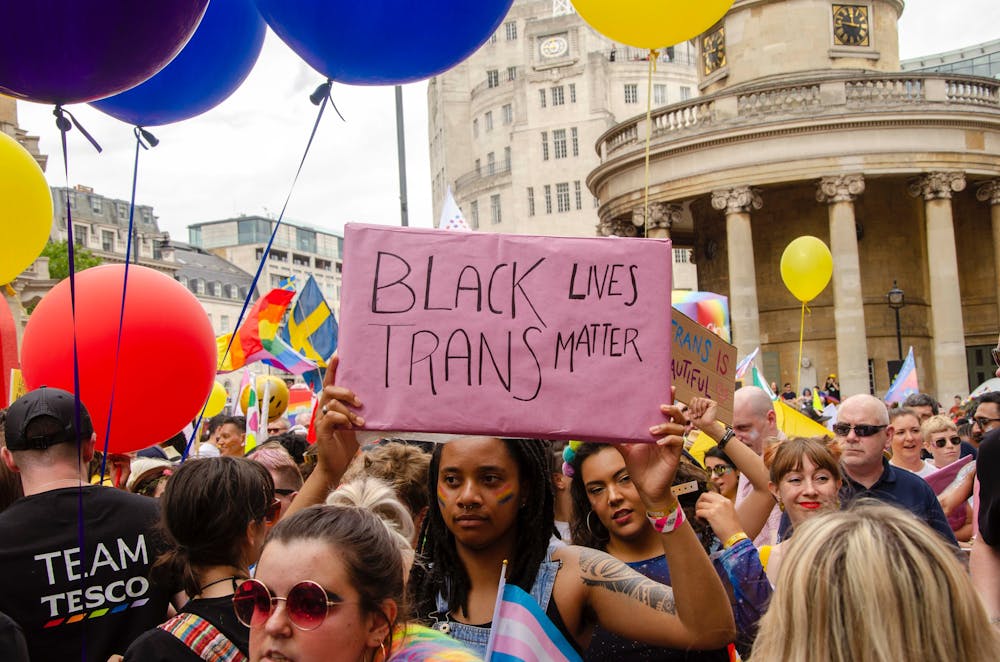 Alva Gotby calls for support for activist groups that provide care and political support for criminal, queer, trans and migrant people.
Jeff Sof/Pexels, CC BY
Alva Gotby calls for support for activist groups that provide care and political support for criminal, queer, trans and migrant people.
Jeff Sof/Pexels, CC BY
A convincing call to arms?
The book advocates big changes. However, the call is muted (or perhaps rendered premature) by several important limitations.
Gotby’s idea of emotional reproduction mirrors – but does not engage with – the idea of emotional capital, which argues the capacity to manage emotions is learned, not innate. Conceiving of emotional care work as “capital”, which can be learned, allows for change.
For example, men can learn caring skills in teaching and nursing work – albeit with greater difficulty, later in their lives. The ebb and flow of emotional capital allows for emotional winners and losers to emerge, beyond Gotby’s conventional male-oppressor and female-oppressed binary.
 Men can learn caring skills in the context of teaching and nursing jobs.
Anastasia Shuraeva/Pexels, CC BY
Men can learn caring skills in the context of teaching and nursing jobs.
Anastasia Shuraeva/Pexels, CC BY
This exemplifies a second problem. Gotby’s strong critical feminist Marxist position risks inflexibility – and a degree of highly gendered structural determinism. By erasing the possibility women can experience authentic feelings of love and care in heterosexual nuclear families, uncorrupted by gender exploitation, Gotby undervalues existing intimacies.
Bolton and Boyd demonstrate how workers can participate in emotional labour while knowingly and willingly finding it enjoyable. Women’s agency to avoid or resist exploitation – and men’s agency to become involved in care work – is underplayed throughout the book.
A third problem is that this largely theoretical book lacks contemporary empirical data to back up its many assertions, or demonstrate their continued relevance.
It fails to include contrary empirical findings, such as studies that show couples who endorse egalitarian over essentialist gender beliefs have more equal involvement in childcare and housework. Including recent data about women’s ongoing exploitation and men’s lack of emotional effort would give greater weight to many of Gotby’s claims.
A fourth problem, connected to all those raised above, is the unsubtle way the book represents men and masculinity. It relies too often on a standardised depiction of middle-class white men as ubiquitous, unconscious, privileged recipients of care.
It doesn’t account for the nuance in men’s emotions. Australian survey data shows that – contrary to classic depictions of unfeeling male stoicism – men experience a complex range of emotions. These include feelings of care, concern and sympathy with family and childcare.
Gotby’s work also fails to encompass emotional work performed by different types of men, based on characteristics such as social class, age or cultural background. And it doesn’t account enough for shifts in men’s housework and care work. Studies have shown men increased their domestic work contribution during COVID, and maintained higher levels of childcare in the immediate aftermath.
These problems undermine Gotby’s powerful call to end the nuclear family altogether.
 The book nonetheless has much to recommend it. It helps us understand the ongoing situation faced by many women in performing unrecognised (and unpaid) care work. It clearly links private and public emotional work and labour (in a way often missing from emotion management literature) by pointing out how much the formal capitalist economy relies on informal unpaid labour and reproductive effort to sustain it.
And it de-naturalises and de-essentialises emotional labour and care as distinctly feminine. This opens up this space for a bigger (and welcome) role for men to take on more of it – as they can and should.
The book provokes and challenges, raising important questions around the future role of the family, and about the sustainability of emotional labour within a capitalist economy increasingly dominated by emotional services, concerns and requirements.
Authors: Roger Patulny, Affiliate Researcher, Monash University
The book nonetheless has much to recommend it. It helps us understand the ongoing situation faced by many women in performing unrecognised (and unpaid) care work. It clearly links private and public emotional work and labour (in a way often missing from emotion management literature) by pointing out how much the formal capitalist economy relies on informal unpaid labour and reproductive effort to sustain it.
And it de-naturalises and de-essentialises emotional labour and care as distinctly feminine. This opens up this space for a bigger (and welcome) role for men to take on more of it – as they can and should.
The book provokes and challenges, raising important questions around the future role of the family, and about the sustainability of emotional labour within a capitalist economy increasingly dominated by emotional services, concerns and requirements.
Authors: Roger Patulny, Affiliate Researcher, Monash University


 Daily Bulletin


