

70 years of road-based policies created today's problems – does National’s transport plan add up?
- Written by: Timothy Welch, Senior Lecturer in Urban Planning, University of Auckland
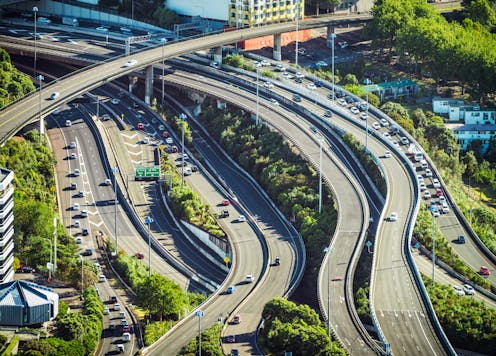
The old joke about “just one more lane” being all that’s needed to solve traffic congestion has been heard a few times since the National Party released its transport policy this week.
The plan is nothing if not ambitious: more and bigger roads worth nearly NZ$25 billion over ten years, including a four-lane motorway from Whangārei to Tauranga at a stated cost of $6 billion.
That might sound like a lot, with the cost per kilometre of road being about $20 million. But recent big road projects suggest it could be a significant underestimate.
Wellington’s Transmission Gully spans just 27km and cost an estimated $1.25 billion – that equates to over $46 million per kilometre. The recently opened Ara Tūhono (dubbed the “holiday highway”) from Puhoi to Warkworth north of Auckland cost about $1.05 billion for just 18.5km – almost $57 million per kilometre.
A four-lane motorway between Whangarei and Tauranga would face more challenging terrain than Transmission Gully or Ara Tūhono and would span much longer distances.
Given the significant cost overruns of recent big roading projects, as well as the time it will take to build these roads, it’s likely the bill will be much more than $6 billion.
Private versus public transport
The opportunity cost of these projects also needs to account for those who don’t – or don’t want to – drive a car.
National’s proposal calls for scrapping most of the “Let’s Get Wellington Moving” project, including a long-planned light rail line. This is on top of the party’s promise that it will axe the proposed Auckland light rail scheme.
Read more: National’s housing u-turn promotes urban sprawl – cities and ratepayers will pick up the bill
Both light rail proposals have been a point of contention: National argues that additional motorways and tunnelling in Wellington would be more cost-effective, and tunnelled light rail in Auckland has an enormous price tag.
But the transport mode itself is fast, efficient and equitable. A similarly controversial light rail line in Sydney opened a few years ago, with patronage more than doubling in a single year, despite the pandemic.
Public transport pollution is far less than that from personal vehicles. Buses and trains produce about 80% less carbon emissions per passenger kilometre than personal vehicles.
Roads versus climate
Around the same time National was releasing its transport policy, July was confirmed to be the hottest month ever on Earth (though August could replace that soon).
The northern hemisphere is experiencing extreme heatwaves. Some places are reaching the upper limits of human survival. In the American southwest, the pavement got so hot people were treated for second-degree burns.
Records are also breaking around Antarctic sea ice melt, with the most significant deviations from historical averages ever recorded. Wildfires have raged across Canada, Sicily, Algeria and other countries.
Read more: Too big, too heavy and too slow to change: road transport is way off track for net zero
Human-generated carbon emissions have exacerbated these extremes. Of those emissions, almost 25% are from the transport sector, and passenger transport (cars and light trucks) accounts for about 45% of the sector’s emissions.
Given the observable realities of the climate crisis, many have questioned the logic of leaning into road expansion as a policy, especially at the expense of efficient public transport.
More roads encourage more traffic and more driving, often leading to even worse congestion. Expanded road networks also encourage development in lower-density areas by making them more accessible, at least in the short term.
While this is a selling point in National’s transportation plan, it often leads to more car-dependent development that make traffic congestion even worse. Combined with National’s proposal to build housing in “greenfields” zones away from cities, it risks locking the country into a car-dependent, high-carbon future.
The EV mirage
National leader Christopher Luxon has made the point that “even electric vehicles need adequate roads”. But this begs a bigger question about relying on EVs to solve transport and climate problems.
Despite years of generous subsidies, battery-electric vehicles still make up just 1.3% of New Zealand’s total fleet. This is nowhere near the numbers needed to make a meaningful dent in transport emissions.
EVs require the same amount of road space and, due to their increased weight, potentially cause more road damage. But EV owners don’t buy petrol, which means they don’t pay excise tax – the same tax that pays for expanding roads.
Even with inflation around 7%, the excise tax has not increased in more than four years, meaning every year the tax’s purchasing power diminishes.
National’s plan to build more roads rather than focus on better public transport is reminiscent of transport policies from the 1950s and 1960s. That era saw the construction of the car-centric cities we now struggle to maintain and move around in.
That era also moved us closer to climate disaster, and generally made transport less efficient and less equitable. In hindsight, massive roading infrastructure projects weren’t the solution they might have seemed 70 years ago. But they have at least provided a lesson in what not to do today.
Authors: Timothy Welch, Senior Lecturer in Urban Planning, University of Auckland


 Daily Bulletin


